
Good governance is not only about making a decision; it is about preserving the conditions under which that decision was made. In the previous lesson, you learned to distinguish evidence from assumptions and to calculate the share of load-bearing claims that remain unverified. This lesson turns that review into a durable record.
You will initialize two related, append-only artifacts:
- the Decision Log, which records every gate decision and the evidence, thresholds, opposing cases, and accountable people behind it;
- the Deviation Log, which records every material departure from the standard process, including departures that seem sensible in the moment.
Together, they make Phase 17 calibration possible. Months later, the team must be able to reconstruct not merely what it chose, but what it believed, what evidence it had, what the strongest objection was, and whether it followed its own process.
Why two logs instead of one?
A Decision Log answers:
What did we decide at a gate, based on what threshold and actual result?
A Deviation Log answers:
Where did the way we worked differ from the standard, and what happened because of that?
They are related, but mixing them creates confusion. A gate decision may be fully compliant with the process and still be a STOP. For example, failing the Phase 3 unprompted-recognition threshold is not a deviation; it is the process working as designed.
Conversely, a team might reach a PROCEED decision while departing from the standard, such as allowing an unplanned cap extension. That extension must be visible as a deviation even if everyone felt it was justified.
| Artifact | Unit of record | Main question | Typical timing |
|---|---|---|---|
| Decision Log | One row per gate | Did the run meet the precommitted conditions for this decision? | At every gate |
| Deviation Log | One row per departure | Did work differ from the standard, and why? | As soon as the departure occurs or is discovered |
The supplied Decision Log Template shows a useful general structure: decision ID, date, description, status, rationale, impact, decision-maker, affected stakeholders, consultation, and follow-up actions. The Product Factory needs a stricter version because its decisions are numeric, adversarial, and intended for later calibration.
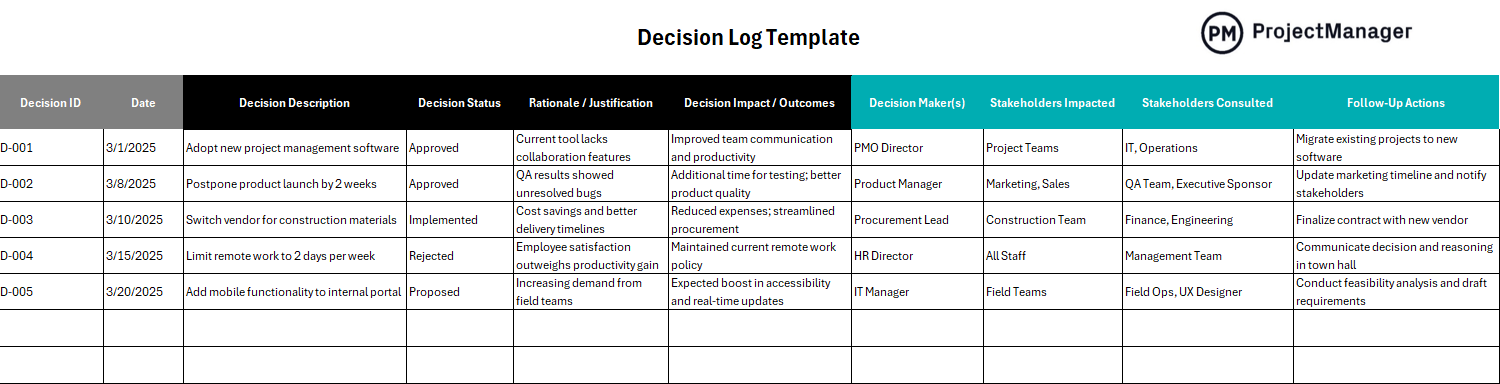
Append-only means preserving history, not freezing learning
“Append-only” does not mean that the team can never change its mind. It means the team never quietly rewrites what it believed at the time.
Suppose a Phase 3 gate is recorded as STOP because only seven of twelve interviewees recognized the problem unprompted, against a threshold of eight. Two weeks later, a new market change gives the idea a genuinely different basis for investigation. The correct action is not to edit the old entry from STOP to PROCEED. Instead:
- Keep the original gate record unchanged.
- Open a new run at Phase 0.
- Link the new run to the earlier stopped run.
- State precisely what changed and why the new investigation is warranted.
This preserves the signal needed for calibration. If the original decision is later judged a false negative, Phase 17 can examine the actual threshold and evidence rather than a tidied-up account of events.
The same principle applies to corrections. If a typo or broken link appears in a log entry, a narrowly marked correction is reasonable. If the correction changes a threshold, evidence figure, rationale, decision, or named decider, append a correction record that references the original entry. Do not overwrite the original.
Architecture Decision Records: Stop Losing Your Mind (and Your Decisions) | Neil Sherman
Read Neil Sherman’s discussion of architecture decision records as a parallel discipline. The Product Factory Decision Log is more structured and gate-focused than an ADR, but both depend on preserving reasoning, alternatives, consequences, and history rather than merely recording a conclusion.
In the discussion that begins “One rule sits above all of this” and leads into the section “What a Weak ADR Looks Like, What a Strong One Looks Like,” read the strong-record example. Notice how the better record preserves concrete context, rejected alternatives, and costs rather than making a bare assertion. Later, read the passage beginning with the accepted-decision rule, especially the append-only discipline. Translate its central rule into your Product Factory practice: a new decision may supersede an old one, but must never erase it.
The operating rule is simple:
The current decision may change. The historical record of prior decisions does not.
The Decision Log: the minimum viable gate record
A generic decision register is often too vague for this process. “Approved” in a status field tells a future reviewer almost nothing. Approved against which criteria? With what results? Who made the STOP case? Was the evidence sufficiently sourced?
Each gate record should therefore contain six groups of information.
| Group | Required fields | Why it matters |
|---|---|---|
| Identity | Decision ID, run ID, date and time, phase and gate, lane | Makes records findable and comparable across runs |
| Precommitment | Exact threshold, cap, and evidence cutoff | Shows the standard existed before evidence was interpreted |
| Actual evidence | Actual figures, evidence references, assumption-share result | Allows the gate to be audited and later calibrated |
| Opposing cases | STOP case first; PROCEED case second | Protects against advocacy disguised as review |
| Authority | Owner, Challenger, decider, consulted people | Makes decision rights visible |
| Outcome | Decision, rationale, required next action, successor link if relevant | States what happened without ambiguity |
A practical Decision Log schema
You can implement this as a protected spreadsheet, a database table, or Markdown records in version control. Initially, a spreadsheet is often sufficient if it has controlled edit rights and a reliable revision history.
| Field | What to record |
|---|---|
decision_id | Unique chronological ID, such as DL-024 |
run_id | The product-factory run, such as RUN-2026-004 |
recorded_at | Date and time the gate was decided |
phase_gate | For example, Phase 3: Does the problem exist? |
lane | S, M, or L |
decision_status | PROCEED, SIMPLIFY, PIVOT, PARK, STOP, GO, or DELAY, as applicable to the gate |
threshold_version | The precommitted threshold set and its effective date |
thresholds | The exact numeric conditions that had to be met |
actual_figures | The observed counts, costs, test results, or other measures |
evidence_references | Claim IDs, interview IDs, data-query names, or URLs supporting the actual figures |
assumption_share | Numerator, denominator, percentage, and unresolved load-bearing assumptions |
stop_case | The Challenger’s strongest honest argument for stopping |
proceed_case | The Owner’s strongest honest case for continuing |
owner | Named accountable person doing the work |
challenger | Named person who authored or reviewed the STOP case |
decider | Person with standing to make the final decision |
consulted | People consulted but not necessarily responsible for the decision |
rationale | Why the decider chose the stated outcome |
next_action | Specific required action, owner, and due date where needed |
links | Idea Record, Evidence Pack, Build Spec, deviation entries, or successor run |
supersedes_or_superseded_by | Blank unless a later record formally replaces the decision |
The most important fields are the ones teams are tempted to omit under time pressure: the threshold, actual figures, STOP case, and decider. Without them, a row is a meeting note, not a decision record.
Keep the threshold and actual result separate
A gate cannot be calibrated if the record says only “validation was positive.” Store the target and outcome separately.
For example, a Phase 3 record might state:
| Item | Recorded value |
|---|---|
| Threshold | At least 12 ICP-matched conversations; at least 8 unprompted recognitions; at least 3 participants with a paid or two-hour weekly workaround; at least 1 abandoned alternative; at least 3 stated-value figures |
| Actual figures | 12 ICP-matched conversations; 7 unprompted recognitions; 4 workaround cases; 1 abandoned alternative; 3 stated-value figures |
| Provenance result | 2 load-bearing assumptions out of 9 load-bearing claims, or 22.2% |
| Decision | STOP |
This is a STOP even though most figures passed and the provenance rule passed. Gates are not weighted scorecards unless the process explicitly says they are. The missed unprompted-recognition threshold is enough.
Write the STOP case before the PROCEED case
The Product Factory gives the Challenger a structural role: write the strongest honest case for STOP before the case for PROCEED is written. This sequencing matters because once a team begins explaining why it wants to continue, contrary evidence often becomes “manageable,” “interesting,” or “something to test later.”
A useful STOP case is concrete and testable:
The run fails the unprompted-recognition threshold: only 7 of 12 ICP-matched participants described the problem before prompting, against a precommitted minimum of 8. The other passed checks cannot compensate because this threshold tests whether the problem is naturally salient rather than merely agreeable when described. Continuing would violate the gate rule.
[data: p3-unprompted-tally-v1]
A weak STOP case is vague or performative:
There are some risks, but the opportunity seems promising.
Likewise, the PROCEED case must engage with the actual evidence rather than simply restate enthusiasm:
The workaround and stated-value thresholds passed, suggesting a costly problem among a subset of the target population. However, the missed unprompted-recognition threshold requires STOP under the current Lane M gate. A smaller, more narrowly defined problem may justify a new Lane S run if a specific change in scope is documented.
Notice that a good PROCEED case can still conclude that the gate requires STOP. The purpose of the two cases is honest reasoning, not balanced advocacy.
An example gate record
Here is a compact but complete Phase 3 Decision Log entry. It is intentionally written so that a Factory Keeper can revisit it after launch or after a later re-entry.
| Field | Example entry |
|---|---|
| Decision ID | DL-024 |
| Run ID | RUN-2026-004 |
| Gate | Phase 3: Does the problem exist? |
| Lane | M |
| Thresholds | 12 ICP-matched conversations; 8 unprompted recognitions; 3 revealed-cost cases; 1 abandoned alternative; 3 stated-value figures; load-bearing assumption share at most 30% |
| Actual figures | 12 conversations; 7 unprompted recognitions; 4 revealed-cost cases; 2 abandoned alternatives; 3 stated-value figures; 2 assumptions among 9 load-bearing claims, 22.2% |
| Evidence references | p3-participant-audit-v1, p3-unprompted-tally-v1, p3-workaround-tally-v1, int-019, p3-value-tally-v1 |
| STOP case | The unprompted-recognition result is below the precommitted minimum. Participants often agreed after the problem was named, but that is not evidence of naturally experienced pain. The run must stop at the time-box. |
| PROCEED case | Workaround cost and stated value meet their thresholds, indicating a potentially valuable subgroup. However, those results do not override the failed recognition threshold. Consider a new, narrower Lane S run only if the ICP or problem statement materially changes. |
| Owner | Priya Shah |
| Challenger | Mateo Green |
| Decider | Product Portfolio Lead |
| Decision | STOP |
| Rationale | One required numeric condition failed. No extension or additional research is authorized within this run. |
| Next action | Finalize the Idea Record and preserve links to the Evidence Pack. Review only if a new trigger justifies a new Phase 0 intake. |
| Recorded at | 2026-10-17, 16:00 |
The entry does not say “the idea was bad.” It says something narrower and more useful: this run did not satisfy its precommitted conditions for further investment.
Where the logs should live
The logs must be easy to use at the moment a decision is made and easy to find months later. A sophisticated system that people bypass is worse than a simple shared record that is consistently maintained.
For a software-backed Product Factory, version-controlled storage is a strong default. It provides an edit history, access control, review workflow, durable links, and a natural association with the implementation work. For a cross-functional team that cannot work directly in a code repository, use a controlled workspace with an owner, stable links, and revision history.
Read Hidekazu Konishi’s operational guidance on where decision records should live. It is written for architecture decisions, but the same lesson applies to Product Factory logs: discoverability and history are operational requirements, not administrative extras.
In Section 7, “Storage and Discoverability (Repo / Wiki / Backstage),” read the source-control rationale. Focus on the specific benefits of revision history, search, review, and an index. Then decide which equivalent mechanisms your own team can reliably maintain.
A practical starting layout might look like this:
product-factory/
  runs/
    RUN-2026-004/
      idea-record.md
      evidence-pack.md
      build-spec.md
      decision-log.csv
      deviation-log.csv
      source-register.md
  indexes/
    active-runs.md
    closed-runs.md
The exact tooling is secondary. The rules are not:
- Every run has a stable identifier.
- Every gate record has a unique identifier.
- Records have a visible author and time.
- Final gate records are not silently edited.
- Evidence links resolve to retrievable underlying material.
- A later entry can correct, supersede, or re-open work only by referencing the earlier entry.
The Deviation Log: evidence about the process itself
A deviation is a material difference between what the standard required and what actually happened. It is not automatically misconduct, failure, or bureaucracy. It is data.
For example, the following are deviations:
- The Phase 3–6 time-box was extended by two days.
- The Owner also acted as Challenger.
- Market research was conducted without a written decision-trigger statement.
- A Lane M build estimate exceeded the cap, but the team continued without cutting scope.
- A gate was decided without a complete STOP case.
- A committed run was accidentally included in kill-rate reporting.
The following are not deviations:
- A Phase 4 market analysis was skipped because no later decision depended on it. Skipping is compliant with the standard.
- A Phase 3 gate resulted in STOP because its numeric threshold was missed.
- The team chose Lane L because the Phase 0 risk screen required it.
- A later run began after a stopped run because the triggering conditions genuinely changed and the new run was logged.
The Deviation Log should preserve the before-and-after facts. It must never become a way to retroactively bless exceptions.
A practical Deviation Log schema
| Field | What to record |
|---|---|
deviation_id | Unique ID, such as DEV-011 |
run_id | The affected run |
identified_at | Date and time observed |
phase | Where it occurred |
standard_expected | Exact process rule, cap, or role requirement |
actual_departure | What happened instead |
reason_given_at_the_time | Constraint, error, emergency, missing capacity, deliberate exception, or unknown |
impact_on_decision | Whether it affected evidence quality, budget, timing, authority, or calibration |
related_decision_id | Link to the affected gate decision, if any |
recorded_by | Person entering the deviation |
acknowledged_by | Owner, Challenger, Factory Keeper, or decider as appropriate |
immediate_action | Correct now, accept temporarily, stop the run, or escalate |
calibration_note | Blank during the run; completed in Phase 17 if a pattern emerges |
Example: logging a cap extension honestly
| Field | Example entry |
|---|---|
| Deviation ID | DEV-011 |
| Run ID | RUN-2026-006 |
| Phase | Phase 10: Build |
| Standard expected | Lane M build time-box is a maximum of three weeks. At the cap, test what exists rather than extending the cap. |
| Actual departure | Build continued for four additional working days to complete a dashboard feature. |
| Reason given at the time | Team believed the dashboard was necessary for user testing. |
| Impact on decision | The build cap no longer constrained scope; Phase 11 results may not be comparable with other Lane M runs. |
| Related decision | DL-031 |
| Immediate action | Record the extension; remove the dashboard from the core-hypothesis claim unless the Build Spec maps it to a hypothesis; Factory Keeper reviews the pattern at Phase 17. |
The correct response is not to rewrite the run as though it remained within its cap. The deviation may reveal that the lane cap was unsuitable, that Phase 8 scope discipline failed, or that the team had treated a nonessential feature as necessary. Phase 17 needs the unvarnished record to distinguish among those possibilities.
A short operating ritual
Initialize both logs at Phase 0, alongside the Idea Record. Do not wait until the first difficult decision; by then, history has already begun to disappear.
Use this minimal ritual throughout the run:
- Open the run. Create the run ID, lane, Owner, Challenger, intended decider, Decision Log, and Deviation Log.
- Precommit the gate. Before gathering evidence, record the applicable threshold values, lane caps, and evidence cutoff.
- Maintain evidence links. As evidence is gathered, link claim IDs and source records to the relevant prospective gate.
- Write the STOP case first. The Challenger drafts it before the Owner’s PROCEED case.
- Record actual figures. Copy the observed counts, costs, and assumption-share calculation exactly; do not translate them into vague summaries.
- Name the decider and outcome. Record the person, time, decision, rationale, and required next action.
- Log departures immediately. If the team deviates from a standard rule, add a Deviation Log entry rather than relying on memory.
- Protect final entries. Use version history, locked rows, or review controls so that changes create a visible new record.
A decision log that is completed at the end of a project is usually a reconstruction of what people now wish they had believed. A useful log is created at the point of uncertainty, before the outcome is known.
Key takeaways
The Decision Log and Deviation Log are the Product Factory’s institutional memory.
- Create one append-only Decision Log row per gate, with the exact threshold, actual figures, evidence references, assumption-share result, STOP case, PROCEED case, decider, decision, and next action.
- Preserve gate history. Correct or reverse a material decision by appending a linked record or opening a new run, never by silently rewriting the past.
- Require the STOP case first so that the Challenger’s argument is not weakened by an already-established narrative of continuation.
- Use a separate Deviation Log to record departures from roles, caps, sequencing, evidence rules, or other process standards.
- Treat deviations as evidence about the process. A recurring deviation may indicate that the standard needs revision at Phase 17.
- Store the logs somewhere searchable, durable, access-controlled, and easy to use during real work.
Next, you will begin the evidence module by defining an initial ideal-customer profile and a recruitment plan for 6–11 relevant participants, while being explicit about which Lane M claims that initial sample cannot yet support.
Can't find a good explanation? Sign up and we'll make it for you
Sign up