
Hello! Welcome back to your course on DJing DnB.
In our last session, you performed a crucial task familiar to any developer: a post-mortem. By critically analyzing your 15-minute mix, you identified specific points for improvement, turning a performance into actionable data. That was a micro-level analysis of execution.
Today, we zoom out to the architectural level. Before you write a single line of code for a large application, you design the system architecture. Similarly, before performing a long DJ set, you design its structure. This lesson is about creating that blueprint.
Our learning outcome is to select and arrange 20-25 DnB tracks in Rekordbox to create a one-hour playlist with a logical energy curve. This is the foundational skill for crafting compelling, hour-long DJ sets that take the listener on a journey.
1. The Concept of the Energy Curve
A DJ set is more than just a sequence of tracks; it's a narrative. The "energy curve" is the emotional and physical intensity profile of that narrative. A flat, monotonous set will bore the audience, while a set that is relentlessly high-energy from start to finish can be exhausting. Your role as the DJ is to manage this energy flow.
To begin, let's explore this core concept of dancefloor energy.
Controlling the dancefloor: a guide on organizing playlists ...
The article 'Controlling the dancefloor' from DJ TechTools provides an excellent introduction to the idea of dancefloor energy and the DJ's role as a curator of that energy.
Please read the first three sections: 'What is Dancefloor Energy?', 'Understanding Your DJ Style', and 'Imagining Your Ideal Set'. As you read, think about the DnB sets you enjoy. What kind of energy progression do they typically have? What is your personal style aiming for?
As the article suggests, defining your ideal set is like gathering requirements before starting a project. For a one-hour DnB mix, a classic energy curve might look like this:
- Introduction (0-15 mins): Lower energy tracks, often more atmospheric or "liquid" funk style, to set the mood and get heads nodding.
- Build-up (15-30 mins): Gradually increasing the intensity. Tracks might have more prominent basslines, faster-paced drums, and more complex melodic elements.
- Peak Time (30-45 mins): The core of the set. This is where you play your most powerful, high-energy tracks—the "bangers."
- Cool-down (45-60 mins): Gradually decreasing the energy, providing a sense of resolution and leaving the listener satisfied rather than abruptly cut off.
This is a basic template. The art is in how you shape this curve, creating smaller peaks and valleys along the way to maintain interest.
2. A System for Classifying Energy
To build an energy curve, you need a way to quantify the energy of each track in your library. Relying on BPM alone is insufficient, as two tracks at 174 BPM can have vastly different intensities. A systematic approach is required.
Let's examine a practical and highly structured system developed by another DJ. This method will likely resonate with your background in creating organized systems.
The blog post 'How I prepare my DJ playlists' by Daniel Sokolovskiy details a personal, robust system for organizing a music library. We will focus on his core concept of energy levels.
First, read the section 'Energy levels' to understand the 1-5 star classification system. Then, scroll down to the comments section and read the author's detailed reply to Joseph Saliba (it begins 'Well, if I play one of those longer sets...'). This comment provides concrete examples and BPM ranges for each of the five energy levels, which is extremely helpful.
The 5-star system is an excellent starting point:
- ★ (1): Opening. Deep, atmospheric.
- ★★ (2): Build-up. Groovy, more prominent basslines.
- ★★★ (3): Driving. The workhorse tracks of a set, solid energy.
- ★★★★ (4): Peak-time. Aggressive, busy, high-impact.
- ★★★★★ (5): Banging. The most intense, often reserved for special moments.
Your task is to become the analyst for your own music library, assigning an energy value to each track based on your own perception. This is a subjective process, but it's the key to making the system work for you.
3. Practical Exercise: Building Your Playlist in Rekordbox
Now, let's translate this theory into a practical workflow within Rekordbox.
Step 1: Implement the Rating System
The most direct way to apply the 5-level energy system in Rekordbox is by using the Rating column. It's a built-in 5-star system that is easy to see, sort, and filter.
- Go to your main track collection in Rekordbox.
- If the "Rating" column isn't visible, right-click the column headers (like Title, Artist, BPM) and check "Rating" to enable it.
- Listen to a track. Based on the 1-5 energy scale, click in the Rating column to assign it a star value.
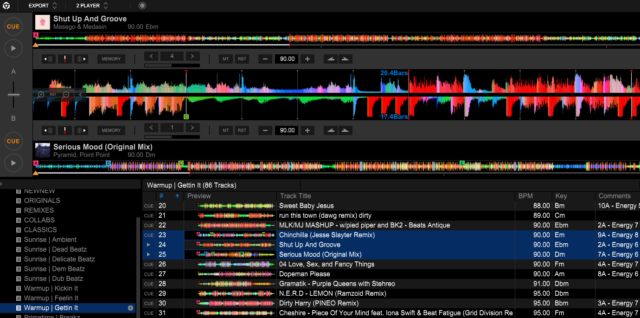
Step 2: Analyze and Rate Your Tracks
This is the most time-consuming but vital part of the process. Go through your collection of DnB tracks and assign a star rating to each one. Don't overthink it; your initial feeling is usually correct. Aim to rate at least 40-50 tracks to give yourself a good pool to select from.
(This step will take longer than this lesson, but you can begin with the first 10-15 tracks now to get a feel for the process.)
Step 3: Create and Structure Your Playlist
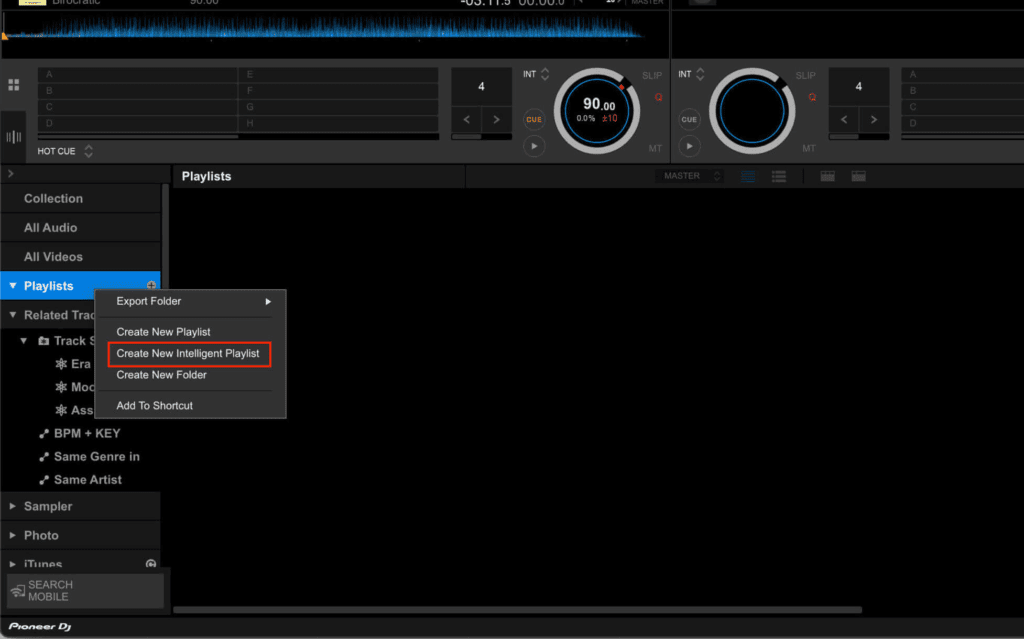
- In the Rekordbox sidebar, right-click on "Playlists" and select "Create New Playlist." Name it something like "DnB Hour Mix V1."
- Go back to your main collection and sort by the "Rating" column. This groups all your 1-star tracks, 2-star tracks, etc., together.
- Now, start building your set. Drag and drop 20-25 tracks into your new playlist, arranging them to follow the energy curve we discussed.
Your Task (Approx. 25 minutes for this lesson, continue afterwards):
- Rate a Batch: Spend about 10 minutes rating at least 15-20 of your DnB tracks in Rekordbox.
- Create the Playlist: Create the new playlist as described above.
- Build the Curve: Spend the next 15 minutes populating your playlist.
- Start by dragging in 3-4 tracks rated 1-2 stars for your intro.
- Add 5-6 tracks rated 2-3 stars to build momentum.
- Select 5-6 of your best 4-star tracks for the peak section.
- If you have any 5-star tracks, consider where one might fit for maximum impact.
- Finally, add 5-6 tracks rated 3-2 stars to form the cool-down and outro.
- Review and Refine: Look at the order. Does it tell a story? Try sorting the playlist by BPM or Key to see if any tracks are wildly out of place, but prioritize the energy flow. You can re-order them by dragging them up or down in the playlist.
Pro Tip: Once your library is well-rated, you can use "Intelligent Playlists" to automatically manage these groups. For example, you could create an intelligent playlist that automatically includes all tracks you've rated as 4-stars.
Conclusion
You have now created the architectural blueprint for your first one-hour DJ set. This process of curating and structuring a playlist is a fundamental skill that transforms you from someone who simply plays tracks to a DJ who crafts an experience.
Key Takeaways:
- A DJ set's energy curve is the intentional management of intensity over time to guide the listener's journey.
- A systematic approach, like a 1-5 star rating system, is crucial for classifying tracks and building a coherent playlist.
- Rekordbox's Rating and Playlist features are the primary tools for organizing your library and structuring your set.
- The final playlist is not just a list of songs, but a planned narrative with an introduction, build-up, peak, and conclusion.
In our next lesson, we will begin the "implementation" phase. You will annotate the first 15 minutes of your planned set with cue points and transition plans. This is where we zoom back into the micro-level, preparing the exact mix points and techniques to bring your architectural plan to life on the decks.
Can't find a good explanation? Sign up and we'll make it for you
Sign up