
Hello. In the previous lesson, you set a provisional GRE target of roughly – Quantitative and – Verbal, while recognising that the GRE is only one part of a credible MBA application. You also identified that the larger section gap and the patterns in your error log—not a generic study plan—should determine where effort goes.
This lesson turns that principle into a calendar. Your constraint is clear: about six total hours per week alongside full-time work, split roughly evenly between GRE preparation and MBA application readiness. The goal is not to create an idealised timetable; it is to establish a routine you can repeat for months without sacrificing either the test score or the application profile you will need for a 2027 Round 1 application.
Treat six hours as a fixed budget
A common planning mistake is to say, “I will study when I have time.” For a working professional, that usually means work expands, study becomes irregular, and a missed week turns into an anxious weekend cram. Instead, treat your six hours as a fixed weekly budget:
| Workstream | Weekly allocation | Purpose |
|---|---|---|
| GRE preparation | 3 hours | Improve Quantitative and Verbal performance through targeted learning, practice, and review |
| MBA application readiness | 3 hours | Build school knowledge, career clarity, and evidence of professional impact gradually |
| Total | 6 hours | A sustainable commitment alongside work |
The split matters. A GRE score in your target range supports your application, particularly as evidence of quantitative readiness. But it cannot substitute for a well-researched school list, a coherent product-management or consulting goal, or clear examples of leadership and impact from your project-coordination work.
The reverse is also true: strong career stories do not remove the need for a competitive GRE score. Your routine should therefore protect both tracks every week.
Magoosh’s schedule guidance is useful here because it distinguishes between a short, intensive test-prep sprint and a longer plan for people studying a few hours per week while working.
GRE Study Schedules and Guides - Magoosh Blog — GRE® Test
Read Magoosh Blog’s guide for a practical model of long-horizon GRE preparation. Its central message is that a study plan should follow your baseline, your available timeline, and a consistent learn-practice-review cycle—not an arbitrary number of study hours.
Begin with the section “Which GRE study schedule fits your timeline.” Read the timeline table, focusing on the guidance for six months or more. Then move to “How many hours a day should you study?” and read the consistency guidance. Your sessions will be shorter than the maximum discussed there; the important point is to avoid trying to compensate for missed work with exhausting study marathons. Finally, in “How to use your GRE study schedule,” read the learn practice review loop. Connect the review stage directly to the error log you created earlier.
You have substantial time before a 2027 intake, but that does not mean you should work indefinitely at a low level without milestones. Use the weekly routine below in repeating four-week cycles. At the end of each cycle, you will assess whether the plan is producing better accuracy, clearer error patterns, and steady MBA-application progress.
Build a weekly rhythm rather than a daily ideal
A six-hour plan needs two features:
- Frequent contact with GRE material, especially vocabulary, error correction, and the weaker section.
- Longer focused blocks for work that cannot be done effectively in ten minutes: learning a Quant topic, reviewing difficult Reading Comprehension questions, or extracting reliable MBA information from official school sources.
For now, schedule five study touchpoints. None needs to exceed 90 minutes, and the longest day contains one GRE block and one application block rather than a single prolonged task.
Your default six-hour week
| Day | GRE block | MBA application-readiness block | Total |
|---|---|---|---|
| Monday | 45 min: weakest GRE topic | 45 min: school research | 90 min |
| Tuesday | 30 min: vocabulary and short Verbal practice | — | 30 min |
| Wednesday | 45 min: targeted GRE questions and review | 45 min: professional-impact evidence or career work | 90 min |
| Thursday | 30 min: stronger-section maintenance | 30 min: update application tracker and plan next actions | 60 min |
| Saturday | 30 min: timed mixed mini-set and error-log review | 60 min: one deeper MBA task | 90 min |
| Total | 180 min / 3 hours | 180 min / 3 hours | 360 min / 6 hours |
Choose the actual times according to when you are most alert. For example, a 45-minute morning block before work may be more effective for Quantitative Reasoning than an unplanned late-evening session. Conversely, a Saturday morning might be your best time for the deeper school-research or career-planning task.
Kaplan’s guidance for working GRE candidates reinforces this approach: select your strongest available study windows, combine short sessions with deeper work, and revise the plan when work becomes unusually busy.
How to Study for the GRE While Working Full-Time – Kaplan Test Prep
Read Kaplan Test Prep’s practical advice for fitting GRE preparation around full-time work. Use it to decide when your fixed blocks should happen, not to add more hours to your six-hour limit.
First, under “How to Balance Work and GRE Prep,” read the practical tips. Notice the emphasis on short focused sessions and treating study time as a real commitment. Then read the full section “How to Create a GRE Study Schedule Around a Full-Time Job,” from the scheduling framework. In particular, identify two likely high-energy periods in your own week and reserve them for Monday and Wednesday GRE work.
The schedule is deliberately not built around studying every day. A plan with one or two recovery evenings is generally more durable than one that assumes perfect energy and no professional surprises.
Make each GRE hour do a distinct job
“Study GRE for 45 minutes” is too vague to be actionable. Every GRE block should have one of four jobs:
- Learn a concept or question process.
- Practise questions that require that concept or process.
- Review both incorrect and uncertain answers.
- Retain vocabulary, formulas, and reusable reasoning habits.
Your weekly GRE blocks should work as follows.
| Block | Default activity | What you should produce |
|---|---|---|
| Monday, 45 min | Learn the week’s weak topic, then attempt a few relevant questions | A short note on the method or rule; initial error-log entries |
| Tuesday, 30 min | Active vocabulary recall plus a small Text Completion, Sentence Equivalence, or Reading Comprehension drill | New and recurring vocabulary cards; a brief note on missed Verbal logic |
| Wednesday, 45 min | Targeted question set on the same weak area, followed by careful review | Corrected solutions and clearly classified errors |
| Thursday, 30 min | Maintain the stronger section with a short set | Confirmation that the stronger section is being retained, not ignored |
| Saturday, 30 min | Timed mixed mini-set, retry of selected prior mistakes, and weekly error-log update | A next-week priority based on actual evidence |
Use your existing resource system: official ETS material should remain the core for representative GRE questions and practice tests, while your one supplementary source should help only when your error log identifies a specific skill gap. Avoid spending precious time comparing multiple platforms or collecting extra materials.
Allocate GRE time according to your diagnostic
Your prior target-setting lesson gave you a clear starting rule. Apply it to the three GRE hours rather than dividing time evenly by habit.
| Diagnostic situation | Suggested weekly emphasis |
|---|---|
| Quantitative is more than five points below | Use Monday and Wednesday for Quant; Tuesday and Thursday preserve Verbal; Saturday remains mixed review |
| Verbal is more than five points below | Use Monday and Wednesday for Verbal strategy and question types; Tuesday becomes an essential vocabulary session; Thursday maintains Quant |
| Both sections are within about three points of their target floors | Divide Monday and Wednesday between Quant and Verbal; use Saturday to develop timed execution and review |
| One section is already securely in the working range | Maintain it weekly, but direct most new learning and targeted practice to the weaker section |
The point is not to label yourself “a Quant person” or “a Verbal person.” It is to use evidence. If your error log shows repeated percentage, ratio, or algebra errors, Monday and Wednesday should not be spent on random mixed questions. If it shows that you understand the material but lose time on Reading Comprehension, your blocks should shift toward timed passage work and review of answer-choice traps.
Your French master’s degree may give you useful experience with close reading and written argument, but GRE Verbal success still depends on test-specific vocabulary, logical precision, and efficient handling of answer choices. Maintain the Tuesday vocabulary block even if Verbal begins as the stronger score.
Give the other three hours a clear MBA purpose
At this stage, “application work” does not mean writing essays prematurely. It means steadily creating the inputs that will make later application tasks easier and more credible.
Use the three application-readiness blocks for work that accumulates over time.
| Weekly block | Current focus | Example output |
|---|---|---|
| Monday, 45 min | School research | One verified entry in a school-comparison sheet: format, location, career outcomes, cost, admissions facts, and source date |
| Wednesday, 45 min | Career and impact evidence | One concise record of a project, stakeholder challenge, process improvement, leadership action, or measurable result |
| Thursday, 30 min | Organisation and follow-through | Update your MBA tracker; record completed work and schedule the next school or professional-development action |
| Saturday, 60 min | Deeper rotating task | Research a school, refine a career-direction note, strengthen an evidence bank, or plan a feasible workplace initiative |
For the next few weeks, rotate the Saturday deep block between two themes:
- School and career research: Build a fact-based understanding of UK and European MBA options and the post-MBA product or consulting opportunities you are evaluating.
- Professional profile building: Notice opportunities in your current project-coordinator role to take greater ownership, work across teams, improve a process, or quantify an outcome. Your CSPO certification is a useful signal of product interest, but later applications will need concrete workplace evidence alongside it.
This approach prevents a damaging pattern: spending all available time on the GRE until application deadlines feel close, then trying to invent career goals, leadership stories, and school rationale in a rush.
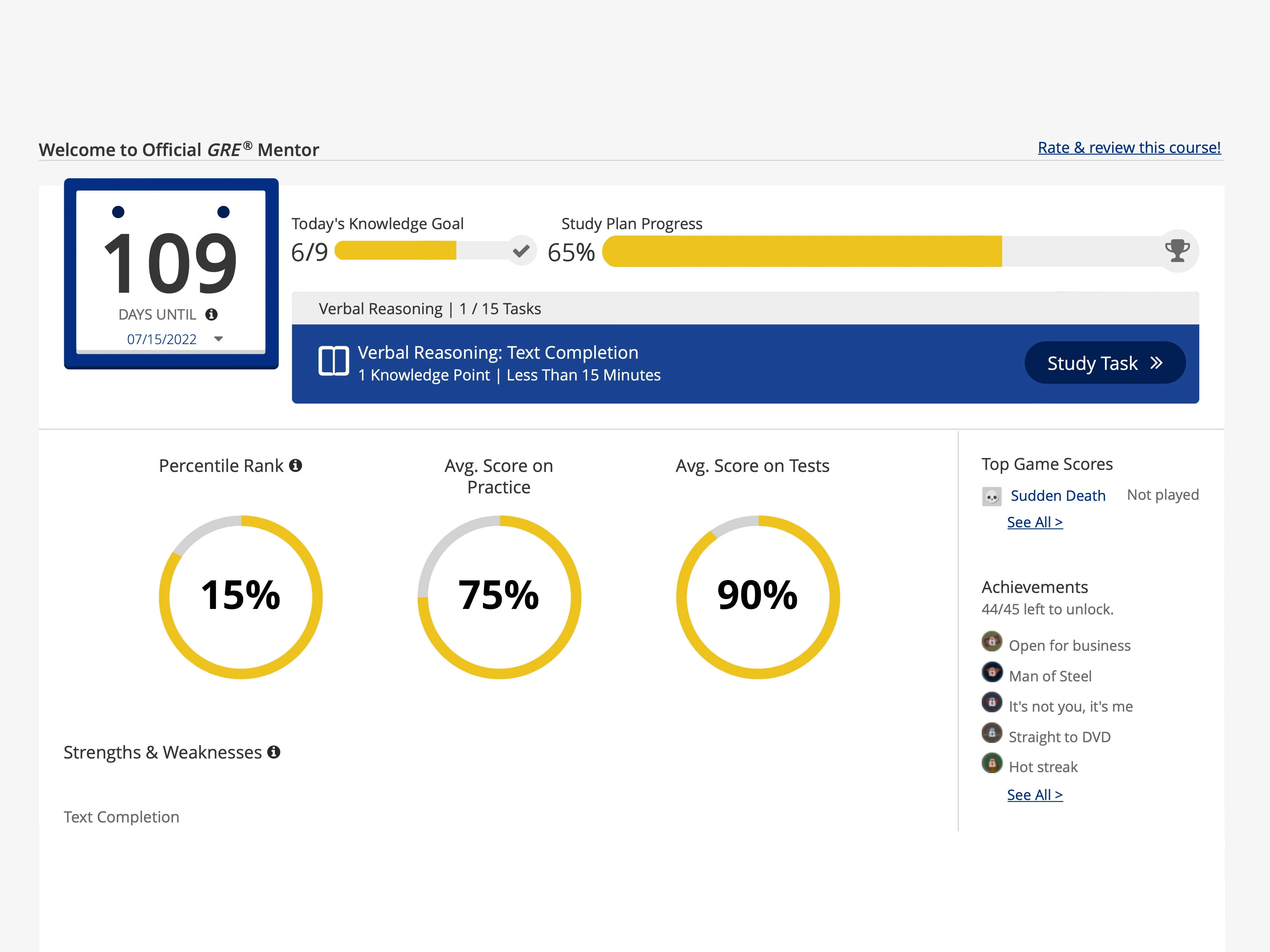
You do not need a particular dashboard. A spreadsheet, notes app, or calendar is enough if it captures the right information.
| Week of | GRE minutes completed | Main GRE error pattern | MBA task completed | Next week’s priority |
|---|---|---|---|---|
| ___ | ___ / 180 | ___ | ___ | ___ |
| ___ | ___ / 180 | ___ | ___ | ___ |
| ___ | ___ / 180 | ___ | ___ | ___ |
The purpose of tracking is decision-making, not self-surveillance. A useful tracker tells you what to change next week.
Protect the routine when work becomes busy
A sustainable plan anticipates disruption. Project deadlines, family commitments, illness, and unexpected work demands will occur. The wrong response is to abandon the plan entirely or attempt a four-hour catch-up session on Sunday.
Use these operating rules instead.
Rule 1: Schedule first, then defend the blocks
At the start of each week, enter the five blocks into your calendar as real appointments. If possible, assign a specific task to each one:
- “Quant ratios: learn and practise,” not “GRE.”
- “Verify LBS employment-report data,” not “MBA research.”
- “Update error log and retry errors,” not “review.”
Specificity reduces the friction of starting.
Rule 2: Move a missed block once, within 48 hours
If a Monday block is disrupted, move it to Tuesday or Wednesday. If it cannot be moved within 48 hours, let it go and continue with the remaining scheduled work. Do not create a growing backlog.
The next week’s plan should respond to the missed block. For example, if you missed Monday’s Quant foundations session, retain that topic for the following Monday rather than jumping ahead.
Rule 3: Use a four-hour minimum week when necessary
During an unusually demanding work week, preserve the habit with a reduced version:
| Workstream | Minimum commitment | Keep these tasks |
|---|---|---|
| GRE | 2 hours | One weak-topic block, one vocabulary or Verbal block, one timed/review block |
| MBA readiness | 2 hours | One school or career task, one professional-evidence or planning task |
| Total | 4 hours | Maintain continuity without cramming |
Return to the normal six-hour plan the following week. A temporary reduction is better than repeated failure against an unrealistic schedule.
Rule 4: Review every error, not only wrong answers
A correct answer reached through guessing, inefficient work, or a shaky method may reveal a future problem. In your error log, keep classifying errors as:
- knowledge;
- interpretation;
- strategy;
- pacing; or
- carelessness.
This classification determines the next week’s content. For instance, repeated pacing errors call for shorter timed sets and better skip decisions later in the course; repeated knowledge errors call for deliberate foundational learning first.
Add a four-week review point
A weekly schedule becomes effective only when it is adjusted using evidence. At the end of every fourth week, spend part of Thursday’s MBA-planning block reviewing the system itself.
Look at four indicators:
| Indicator | What to inspect | Decision it supports |
|---|---|---|
| Completion | Did you complete at least most scheduled blocks? | If not, change timing or reduce unrealistic task size—not your long-term goal |
| Error log | Which topic or error category appears most often? | Assign the next two Monday/Wednesday GRE blocks accordingly |
| Timed performance | Are you becoming more accurate or efficient on short timed sets? | Continue, adjust timing, or revisit foundations |
| MBA evidence | What concrete school-research or professional-profile output exists? | Select the next month’s application-readiness focus |
Every four to six weeks, one GRE week can become a practice-test week. Keep the total GRE allocation at three hours: use the official timed test, then spend the remaining time on initial review and error-log entries. Do not add extra study hours that week; resume targeted learning in the following week.
This is especially important because your future GRE test date has not yet been selected. For now, your task is to build a reliable evidence base: steady study completion, identifiable weaknesses, and gradual movement toward your provisional score range. A later lesson will use practice-test performance and Round 1 deadlines to choose a first test date and leave sensible space for a retake if needed.
Set up the routine this week
Before your next study week begins:
- Reserve the five blocks from the default schedule in your calendar.
- Choose your Monday and Wednesday GRE focus from the largest diagnostic gap and your error log.
- Choose one school-research task and one professional-evidence task for the application blocks.
- Create the four-column weekly tracker: GRE minutes, error pattern, MBA output, and next priority.
- Decide in advance which day can serve as your 48-hour recovery window if a weekday block is disrupted.
The value of this plan lies in repetition. After several weeks, you should not need to negotiate with yourself about whether to study; you should only need to open the designated task.
Key takeaways
A six-hour weekly commitment can support both GRE progress and MBA readiness if it is deliberately structured.
- Protect a three-hour GRE budget and a three-hour MBA application-readiness budget rather than letting one crowd out the other.
- Use five short-to-medium study touchpoints: focused learning, vocabulary, targeted practice, maintenance, and timed review.
- Allocate Monday and Wednesday to the section with the greatest score gap and most important recurring error pattern.
- Use application time for cumulative preparation—school research, career clarity, and professional-impact evidence—not premature essay drafting.
- Plan for disruption with a recovery rule and a four-hour minimum week; do not rely on catch-up marathons.
- Review completion, error patterns, timed performance, and MBA outputs every four weeks, then revise the following month’s focus.
Next, the course begins GRE Quantitative Foundations. You will start with a high-yield skill that appears throughout GRE problem solving: translating ratios, percentages, and rates into equations.
Can't find a good explanation? Sign up and we'll make it for you
Sign up