Hello! Welcome back to your course on building a global e-commerce business.
In our last lesson, we analyzed the major operational shifts involved in moving from a local retail model to a location-independent, global one. We focused on the concepts of scaling, different fulfillment models, and the new complexities of selling internationally.
Now, we move from strategy to action. To operate in the US market, you need a formal business presence there. This lesson covers the first and most critical decision in that process: choosing the right legal structure for your company. Your experience is with a local business, which may have had a simple structure. For international sales, creating the right legal entity is essential to protect yourself and operate professionally.
By the end of this lesson, you will be able to compare common US business structures—specifically the Sole Proprietorship and the Limited Liability Company (LLC)—and determine the most suitable option for your goals as a non-US resident.
1. Understanding the Default: The Sole Proprietorship
When you start a business by yourself in the US, the default structure is a Sole Proprietorship. It's the simplest way to get started, but it comes with significant drawbacks, especially for an international seller.
To understand the basics, let's watch a short video that defines a Sole Proprietorship.
LLC vs Sole Proprietor: Which is Better for Your Business?
This video from LYFE Accounting gives a clear, quick definition of a Sole Proprietorship and how it's viewed from a legal and tax perspective.
Watch from 00:58 to 02:08. This segment explains that a Sole Proprietorship is the default structure, has no formal setup process, and, most importantly, is legally and financially indistinct from its owner.
The key takeaway is that with a Sole Proprietorship, you and the business are the same legal entity. This leads to a critical problem:
Unlimited Personal Liability: If your business is sued or incurs debt, your personal assets—your home, car, and personal savings—could be at risk. For an e-commerce business selling products to the public, this is a level of risk you should not accept.
Furthermore, as a non-resident, this structure is generally not a viable option.
How to register a US business as a nonresident
This article from Stripe, a major payment processor, explains why a Sole Proprietorship is typically not an option for non-residents.
Read the short section titled 'Sole proprietorship'. It explains that this structure often conflicts with visa and work permit regulations for non-residents.
In summary, the Sole Proprietorship is simple, but its lack of liability protection and unsuitability for non-residents makes it the wrong choice for your global e-commerce goals.
2. The Recommended Choice for Non-Residents: The LLC
The most popular and highly recommended structure for international entrepreneurs selling in the US is the Limited Liability Company (LLC).
An LLC is a hybrid structure that combines the liability protection of a corporation with the flexibility and tax simplicity of a sole proprietorship.
LLC vs Sole Proprietor: Which is Better for Your Business?
Let's return to the LYFE Accounting video to see how an LLC differs from a Sole Proprietorship.
Watch from 03:37 to 05:25. This part explains the core concept of an LLC: it's a separate legal entity that you must actively create, and it provides 'limited liability' to protect your personal assets.
The most important benefit here is limited liability. The LLC creates a legal "shield" between your business assets and your personal assets. If the business faces a lawsuit, only the assets owned by the LLC are at risk.
This infographic provides a clear side-by-side comparison.
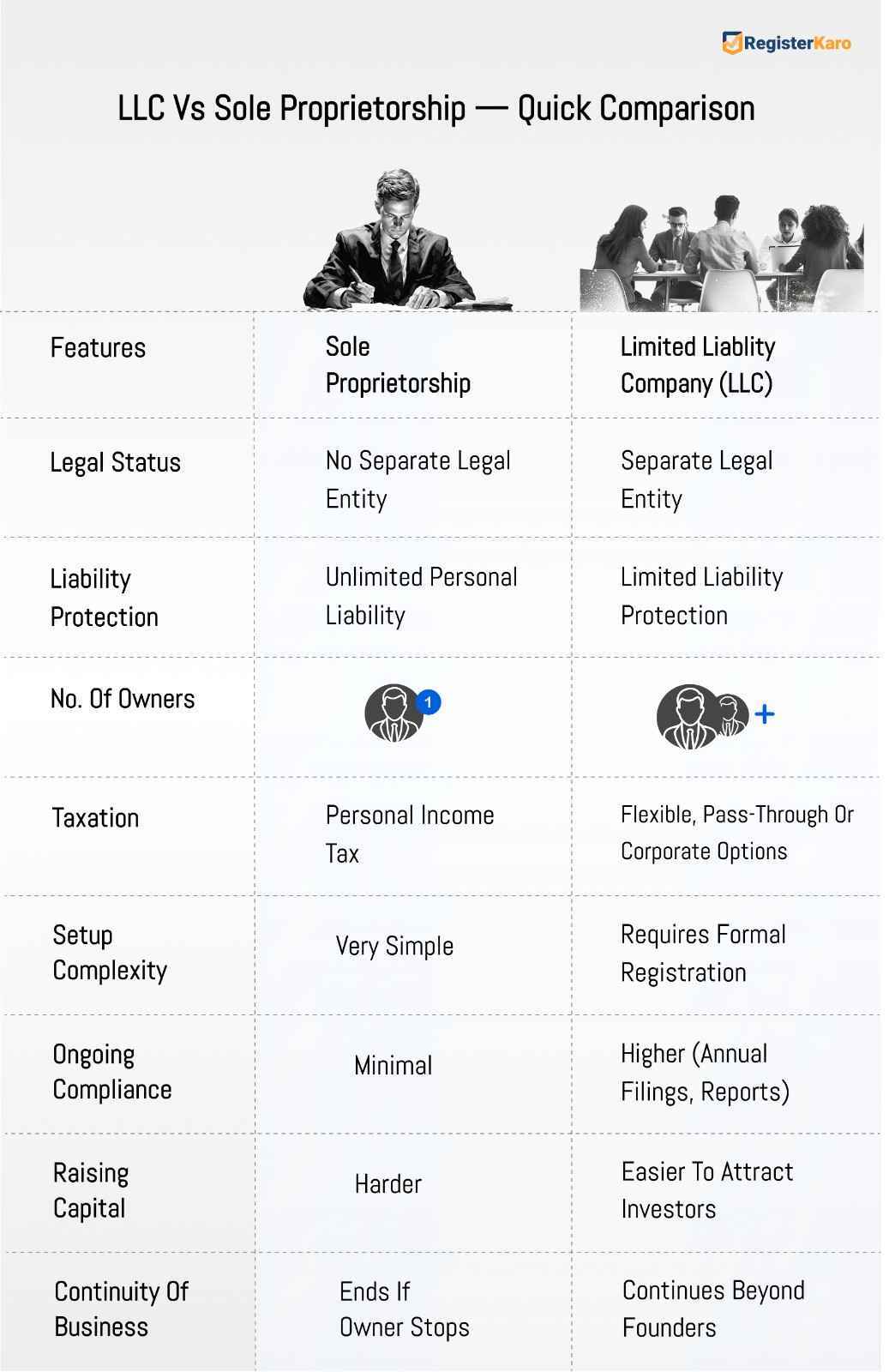
Test your understanding!
Imagine a customer in the US has a bad reaction to a skincare product you sold on Amazon and decides to sue your business for damages.
- If your business was registered as a Sole Proprietorship, what is at risk?
- If your business was registered as an LLC, what is at risk?
Show answer
- With a Sole Proprietorship, your personal assets (car, house, savings) could be targeted in the lawsuit because there is no legal separation between you and the business.
- With an LLC, only the assets belonging to the business (its bank account, inventory) are at risk. Your personal assets are protected.
3. LLCs vs. Corporations: What's the Difference?
You might also hear about Corporations (C-Corps). While an LLC is generally the best fit for your goals, it's useful to know how a C-Corp differs.
LLC for Foreigners: How to Start a Business in the U.S.?
This article provides a fantastic, clear comparison table of the main business structures for foreigners.
Focus on the 'Comparison of Business Structures' table. Compare the rows for LLC and Corporation (C-Corp) on the features of 'Taxation', 'Complexity', and 'Costs & Fees'.
Here's a quick summary of the key differences for your situation:
| Feature | LLC (Recommended for you) | C-Corporation |
|---|---|---|
| Liability | Strong protection (separates personal & business assets). | Strongest protection. |
| Taxation | Pass-through: Profits "pass through" to you, and you report them on your US tax filings. Avoids "double taxation." | Double taxation: The corporation pays tax on its profits, and you pay tax again on any dividends you receive. |
| Complexity | Moderate: requires state filing and annual reports. | High: requires a board of directors, shareholder meetings, and strict record-keeping. |
| Best for... | Most online businesses, e-commerce, and service providers. | Startups planning to raise money from venture capitalists by issuing stock. |
For your business model—selling on platforms like Amazon, Walmart, and TikTok—a C-Corp's complexity is unnecessary. The LLC provides the protection you need with much simpler administration.
(Note: You may also see mention of an "S-Corporation." You can ignore this, as only US citizens or residents can own one.)
4. Practical Steps: Setting Up Your LLC as a Non-Resident
Now that we've established that a single-member LLC is your best option, let's look at the practical details. This is where your IT background in understanding systems and processes will be helpful.
This next video is a step-by-step guide specifically for non-residents. We will refer back to it in future lessons, but for now, we'll focus on the key decisions and concepts.
How to Open a US LLC as a Non-Resident (Step-by-Step Guide for Foreigners)
This guide by Hessel is one of the clearest walkthroughs for non-residents forming a US LLC. It covers the exact topics you need to understand: choosing a state, the role of a registered agent, and the tax implications.
Please watch two key sections: Choosing a State (00:37 - 02:51): This explains why Wyoming, Delaware, and New Mexico are the top choices for non-residents and helps you compare them. Tax Implications (08:49 - 11:32): This is the most important part. It explains the 'disregarded pass-through entity' status, tax exemptions for non-residents, and the crucial annual IRS filing requirements.
Let's break down the key action points from that video:
1. Choosing a State:
As a remote business without a physical presence, you can choose any state. The best states for non-residents are:
- Wyoming (Often Recommended): Low fees ($60/year), simple compliance, and strong privacy. The best all-around choice for most e-commerce sellers.
- Delaware: The "premium" choice, preferred by startups seeking investment. More expensive ($300/year franchise tax).
- New Mexico: The cheapest option with no annual fees, but it's less recognized by banks and payment processors, which can cause issues.
For your goals, Wyoming is the most practical and cost-effective choice.
2. Tax Status: "Disregarded Entity"
For a single-member LLC owned by a non-resident, the IRS treats it as a "disregarded entity." This means:
- No US Corporate Tax: The LLC itself does not pay US federal income tax.
- Pass-Through Income: The profits "pass through" the LLC to you, the owner.
- Tax in Your Home Country: You are responsible for reporting this income and paying taxes on it according to the laws of your country of residence.
3. Critical US Tax Filing Obligation:
Even though you may not owe income tax in the US, you are still required to file informational forms with the IRS each year. As the video explains, these are Form 5472 and a pro-forma Form 1120.
This is non-negotiable. Failing to file these forms on time results in a minimum penalty of $25,000. We will cover this in more detail later, but it is essential to be aware of this from day one.
Conclusion
You now have a clear framework for making one of the most important foundational decisions for your business. Moving from a local operation to a global one requires a robust legal structure to protect you and enable you to work with US-based platforms and partners.
Key Takeaways:
- A Sole Proprietorship is not a suitable structure as it offers no liability protection and is generally unavailable to non-residents.
- A C-Corporation is overly complex and expensive for most e-commerce businesses that are not seeking venture capital.
- A Limited Liability Company (LLC) is the ideal choice. It provides a legal shield for your personal assets while being relatively simple to manage.
- For your specific situation, a single-member LLC registered in a business-friendly state like Wyoming is the standard and recommended path.
- While your LLC's income may not be subject to US income tax, you have a mandatory annual filing requirement with the IRS (Form 5472) that carries severe penalties if missed.
Next Up:
Now that you've decided on an LLC as your business structure, the next practical step is to get the necessary components to register it. In the next lesson, we will walk through how to set up a virtual US business address and a VoIP phone number—two essential prerequisites for forming your company as a non-resident.