Hello! Welcome to the first lesson in our module on "Caching and In-Memory Stores: Redis."
Given your extensive experience in building high-load systems, you know that every component's failure modes and recovery mechanisms are critical. Redis, as an in-memory store, presents a unique challenge: how do you ensure data isn't lost when a server crashes or restarts?
Today's lesson addresses this fundamental question. Our goal is to explain Redis persistence models—RDB snapshots and AOF—and analyze their durability versus performance trade-offs. Understanding these options is the first step toward configuring Redis correctly for your specific use case, whether it's a volatile cache or a durable, high-performance data store.
We will explore how each model works under the hood, their respective strengths and weaknesses, and how they can be combined for a robust solution. This knowledge will be the foundation for our next lessons on replication, high availability, and clustering.
1. The Need for Persistence
Redis stores its entire dataset in RAM to achieve its signature high performance. However, RAM is volatile. A server crash, a power outage, or even a simple restart would wipe out all the data.
In a high-load environment, the sudden disappearance of a cache can be catastrophic. To understand why, please read the introductory section of the following article, which describes the "thundering herd" problem.
Redis Persistence Dive Deep - Trade-offs Between ...
This article, 'Redis Persistence Dive Deep', clearly explains the consequences of data loss in an in-memory cache and why persistence is a critical feature.
Please read the section titled 'Why does Redis need data persistence?'. It sets the stage by explaining what happens to a system when its Redis cache crashes without a recovery mechanism.
As the article highlights, a cache failure can cascade, overwhelming your primary databases and severely degrading application performance and availability. To prevent this, Redis provides two primary persistence mechanisms: RDB and AOF.
2. RDB (Redis Database) Persistence
The first model, RDB, works by taking point-in-time snapshots of your dataset.
How RDB Works
At configured intervals (e.g., every 5 minutes if at least 100 keys have changed), or when manually triggered, Redis saves the entire dataset to a compact, binary file named dump.rdb.
To do this without blocking the main process, Redis uses the fork() system call to create a child process. Thanks to the copy-on-write (CoW) memory optimization, the child process gets a snapshot of the parent's memory space. This child process then writes the dataset to disk, while the parent process continues to serve requests. Your background in operating systems gives you a solid understanding of the efficiency and implications of this fork() and CoW model.
The official Redis documentation provides a concise overview of the RDB mechanism and its advantages and disadvantages.
Let's turn to the official Redis documentation for a technical breakdown of RDB.
Please read the following sections: 'How it works' (under 'Snapshotting'), 'RDB advantages', and 'RDB disadvantages'. Focus on how the fork-based approach enables non-blocking saves and what trade-offs this introduces.
The following diagram visually contrasts the RDB mechanism with AOF, which we will discuss next. Notice the bgsave subprocess and copy-on-write step specific to RDB.
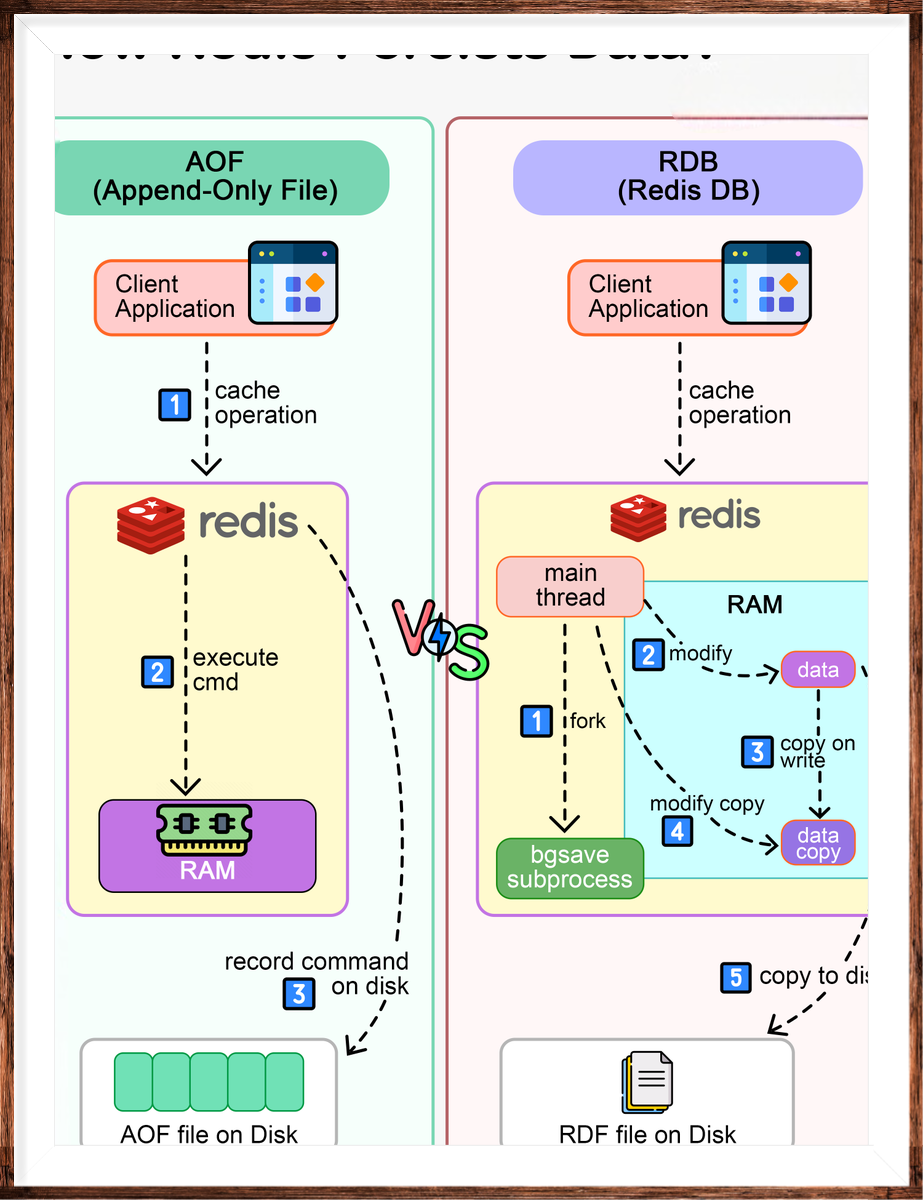
RDB Trade-offs
Based on the readings, we can summarize the trade-offs:
-
Advantages:
- Performance: The parent process is minimally impacted, as the heavy I/O work is offloaded to a child process.
- Compactness: The RDB file is a compressed binary representation of the data, making it smaller than an AOF file and ideal for backups and disaster recovery.
- Fast Recovery: Loading a single RDB file on startup is generally much faster than replaying a log of commands.
-
Disadvantages:
- Data Loss: This is the most significant drawback. If Redis crashes between snapshots, all data written since the last successful snapshot is lost. For a snapshot configured to run every 5 minutes, this could mean up to 5 minutes of data loss.
fork()Latency: For very large datasets, thefork()operation itself can be time-consuming and consume memory, potentially causing a brief pause in Redis's ability to serve clients.
3. AOF (Append-Only File) Persistence
The AOF model offers a more durable alternative to RDB. Instead of snapshotting the data, it logs every write operation received by the server.
How AOF Works
When AOF is enabled, every command that modifies the dataset (e.g., SET, INCR, LPUSH) is appended to the appendonly.aof file. When Redis restarts, it reconstructs the state by re-executing all the commands in this file.
Since this log file can grow very large, Redis has a clever auto-rewrite mechanism. It can generate a new, minimal AOF in the background that represents the current dataset, and then atomically switch to the new file.
The core of AOF's flexibility lies in its fsync policy, which dictates how often data is written from the OS buffer to the disk. This setting directly controls the balance between performance and durability.
The Redis documentation details the AOF mechanism, its advantages, disadvantages, and the crucial fsync policies.
Please read the sections 'AOF advantages', 'AOF disadvantages', and 'How durable is the append only file?'. Pay close attention to the three appendfsync options, as this is the primary lever for tuning AOF's behavior.
AOF Trade-offs
Let's summarize the key trade-offs for AOF:
-
Advantages:
- Durability: AOF is far more durable than RDB. With the default
appendfsync everysecpolicy, you risk losing at most one second of data. Withappendfsync always, you achieve zero data loss (at a performance cost). - Log Integrity: The append-only nature of the log makes it robust against corruption. Even if a write is incomplete due to a crash, Redis provides tools to fix the AOF file.
- Durability: AOF is far more durable than RDB. With the default
-
Disadvantages:
- File Size: The AOF file is almost always larger than the equivalent RDB file for the same dataset.
- Performance: The
fsyncoperation can be a bottleneck.fsync-ing on every command (always) is slow, though the default (everysec) offers a great balance and is still very performant. - Slower Recovery: For large datasets, replaying the AOF log can take significantly longer than loading an RDB file.
4. Comparison and Practical Application
So, which model should you use? The answer depends entirely on your application's requirements for durability.
- If Redis is used as a volatile cache where data loss is acceptable, RDB alone is a fine choice.
- If you cannot afford to lose any data, such as when using Redis for financial transactions or as a primary database, AOF is necessary.
However, you don't have to choose just one. Redis can run both persistence models simultaneously. When both are enabled, Redis uses the AOF file for recovery on restart, as it guarantees more recent data. This hybrid approach is now the standard recommendation for achieving high durability.
The following article provides a superb comparison and discusses the hybrid model, along with practical use cases for each approach.
Redis Persistence Dive Deep - Trade-offs Between ...
This article provides a practical comparison of the persistence models and explains the powerful hybrid approach.
Please read the sections 'AOF + RDB' and 'AOF vs RDB vs AOF + RDB'. The table and the list of practical applications are particularly useful for connecting these concepts to real-world scenarios.
When AOF and RDB are used together, the AOF rewrite process is optimized. Instead of writing out every key as a command, Redis can write an RDB snapshot into the beginning of the new AOF file and then append only the commands that arrived during the rewrite process. This gives you the fast recovery of RDB and the strong durability of AOF.
Conclusion
In this lesson, we've dissected the two primary persistence models in Redis and analyzed their fundamental trade-offs.
Key Takeaways:
- RDB (Snapshotting): Prioritizes performance and compact file size at the cost of potential data loss (minutes worth). It's suitable for caching scenarios where data can be regenerated.
- AOF (Command Logging): Prioritizes durability, allowing for configurable data loss windows (from zero to a few seconds). It's essential for use cases where Redis acts as a system of record.
- Performance vs. Durability: The core trade-off is clear. RDB's
fork()can cause a brief latency spike for large datasets, while AOF'sfsyncpolicy directly trades write performance for durability. - Hybrid Approach: Using both RDB and AOF is the recommended strategy for most production systems that require high durability. It combines AOF's data safety with RDB's fast restarts and backup-friendly format.
Your choice of persistence strategy is a critical architectural decision that directly impacts the reliability and performance of your system.
Preview of the Next Lesson:
Now that we've established how to make a single Redis instance durable, the next logical step is to make it highly available. In our next lesson, we will configure Redis replication with a master-replica topology, exploring how data is propagated and how replicas can handle read traffic and provide a hot standby for failover.