
Hello! Welcome back to the SQL Injection module.
In our last lesson, you saw how to use SQLMap to automate the detection and exploitation of SQL injection vulnerabilities. We also touched upon its --tamper scripts, which can modify payloads to evade basic Web Application Firewalls (WAFs). However, as you advance, you'll encounter sophisticated filters and custom sanitization routines that can outsmart automated tools. In these situations, your success will depend on your ability to manually analyze the defense mechanism and craft a bespoke payload to bypass it.
This lesson is all about that manual process. We're going to dive into the art and science of writing SQL injection payloads that bypass common input filters and sanitization. This skill is a significant differentiator between a script-user and a professional penetration tester or bug bounty hunter.
1. Understanding Your Adversary: How Filters and WAFs Work
To bypass a defense, you must first understand how it operates. Web Application Firewalls (WAFs) and application-level filters are the primary defenses against SQL injection. They sit between the user and the web server, inspecting incoming requests for malicious patterns.
To get a solid foundation on what WAFs are, how they work internally, and the general categories of bypass techniques, please watch the following video.
Web Application Firewall Bypassing by Khalil Bijjou
The talk 'Web Application Firewall Bypassing' by Khalil Bijjou provides an excellent overview of WAF architecture and bypass theory. It's a great starting point for thinking about how to defeat them.
Watch from the beginning to 18:06. Focus on these key concepts: WAF Purpose: Why companies use them (00:30). Internal Workings: The role of preprocessors and normalization functions (like lowercase conversion and URL decoding) (03:30). Security Models: The difference between a negative (blacklist) and positive (whitelist) security model (06:05). Bypass Categories: The high-level concepts of Preprocessor Exploitation, Impedance Mismatch, and Ruleset Bypassing (10:45). Your Computer Science background will help you appreciate the logic behind these systems, especially the parts about normalization and regular expressions.
As the video explained, most WAFs that you'll be able to bypass operate on a negative security model (blacklisting). They maintain a list of known-bad signatures (e.g., ' OR 1=1, UNION SELECT, <script>) and block any request that matches. Our goal is to craft a payload that is functionally equivalent but doesn't match any of these signatures.
2. A Systematic Approach to Bypassing Filters
Bypassing a WAF is not about throwing random payloads at it; it's a methodical process of reconnaissance and iterative payload crafting.
This process involves:
- Finding the Filter: Start with a classic, simple payload you know will be blocked (e.g.,
' UNION SELECT 1,2--). The block confirms a filter is in place. - Probing the Rules: Isolate what part of the payload is being blocked.
- Try sending just
'. Does it get blocked? - Try sending
UNION. Does that get blocked? - Try sending a space
- This is a process of elimination to understand the WAF's blacklist.
- Try sending just
- Crafting the Bypass: Once you know the "forbidden" words or characters, you can use various techniques to build a payload that avoids them.
The following guide explains this iterative process beautifully.
Guide on Web Application Firewall Bypass
The article 'Guide on Web Application Firewall Bypass' from YesWeHack provides an excellent, practical methodology for crafting bypasses.
Read the sections titled 'Payload preparation' and 'Methodology'. Focus on the idea of starting with a blocked payload and making small, incremental changes to understand the filter's logic. This is the core mental model for manual bypassing.
3. Common SQLi Bypass Techniques
Now, let's explore the arsenal of techniques you can use in the "crafting" phase. The "Awesome-WAF" GitHub repository is an invaluable resource for this.
This resource is a comprehensive collection of WAF bypass techniques. We will focus on the sections most relevant to SQL injection.
Review the 'Blacklisting Detection/Bypass' and 'Obfuscation' sections. You don't need to memorize everything, but focus on understanding the principle behind each technique. The examples provided are excellent.
Let's break down the most important techniques from that resource and others, with a focus on SQL injection.
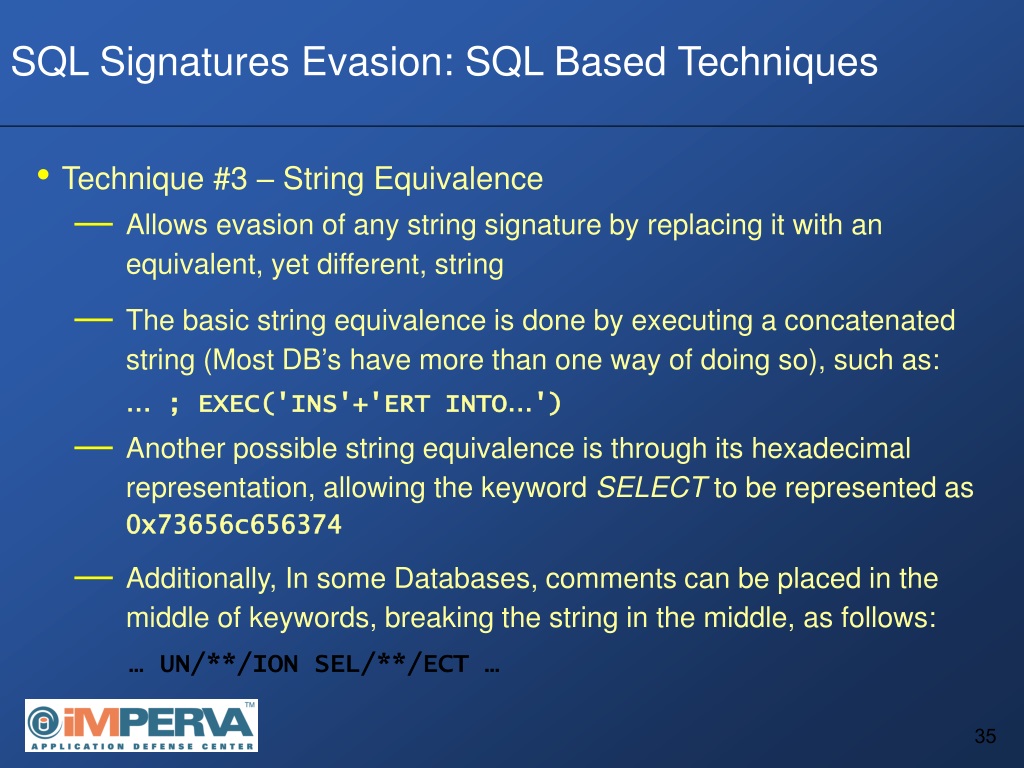
a. Keyword & Syntax Obfuscation
The goal here is to use alternatives to blacklisted keywords like SELECT, UNION, OR, and AND.
- Case Variation: This is the simplest trick. If a WAF is only looking for
union, it might missuNiOnorUNION.- Blocked:
union select - Bypass:
uNiOn sElEcT
- Blocked:
- Comments: SQL comments can be inserted in the middle of keywords to break up the signature.
- Blocked:
union select - Bypass:
union/**/selectorunion--comment%0Aselect
- Blocked:
- Alternative Operators: Many SQL dialects have alternatives for common operators.
ORcan be replaced with||ANDcan be replaced with&&=can be replaced withLIKEor<or>
- Atypical Syntax: Use less common but valid functions that a WAF developer might not have considered.
- Instead of
substr()orsubstring(), you might useLPAD(). ... WHERE id=1might be rewritten as... WHERE id IN (1).
- Instead of
b. Whitespace Bypass
If the WAF is blocking spaces around keywords, you can use other characters that the database will interpret as whitespace.
- URL-encoded characters:
%09(tab),%0a(newline),%0d(carriage return). - Comments:
/**/is a classic replacement for a space. - Parentheses: In some contexts,
(and)can replace spaces.
Blocked: SELECT user FROM users
Bypass: SELECT(user)FROM(users)
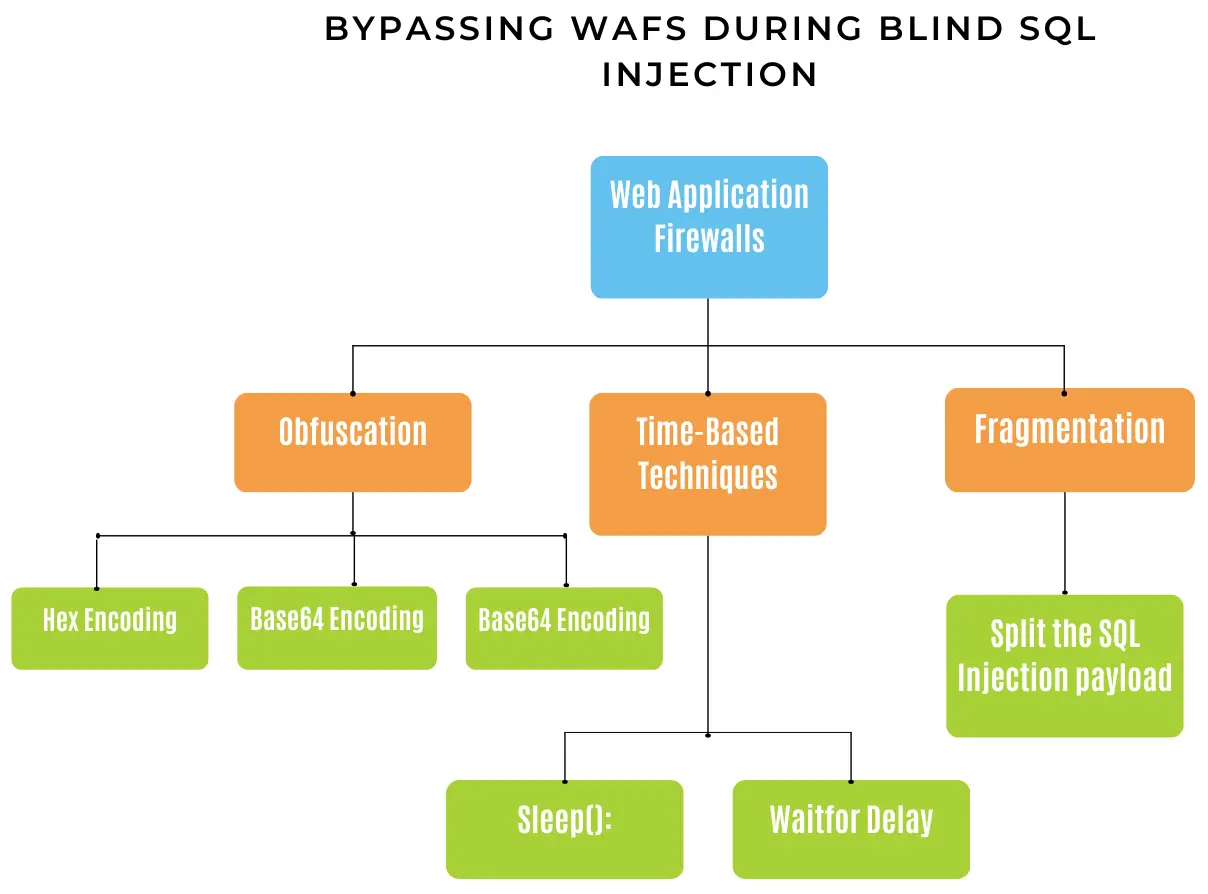
c. Encoding and Normalization
This is where you can exploit differences between how the WAF and the backend server interpret encoded data.
- URL Encoding: All payloads are URL-encoded by the browser, but you can sometimes bypass filters by double-encoding characters.
'->%27(single encoding) ->%2527(double encoding). A naive WAF might decode once, see%27, and let it pass. The server then decodes it again, revealing the malicious'.
- Hex Encoding: You can represent strings in hex format, which might not be on the WAF's blacklist.
- Blocked:
'admin' - Bypass:
0x61646d696e
- Blocked:
- XML/HTML Entity Encoding: If the data is being passed through an XML or HTML parser, you can use entity encoding. This is a more niche but powerful technique.
Let's watch a practical demonstration of a WAF bypass using XML encoding.
SQL Injection - Lab #17 SQL injection with filter bypass via XML encoding | Short Version
The channel 'Rana Khalil' provides excellent, concise lab walkthroughs from PortSwigger's Web Security Academy. This one demonstrates a filter bypass using a Burp Suite extension.
Watch the entire video. Notice how a simple UNION SELECT payload is blocked (01:27). The presenter then uses the Hackvertor extension to encode the payload as XML hex entities (03:16), which successfully bypasses the WAF, allowing the exploit to succeed (04:23).
Test your understanding!
A WAF is blocking any payload containing the word SELECT. You are trying to perform a UNION-based SQL injection. Which of the following techniques would be the most likely to succeed in bypassing this specific filter?
' UNION sElEcT user, pass FROM users--' UNION anD 1=1--' UNION /**/SELECT/**/ user, pass FROM users--- Both 1 and 3.
Show answer
- Both 1 and 3. Case variation (
sElEcT) and using comments (/**/SELECT/**/) are both direct attempts to obfuscate theSELECTkeyword itself to evade a signature-based filter. Option 2 does not include the necessarySELECTstatement to perform a UNION-based attack.
d. Advanced Techniques
- HTTP Parameter Pollution (HPP): If a WAF only inspects the first instance of a parameter, you can sometimes sneak a payload past it. Different server technologies concatenate or prioritize parameters differently.
- Request:
?id=1&id=' UNION SELECT 1,2-- - WAF sees:
id=1(Looks safe) - PHP (backend) sees:
id=' UNION SELECT 1,2--(Uses the last instance)
- Request:
- Known Bypasses: Some WAFs have publicly known bypasses. The
Awesome-WAFresource lists several for common products like ModSecurity and Imperva. These are great to review as they show real-world examples of the techniques we've discussed. (See sections on ModSecurity and Imperva in resource LINK).
Conclusion
Mastering manual bypass techniques transforms you from someone who simply runs tools to someone who can solve complex security puzzles. It requires creativity, a deep understanding of SQL, and a methodical approach to analyzing defenses.
Key Takeaways:
- Understand the Defense: WAFs and filters primarily use blacklists (signature matching). Your goal is to create a payload that is functionally valid but doesn't match a known bad signature.
- Follow a Methodology: Don't guess. Follow the probe-analyze-craft cycle. Start with a known-bad payload to get blocked, then iteratively modify it to pinpoint the exact filter rules.
- Master Your Arsenal: The most common bypass techniques involve obfuscating keywords (case, comments), finding alternatives for whitespace (encoded chars, parentheses), and using different encodings (URL, Hex) to create an "impedance mismatch" between the WAF and the backend server.
- Creativity Wins: This is a cat-and-mouse game. WAF developers create rules, and hackers find ways around them. The techniques here are a starting point; the ability to combine them and invent new variations is what defines an expert.
Next Lesson Preview:
So far, we've focused on injections where we get a response from the application, either directly (error-based, union-based) or indirectly (blind). But what if the application gives no response at all? In our final SQL injection lesson, we will cover Out-of-Band (OOB) SQL Injection, a powerful technique that forces the database server to make an external network request to a server you control, exfiltrating data even when no other channel is available.