Introduction
Welcome back! Over the past several lessons, you've built an impressive toolkit of tactical motifs. We started with the foundational patterns of forks, pins, and skewers, and then moved on to more advanced ideas like discovered attacks, double checks, removal of the defender, and exploiting overloaded pieces. In each lesson, you knew which pattern to look for.
Today, we're taking the next crucial step. The goal of this lesson is to solve mixed tactical puzzles where you don't know the theme in advance. This simulates a real game, where opportunities are hidden and you must be the one to find them. Your challenge will be to scan the position, identify the correct motif from all the patterns you've learned, and calculate the winning line. This is the capstone lesson for our first two modules on tactics, and it's essential for developing the quick pattern recognition you need to climb toward 1500 ELO.
1. A Systematic Approach: Checks, Captures, and Threats
When you're faced with a complex position and don't know where to start, it's easy to feel overwhelmed. The key to cutting through the noise is to have a systematic thought process. For tactical puzzles, the most effective method is to analyze moves in a specific order of priority:
- Checks: These are the most forcing moves. Your opponent has a very limited number of legal replies, which makes calculation much easier. Always look at every possible check, even if it seems silly at first.
- Captures: These are the next most forcing moves. Capturing an enemy piece reduces their material and forces a reaction. Again, consider all possible captures.
- Threats: If no checks or captures lead to an advantage, look for moves that create a serious threat. This could be attacking a valuable piece, setting up an unstoppable checkmate, or creating a passed pawn.
This "Checks, Captures, Threats" (CCT) framework provides the structure you need to find tactical solutions efficiently. Let's hear it explained by International Master Levy Rozman.
How to Solve Chess Tactics | 1200-1400 Puzzles Training
In this clip from GothamChess, he introduces the core methodology of looking for checks, captures, and attacks first. This is the foundation of a strong tactical thought process.
Watch the first 39 seconds of the video. Pay close attention to how he frames the puzzle-solving process as a hierarchy of moves to consider.
By consistently applying this CCT method, you turn a chaotic search for a good move into a structured, logical process.
2. Reviewing Your Tactical Toolkit
Before we dive into mixed puzzles, it's helpful to quickly review the patterns you've learned. The article "The 15 Tactics Motifs You MUST Know to Reach 1800 Elo" is a great resource for this.
I suggest you take a few minutes to browse through the following sections to refresh your memory on the tactical motifs we have covered so far:
- Pin (Section 1)
- Fork (Section 2)
- Skewer (Section 3)
- Discovered Attack (Section 4)
- Removal of the Defender (Section 5)
- Overloaded Piece (Section 8)
You can find this article here (resource ID LINK). This is just a quick review; don't spend too much time on it. The main goal is to have these patterns fresh in your mind.
3. Tactical Warm-Up
Let's begin with a few puzzles from grandmaster games. In the image below, each puzzle names the key tactical motif. This will help you bridge the gap between single-theme practice and fully mixed puzzles.
For each puzzle, cover the solution with your hand, apply the CCT method, and try to find the winning sequence before you read the answer.
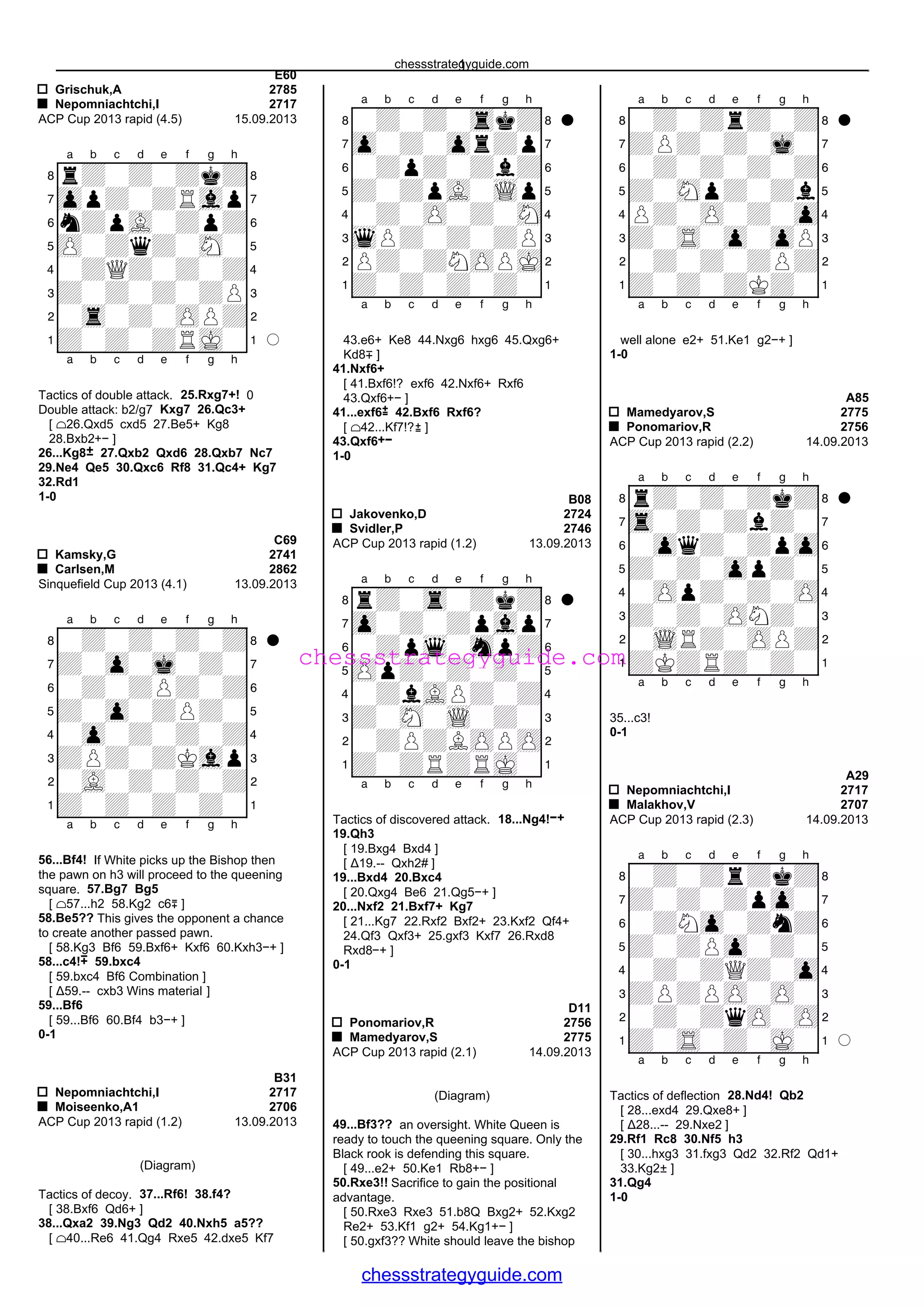
How did you do? Notice how even when the theme is given, finding the precise move order still requires careful calculation.
4. The Main Workout: Mixed Puzzle Gauntlet
Now for the main event. You're going to work through a series of puzzles where the difficulty increases and the themes are mixed. We'll use a video where the host solves these puzzles while explaining his thought process.
Your task is to pause the video at the beginning of each new puzzle. Apply the "Checks, Captures, Threats" method to find the solution on your own. Once you have an answer, or if you get stuck, unpause the video to see the solution and hear the explanation. This active learning approach is far more effective than just passively watching.
How To Solve Chess Tactics/Puzzles/Problems (with 48 examples)
The video 'How To Solve Chess Tactics/Puzzles/Problems (with 48 examples)' by Chess Vibes is an excellent training resource. The presenter works through a long series of puzzles, vocalizing his CCT thought process.
Please watch from the beginning up to the 30-minute mark. At the start of each puzzle, pause the video. Try to solve it yourself, then play the video to see the solution and hear the thought process. Pay attention to how he identifies which motif is present in the position.
Don't be discouraged if you don't solve them all instantly. The goal is to practice the process. Pay attention to puzzles where your chosen move was different from the solution. Why was the video's move better? Did you miss a defensive reply from your opponent? This analysis is where the real learning happens.
Conclusion
Excellent work today. You've tackled the most challenging and most realistic form of tactical training: solving mixed puzzles. This is the skill that directly translates to finding winning opportunities in your own games.
Key Takeaways:
- Embrace a System: When faced with a puzzle, don't just look for random moves. Use the Checks, Captures, Threats (CCT) method to structure your thinking and ensure you don't miss forcing lines.
- Pattern Recognition is Key: The more mixed puzzles you solve, the faster you'll become at recognizing the underlying tactical motifs (forks, pins, discoveries, etc.) in any position.
- Active Solving is Best: The process of pausing, thinking for yourself, and then comparing your analysis to an expert's is the most effective way to improve your tactical vision.
Preview of the Next Lesson:
We've spent the first two modules building a powerful tactical foundation for winning material. Now, we'll shift our focus to the ultimate objective of the game: checkmate. In the next lesson, we will begin Module 3 by studying the most common checkmating pattern in all of chess: the back-rank mate. You will learn to recognize the conditions for it, execute it flawlessly, and, just as importantly, defend against it.