Introduction
Welcome to our next lesson on advanced tactical motifs. In the previous session, we focused on "removing the defender," and we briefly saw how you can deflect a key defensive piece by giving it a second, more urgent task. This is often called making the piece "overworked."
Today, we're going to explore that idea in much more detail. The learning outcome for this lesson is to identify and exploit overloaded pieces in the opponent's position. An overloaded piece is a defender that is stretched too thin, trying to do too many jobs at once. Recognizing this vulnerability is a powerful tool for creating winning opportunities, and it's a very common theme in games around your current rating level.
1. What Is an Overloaded Piece?
An overloaded piece is a single piece that is tasked with multiple defensive duties. For example, it might be defending two different pieces, or it might be protecting one piece while also blocking a checkmate threat. Because it can't perform all its duties simultaneously, it becomes a tactical weakness.
Let's start with a formal definition.
This article from Chess.com provides a concise and clear definition of the overloading tactic.
Please read the short section titled 'What Is Overloading In Chess?'. This will give you the core definition we'll be working with today.
To visualize this, look at the diagram below.
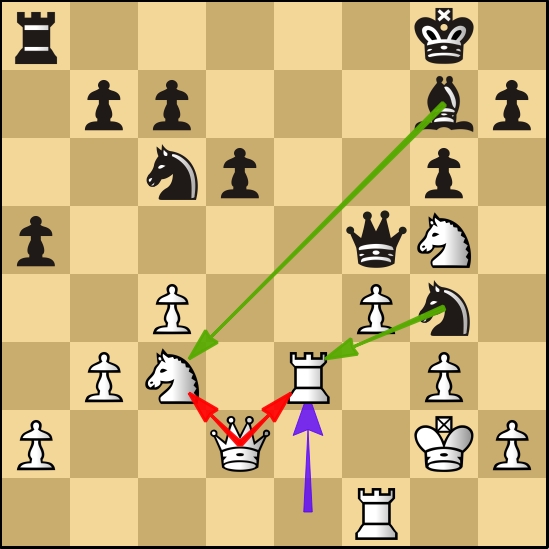
Now, let's see this concept in action with a simple, clear video example.
How to take Advantage of overloaded Pieces| Chess Beginner Tactics
The Chessfactor channel provides an excellent introductory explanation that builds on what we learned last lesson.
Watch the first 1 minute and 17 seconds of this video. It starts with a very simple example of an overloaded rook and clearly explains why it can't fulfill both of its defensive tasks.
2. Recognizing the Defensive Tasks
The key to spotting this tactic is to identify a piece that is performing at least two crucial jobs. These jobs typically fall into two categories:
- Defending two (or more) pieces/pawns.
- Defending a piece/pawn AND a critical square or threat (like a checkmate square or a back-rank threat).
Let's look at an example of each.
Defending Two Pieces
A piece that is the sole defender of two other pieces is a classic target. The Chessfactor video you just started provides a perfect example of this.
How to take Advantage of overloaded Pieces| Chess Beginner Tactics
Let's continue with the Chessfactor video to see how an overloaded queen can be exploited.
Watch from 01:17 to 02:33. Notice how the Black Queen on d7 is defending both the pawn on d4 and the rook on c7. The video also makes an important point about move order, which is crucial for making the tactic work.
Defending a Piece and a Threat
This is a more subtle, but very common, form of overloading. A piece must guard one of its allies while also preventing a tactical blow like a checkmate or a fork.
10 Levels of Tactics: Master Overloading
This next video offers a series of puzzles that increase in difficulty. We'll look at an early example where a queen is overloaded defending against a checkmate threat.
Watch from 04:32 to 06:06. Before the solution is revealed, try to identify the overloaded piece and its two jobs. You'll see the Black Queen is responsible for both defending against a back-rank threat and protecting the g7 square.
3. Guided Practice: Building Your Pattern Recognition
Your ability to spot these patterns in your own games comes from practice. The following puzzles are designed to be at and slightly above your current rating level to sharpen your tactical vision.
For each puzzle, I want you to pause the video and ask yourself two questions before trying to find the solution:
- Which enemy piece looks overworked?
- What are the two (or more) defensive jobs it's trying to do?
Answering these questions first will train your brain to spot the pattern, not just solve the puzzle.
10 Levels of Tactics: Master Overloading
We'll now work through two puzzles from the '10 Levels of Tactics' video. These are perfect for your 1200-1400 ELO target range.
Solve the following two puzzles. Remember to pause and identify the overloaded piece and its tasks before looking for the moves. Level 4 (1000-1200 ELO): Watch from 07:55 to 10:26. This is a complex example where two pieces are overloaded simultaneously! Level 5 (1200-1400 ELO): Watch from 10:26 to 12:54. Here, the queen and king become overloaded, leading to a decisive skewer.
4. Independent Challenge
Now it's time to test your skills on your own. The following resource contains puzzles from famous grandmaster games. Try to solve the first two by applying the thought process we just practiced.
The 'Test Your Skills' section of the Chess.com article on Overloading has interactive puzzles for you to solve. Try to solve at least the first two.
Navigate to the section titled 'Test Your Skills'. For Puzzle 1 (Ftacnik vs. Seirawan) and Puzzle 2 (Tarrasch vs. Lasker), try to find the winning move. First, identify the overloaded piece and its duties, then calculate the sequence to exploit it.
Conclusion
Excellent work today. You've now done a deep dive into the overloading tactic, a critical pattern for any player looking to break through the intermediate level. You've learned not just to solve the puzzles, but to adopt a systematic way of thinking to identify the opportunity in the first place.
Key Takeaways:
- An overloaded piece is a defender with too many jobs. It is a tactical weakness waiting to be exploited.
- The first step is always to identify the overworked piece and name its multiple defensive tasks (e.g., "The queen is defending the rook on c7 and the back rank").
- Once identified, you can exploit it by creating a new threat that forces the piece to abandon one of its duties, leading to material gain or checkmate.
Preview of the Next Lesson:
In our upcoming lessons, we'll start solving mixed tactical puzzles. You'll need to identify the correct pattern from all the ones we've learned so far—forks, pins, skewers, discovered attacks, removing the defender, and now overloading. You'll see that these tactics often work together, with an overloading move often setting up a discovered attack or a fork.
For your daily 30-minute practice sessions, I highly recommend working through interactive puzzles. The resource below links to several Lichess studies specifically on overloaded pieces, which are perfect for this.
Tactics - Overworked Defender (Overloading)
For continued practice, this blog post from The Bishops Bounty compiles several excellent, interactive Lichess studies on overloading. These are ideal for your daily training.
Scroll down to the 'LiChess Studies (Overloading)' section. I recommend starting with the first link, 'Intermediate: Tactics: Overloaded Piece,' and working your way through the chapters in your upcoming study sessions.