
Hello again. In the previous lesson, you built the geographical frame: the UK’s four nations, their capitals, and the crucial difference between Great Britain and the United Kingdom. This lesson adds a time frame. It is the first of two high-yield history lessons, covering early Britain through the fall of James II in 1688.
The goal is not to memorise a dense list of monarchs. For the test, build a timeline of turning points: each entry needs a date or era, a person or event, and one short note explaining why it matters. That structure makes similar names and dates far easier to retrieve under time pressure.
Use a timeline as a retrieval tool
Create one horizontal line on paper and divide it into four visual bands:
- Early Britain and Rome: before
- Anglo-Saxons, Vikings, and Normans: to
- Medieval kingdoms and Parliament: to
- Tudors and Stuarts: to
Use a different colour or symbol for each of these recurring themes:
- Crown: monarchs and succession
- Cross: religious change
- Shield: war, invasion, rebellion
- Scroll: law, Parliament, and limits on royal power
One accuracy rule matters throughout: for much of this lesson there was no United Kingdom. Before , many events concern the kingdom of England, Scotland, Wales, or Ireland, rather than the modern UK. Test questions may use “Britain” broadly, but your timeline should keep the places distinct.
1. Early Britain: settlement, Rome, and the foundations of Christianity
Begin with these anchor points. They establish the sequence from prehistoric Britain to the departure of Rome and the arrival of Anglo-Saxon kingdoms.
| Date | Person or event | Annotation: why it matters |
|---|---|---|
| Stone Age | Hunter-gatherers; later farmers | The first inhabitants were hunter-gatherers. Stonehenge is in Wiltshire, England; Skara Brae is in Orkney, Scotland. |
| Iron Age | Celtic-speaking peoples | Iron tools and weapons became common; hill forts and Britain’s first coins are associated with this period. |
| BC | Julius Caesar’s expeditions | Roman forces first attempted to invade Britain, but did not establish a lasting conquest. |
| AD | Emperor Claudius invades | The successful Roman conquest begins. |
| AD or | Boudicca’s rebellion | Boudicca, queen of the Iceni, led a major revolt against Roman rule. |
| AD | Hadrian’s Wall | Emperor Hadrian ordered the wall built in northern England; it marked and defended the Roman frontier against peoples north of it, including the Picts. |
| AD | Romans leave Britain | Roman administration and soldiers withdrew after roughly four centuries; this created the conditions for new migrations and kingdoms. |
| Fifth century onward | Angles, Saxons, and Jutes settle | Germanic settlers established kingdoms, particularly in what became England. |
| AD | St Augustine arrives in Kent | A mission sent from Rome begins the conversion of Anglo-Saxon England; Augustine became the first Archbishop of Canterbury. |
The Roman period is often tested through associations rather than detail:
- Boudicca: led resistance to the Romans.
- Hadrian: ordered the wall.
- Romans: roads, towns, public buildings, new plants and animals, and elements of administration.
- AD : Romans leave Britain.
Watch the selected parts of this overview now. Its strength is that it pairs the exam facts with places and images, rather than presenting them as disconnected names.
Early Britain (Chapter 3) Life in the UK Test 2026 🇬🇧
Watch “Early Britain (Chapter 3) Life in the UK Test 2026” by UK Life Prep for a rapid visual pass through the period from prehistoric Britain to the Norman Conquest. Focus on the associations that commonly appear in multiple-choice questions: site and location, ruler and action, invader and response.
Watch Stone Age Britain for Stonehenge, Skara Brae, and the earliest inhabitants. Then watch Roman Britain for Claudius, Boudicca, Hadrian’s Wall, and the Roman departure. Finish with new kingdoms for Anglo-Saxon settlement, Christian missionaries, Vikings, Alfred, Kenneth MacAlpin, William, and the Domesday Book.
For the timeline, write only the bolded action beside each name. For example: Augustine, 597: Roman mission; first Archbishop of Canterbury. That is enough to distinguish him from St Patrick, associated with Ireland, and St Columba, associated with Iona and missionary work in Scotland.
2. Anglo-Saxons, Vikings, and the Norman Conquest
After Rome left, Britain was not one political unit. Anglo-Saxon kingdoms developed in much of England, while distinct peoples and rulers held power elsewhere. Christianity spread through missionaries from Rome and Ireland. By the end of the eighth century, Viking raids became sustained invasions.
| Date | Person or event | Annotation: why it matters |
|---|---|---|
| AD | Augustine’s mission | England begins to be converted to Christianity under Roman church influence. |
| AD | Synod of Whitby | The Northumbrian church chose Roman rather than Celtic practices, strengthening links with Rome. |
| AD | First recorded Viking raid | Marks the beginning of the Viking threat in Britain. |
| AD | Raid on Lindisfarne | The attack on the monastery became a famous symbol of Viking raids. |
| c. AD | Kenneth MacAlpin | Traditionally associated with uniting the Scots and Picts, helping form the kingdom of Scotland. |
| AD | Alfred defeats Guthrum | Alfred of Wessex recovered from Viking attack and secured Wessex. |
| AD | Treaty and the Danelaw | England was divided between Alfred’s territory and Viking-controlled territory in the east. |
| AD | Athelstan takes York | Athelstan is regarded as the first king of a unified England. |
| AD | Cnut becomes king | A Danish king ruled England, showing Viking power did not simply disappear after Alfred. |
| AD | Battle of Stamford Bridge | Harold Godwinson defeated the Norwegian king Harald Hardrada in Yorkshire. |
| AD | Battle of Hastings | William, Duke of Normandy, defeated Harold Godwinson and became William I of England. |
| AD | Domesday Book | William I ordered a vast survey of land, property, and resources in England. |
The essential Viking story is not “Alfred defeated all Vikings once and for all.” It is more precise:
- Raids escalated into Viking conquest.
- Alfred defended Wessex and made an agreement with the Viking leader Guthrum.
- The Danelaw became Viking-controlled territory in eastern England.
- Alfred’s descendants extended English control, with Athelstan eventually ruling a unified England.
- Denmark later supplied another English king, Cnut.
Read the relevant dated entries in the BBC’s Vikings and Anglo-Saxons timeline. The surrounding detail will make the sequence more memorable, but retain the five anchors: raids, Alfred, Danelaw, Athelstan, and the approach to .
BBC - History : British History Timeline
Read the BBC’s “Vikings and Anglo-Saxons” timeline to connect Viking attacks with the creation of the Danelaw and the later unification of England. It is particularly useful for preventing a common trap: confusing Alfred’s defence of Wessex with Athelstan’s later unification of England.
On the “Vikings and Anglo-Saxons” timeline, first find the dated entries for 789, 793, 878, and 886. Read from the account beginning Alfred's recovery, then continue to the 886 treaty entry immediately below it. Next, in the later part of the same timeline, find the 939 entry, “Athelstan, first king of all England, dies.” Read Athelstan's achievement to see why the timeline treats him as the first king of all England.
1066: keep the two battles separate
The sequence in is a classic test trap.
- Edward the Confessor died without an heir.
- Harold Godwinson became king of England.
- Harold first defeated Harald Hardrada of Norway at Stamford Bridge, on 25 September.
- Harold then marched south to confront William, Duke of Normandy.
- William defeated Harold at Hastings, on 14 October.
- William became William the Conqueror, the first Norman king of England.
The Norman Conquest did not consist only of one battle. William had to impose control across England, through military force, castles, and a new ruling elite. The Norman Conquest map helps make that longer process visible.
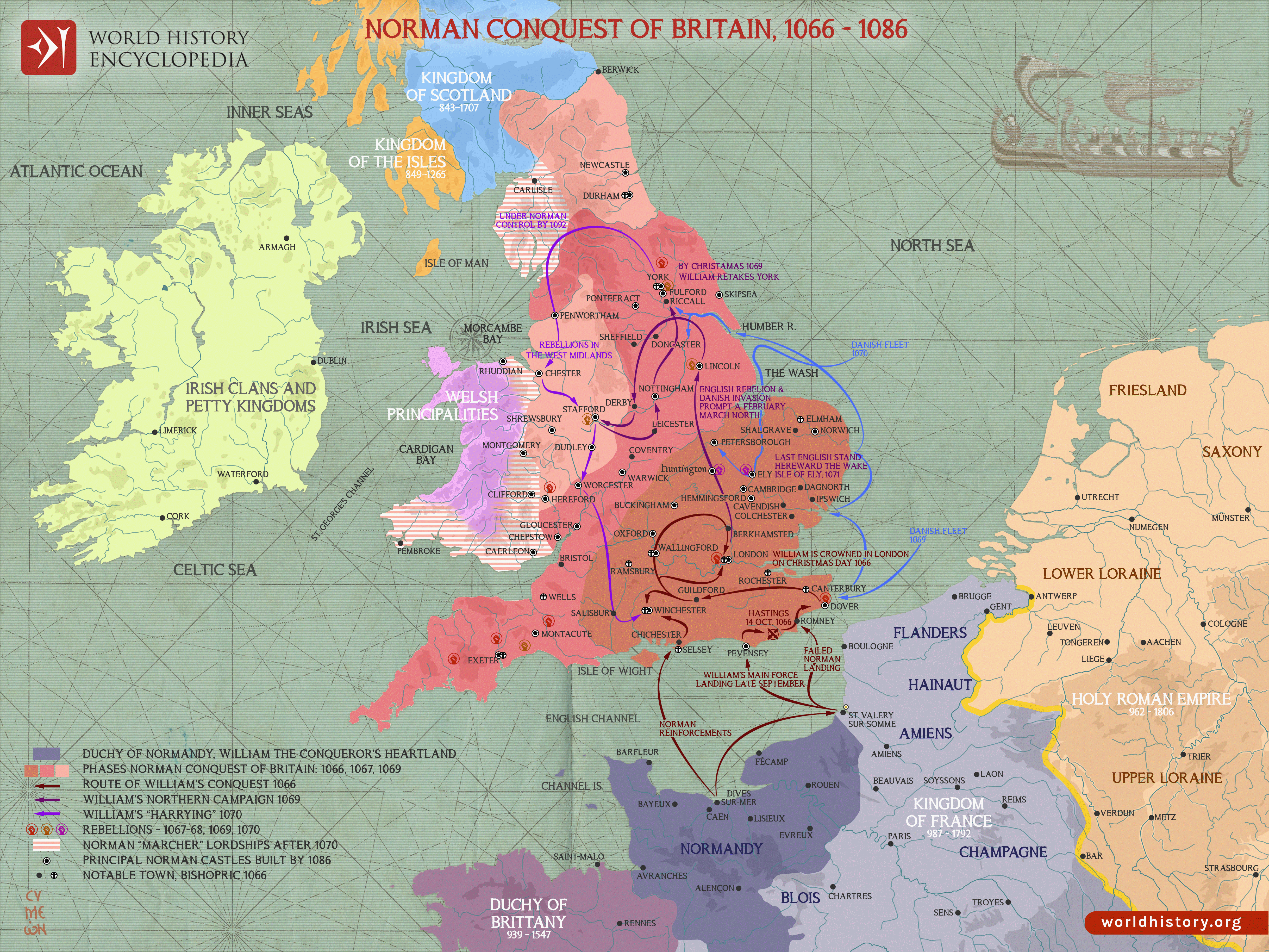
The Domesday Book of is the other key Norman association. It was a survey commissioned by William I recording the ownership, value, and resources of land in England. If the test asks which surviving sources tell us about William’s period, remember both the Bayeux Tapestry and the Domesday Book.
3. Medieval turning points: kingdoms, disease, and limits on monarchy
The medieval period is best understood as a period in which royal power expanded, but was also increasingly challenged by nobles, communities, and eventually Parliament.
| Date | Person or event | Annotation: why it matters |
|---|---|---|
| AD | Magna Carta | King John accepted a charter that established the principle that the monarch is subject to the law. |
| AD | Statute of Rhuddlan | England annexed Wales under Edward I. |
| c. AD | The Pale in Ireland | English authority was concentrated around Dublin in an area called the Pale. |
| AD | Battle of Bannockburn | Robert the Bruce defeated the English, a major victory for Scottish independence. |
| AD | Black Death | Plague killed about one-third of the population; labour shortages increased workers’ bargaining power. |
| AD | Peasants’ Revolt | A major uprising exposed tensions over taxation and social inequality after the Black Death. |
| AD | Battle of Agincourt | Henry V defeated a larger French army during the Hundred Years War. |
| AD | Battle of Bosworth Field | Henry Tudor defeated Richard III; Henry VII began the Tudor dynasty. |
Magna Carta and Parliament
Magna Carta, meaning “Great Charter,” was forced on King John by leading barons in . It did not create modern democracy, nor did it give everyone the vote. Its test significance is the principle that a ruler cannot simply act above the law.
Over time, Parliament developed into two houses:
| House | Historically included |
|---|---|
| House of Lords | Powerful nobles and senior church figures |
| House of Commons | Knights, lesser landowners, and representatives of towns and cities |
This is an early stage in a long constitutional story. At this point, political participation remained highly limited, but the idea of consultation and constraints on monarchy had become more established.
Medieval conflicts across the islands
Keep the geography from Lesson 1 active here:
- Wales: annexed to England under the Statute of Rhuddlan in .
- Scotland: Robert the Bruce defeated an English army at Bannockburn in .
- Ireland: English power existed around Dublin in the Pale, while much of Ireland remained outside direct English control.
- France: England fought the Hundred Years War; Henry V won at Agincourt in .
The selected medieval video sections are useful as a concise recap of these conflicts, social change after the Black Death, and the constitutional significance of Magna Carta.
The Middle Ages (Chapter 4) Life in the UK Test 2026 🇬🇧
Watch the selected sections of “The Middle Ages (Chapter 4) Life in the UK Test 2026” by UK Life Prep to consolidate the most testable medieval associations: Wales and the Statute of Rhuddlan, Scotland and Bannockburn, the Black Death, Magna Carta, Parliament, and common law.
Watch medieval conflicts for Wales, Scotland, Ireland, France, Bannockburn, and Agincourt. Then watch Black Death for feudalism, serfs, the plague, and its social consequences. Finish with Magna Carta for the monarch’s legal limits, the developing Houses of Parliament, and the distinction between English common law and Scottish codified law.
The Black Death is another event with a cause-and-consequence pattern worth retaining. It killed roughly one-third of the population in . With fewer workers available, labourers could demand higher wages. This helped weaken the older feudal system and contributed to the growth of a middle class and the gentry, wealthy landowners below the nobility.
4. Tudors and Stuarts: Reformation, civil war, and revolution
The Tudor and Stuart periods are densely tested because they combine major religious upheaval with decisive changes in the relationship between monarchy and Parliament.
| Date | Person or event | Annotation: why it matters |
|---|---|---|
| AD | Henry VII becomes king | Begins the Tudor dynasty after Bosworth Field. |
| AD | Henry VIII becomes king | His reign transformed the English church and state. |
| AD | Break with Rome | Henry VIII made himself head of the Church of England, beginning the English Reformation. |
| AD | Wales united with England | The Laws in Wales Act formally incorporated Wales into the English legal and political system. |
| AD | Edward VI becomes king | Protestant reforms advanced during his short reign. |
| AD | Mary I becomes queen | Restored Roman Catholicism and persecuted Protestants; remembered as “Bloody Mary.” |
| AD | Elizabeth I becomes queen | Restored a Protestant settlement in the Church of England. |
| AD | Spanish Armada defeated | England defeated an attempted Spanish invasion during Elizabeth I’s reign. |
| AD | James VI of Scotland becomes James I of England | The crowns of England and Scotland came to one monarch, though the countries kept separate parliaments. |
| AD | Gunpowder Plot | Guy Fawkes and other Catholics planned to destroy Parliament and kill James I; the plot failed. |
| AD | Civil War begins | Supporters of Charles I fought Parliamentarians over power, religion, and government. |
| AD | Charles I executed | England became a republic, the Commonwealth, for a time. |
| AD | Oliver Cromwell becomes Lord Protector | Cromwell ruled after the Civil Wars; he was not a king. |
| AD | Restoration | The monarchy returned with Charles II. |
| AD | Great Plague | A major outbreak of plague in London. |
| AD | Great Fire of London | Much of central London was destroyed. |
| AD | James II becomes king | His Catholicism and assertion of royal power created a political crisis. |
| AD | Glorious Revolution | James II was removed from power; this begins the next section of the course. |
The Reformation: the ruler–religion pattern
The fastest way to organise the Tudor religious changes is to connect each ruler with a specific direction:
| Ruler | Religious association |
|---|---|
| Henry VIII | Broke with the Pope and established the monarch as head of the Church of England. |
| Edward VI | Continued Protestant reforms. |
| Mary I | Restored Roman Catholicism and persecuted Protestants. |
| Elizabeth I | Restored the Church of England’s Protestant settlement. |
Henry VIII’s break with Rome was both religious and political. He wanted the annulment of his marriage to Catherine of Aragon, which the Pope would not grant. The break made the English monarch, rather than the Pope, supreme governor of the Church of England. It also led to the dissolution of monasteries and a major redistribution of land and wealth.
In , Elizabeth I’s England defeated the Spanish Armada. The association to retain is simple: Elizabeth I, Protestant England, defeat of Spanish Armada.
From union of crowns to civil war
When Elizabeth I died childless in , James VI of Scotland inherited the English throne as James I. This was a union of crowns, not yet a political union: England and Scotland still had separate Parliaments and legal systems.
James I survived the Gunpowder Plot in , in which Guy Fawkes and fellow conspirators intended to blow up the Houses of Parliament. The event is remembered every 5 November as Bonfire Night, though its historical context is religious and political conflict rather than merely fireworks.
The deeper conflict continued under James’s son, Charles I. Charles believed strongly in royal authority and repeatedly clashed with Parliament over taxation, religion, and the limits of his power. Civil War began in .

The Battle of Naseby, , was decisive because Parliament’s New Model Army defeated Charles I’s forces. The conflict ended with Charles I’s trial and execution in , an extraordinary constitutional rupture: a reigning English monarch was put to death by his own subjects.
England then became a republic known as the Commonwealth. Oliver Cromwell later ruled as Lord Protector. When he died, political instability followed, and the monarchy was restored in under Charles II.
James II and the threshold of modern constitutional monarchy
Charles II’s brother, James II, became king in . He was Catholic in a predominantly Protestant country and attempted to use royal power to promote Catholic toleration. Opponents feared an absolute Catholic monarchy.
In , leading politicians invited the Protestant William of Orange, husband of James’s daughter Mary, to intervene. James II fled. This is called the Glorious Revolution because the transfer of power in England involved comparatively little fighting, though conflict elsewhere in the islands was far more violent.
For this lesson, stop at the threshold: James II was removed in . Next lesson will explain how the Glorious Revolution and the Bill of Rights reshaped the balance between Parliament and the monarchy.
Your one-page timeline: final revision version
Your completed revision timeline should contain at least these anchors:
- AD : Claudius, Roman conquest
- AD : Hadrian’s Wall
- AD : Romans leave
- AD : Augustine, Christianity and Canterbury
- AD / : Viking raids and Lindisfarne
- AD / : Alfred and the Danelaw
- AD : Athelstan, unified England
- AD : Hastings, William the Conqueror
- AD : Domesday Book
- AD : Magna Carta
- AD : Wales annexed
- AD : Bannockburn, Robert the Bruce
- AD : Black Death
- AD : Agincourt, Henry V
- AD : Bosworth, Henry VII
- AD : Henry VIII and the Church of England
- AD : Spanish Armada
- AD : James VI and I, union of crowns
- AD : Gunpowder Plot
- AD to : Civil War and execution of Charles I
- AD : Restoration
- AD : Glorious Revolution, James II removed
Key takeaways
The most useful story to retain is one of changing power:
- Roman rule ended in AD , after which Anglo-Saxon kingdoms developed.
- Viking attacks led to the Danelaw; Alfred defended Wessex, while Athelstan later unified England.
- William’s victory in began Norman rule, followed by the Domesday Book in .
- Magna Carta in established that even the monarch was subject to law.
- Henry VIII’s break with Rome reshaped religion and royal authority.
- Civil War, Charles I’s execution, Cromwell’s rule, and the Restoration tested whether monarchy or Parliament would prevail.
- James II’s removal in opens the next chapter: a more durable constitutional settlement and the political development of the modern UK.
Next, you will continue from the Glorious Revolution to the present, connecting political reform, industrialisation, empire, world wars, social change, and post-war Britain.
Can't find a good explanation? Sign up and we'll make it for you
Sign up