
Hello! Welcome to your sixth lesson on the foundational history of Northern Ireland.
Introduction
Estimated time to complete: 60 minutes
In our last lesson, we explored the 1641 Irish Rebellion, a conflict born from the grievances of plantation and religious discrimination. We saw how it descended into brutal sectarian violence and how the memory of the massacres of Protestants became a foundational trauma for the Ulster-Scots community. The rebellion culminated in the formation of the Catholic Confederation, which, allied with English Royalists, controlled most of Ireland by the late 1640s.
Today, we will examine the English Parliament's devastating response. Our learning outcome is to explain the role of Oliver Cromwell's conquest of Ireland in shaping sectarian divisions. If 1641 was the foundational trauma for Ulster Protestants, the Cromwellian conquest became its equivalent for Irish Catholics. It was not just a military campaign but a revolutionary project to remake Irish society, the consequences of which would define the sectarian landscape for centuries.
For you, with your background in history and government, this lesson offers a stark case study in the use of state power to enact radical social and economic change. We will analyse the motivations, methods, and enduring legacy of a campaign that remains one of the most controversial episodes in British and Irish history.
Recap of the Previous Lesson:
- The 1641 Rebellion, driven by Catholic grievances over land and religion, escalated into the Irish Confederate Wars.
- Brutal massacres of Protestant settlers in Ulster created a powerful narrative of Catholic treachery that was amplified by propaganda in England.
- By 1649, the English Parliament, having defeated and executed King Charles I, was free to turn its full attention to the Catholic and Royalist forces in Ireland.
1. The Man and the Mission: Why Cromwell Came
To understand the events of 1649-1653, we must first understand the man who led them and the context in which he operated. Oliver Cromwell was a figure of immense contradictions: a devout Puritan who believed he was God's instrument, and a military genius who would become a military dictator. In England, he is often remembered as a parliamentary champion and revolutionary. In Ireland, his name is synonymous with massacre and oppression.
To grasp this dual legacy, let's begin with a short introduction from Professor Micheál Ó Siochrú of Trinity College Dublin, who has written extensively on this period.
Watch from 02:06 to 09:46. This segment introduces Cromwell's deeply controversial legacy and the starkly different ways he is remembered on either side of the Irish Sea. The anecdote about a modern Irish Taoiseach's reaction to Cromwell's portrait is particularly telling.
(Watching time: approx. 8 minutes)
As you've just seen, Cromwell evokes powerful emotions. He was not a typical 17th-century leader. His rise from minor gentry to the most powerful man in Britain was fuelled by profound religious conviction and an extraordinary talent for war. After the execution of King Charles I in January 1649, the new English Commonwealth faced a serious threat from Ireland, where a Royalist-Confederate alliance controlled most of the country. Cromwell was chosen to lead the invasion.
His mission had four clear objectives, which perfectly aligned with the goals of the new English Republic:
- Military: To crush the Royalist-Confederate alliance and prevent Ireland from being used as a base to restore the monarchy.
- Religious: To destroy the power of the Catholic Church in Ireland, which Puritans like Cromwell viewed as heresy and the work of the Antichrist.
- Punitive: To exact revenge for the alleged massacres of Protestant settlers in 1641, which had been the subject of intense and lurid propaganda in England for years.
- Economic: To confiscate vast tracts of Irish land to pay off the government's debts to soldiers and to the "Adventurers"—speculators who had funded the war in exchange for the promise of Irish estates.
This combination of religious zeal, political necessity, and economic incentive created the conditions for a campaign of unprecedented severity.
To solidify your understanding of this context, please read the following brief overview.
Cromwellian Conquest - Down Survey - Trinity College Dublin (The Cromwellian Conquest)
Read the section "The Cromwellian Conquest." Focus on the reasons for the invasion and the scale of the force Cromwell brought with him.
(Reading time: approx. 4 minutes)
2. The Conquest: Drogheda and Wexford
Cromwell arrived in Ireland in August 1649 with a large, professional army and a formidable siege train. He intended to make the war swift and decisive. His first major actions, the storming of the towns of Drogheda and Wexford, would come to define his entire campaign and legacy.
At Drogheda in September 1649, after the garrison refused to surrender, Cromwell's forces breached the walls and, on his orders, killed most of the defenders and any clergy they found. A month later at Wexford, a similar slaughter occurred.
Cromwell himself justified these actions in his reports to Parliament, arguing they were a "righteous judgment of God" upon "barbarous wretches" and that the terror they inspired would "tend to prevent the effusion of blood for the future." This raises a critical question for historians: were these actions war crimes, or were they consistent with the brutal laws of war of the 17th century?
The following article by historian John Morrill presents the "case for the prosecution," detailing Cromwell's own chilling accounts of the events.
Cromwell in Ireland | olivercromwell.org (The Case for the Prosecution: Atrocities and Ethnic Cleansing)
Read the section "The case for the prosecution." This powerful section uses Cromwell's own letters to build the case against him, highlighting his justification for killing non-combatants and his vision of ethnic cleansing.
(Reading time: approx. 7 minutes)
While Cromwell's defenders, including some historians, argue that his actions were within the accepted (though brutal) rules of 17th-century siege warfare, and that he was more restrained in other sieges, the events at Drogheda and Wexford were exceptional in their ferocity. They had the opposite of their intended effect: rather than terrifying the Irish into submission, they stiffened resistance, convincing many that they were facing a war of annihilation. The conflict dragged on for another three years, leading to a demographic catastrophe from war, famine, and plague that may have killed up to a quarter of the Irish population.
3. The Cromwellian Settlement: Remaking a Nation
The military conquest, brutal as it was, was only the first step. The second, and arguably more significant, was the political and social re-engineering of Ireland known as the Cromwellian Settlement. This was the mechanism through which the conquest permanently shaped sectarian divisions.
The goal was, as one contemporary put it, to create a "clean slate" in Ireland. This was achieved through the most comprehensive policy of land confiscation in Irish history. The legal framework was the Act for the Settlement of Ireland (1652). This act categorised the Catholic population by their level of guilt in the rebellion and assigned punishments accordingly, with forfeiture of land being the most common.
The result was a revolutionary transfer of property and power.
- Mass Land Confiscation: Catholic land ownership fell from around 60% in 1641 to just 8% by the 1660s. This land was redistributed to Protestant soldiers and "Adventurers."
- Transplantation: Catholic landowners who were not sentenced to death or exile were ordered to transplant themselves and their families to the poorest province, Connacht, west of the River Shannon. This gave rise to the infamous phrase "To Hell or to Connacht."
- Creation of the Protestant Ascendancy: The settlement destroyed the old Catholic landowning elite and replaced it with a new, wealthy Protestant landowning class. This Protestant Ascendancy would dominate the economic, social, and political life of Ireland for the next 200 years.
To understand the mechanics and scale of this settlement, please watch the following clip, which includes maps that vividly illustrate the change in land ownership.
Watch from 26:30 to 31:13. Focus on the demographic impact of the war and the visual representation of the massive land transfer.
(Watching time: approx. 5 minutes)
[Unknown resource ID: https://downsurvey.tchpc.tcd.ie/img/cromwellian-land-confiscation.png]
This map, based on the Down Survey, visually represents the outcome of the Cromwellian Settlement. The areas in red are the lands confiscated and redistributed to Protestant Adventurers and soldiers, while the areas in green (primarily in Connacht) are what remained for the Irish.
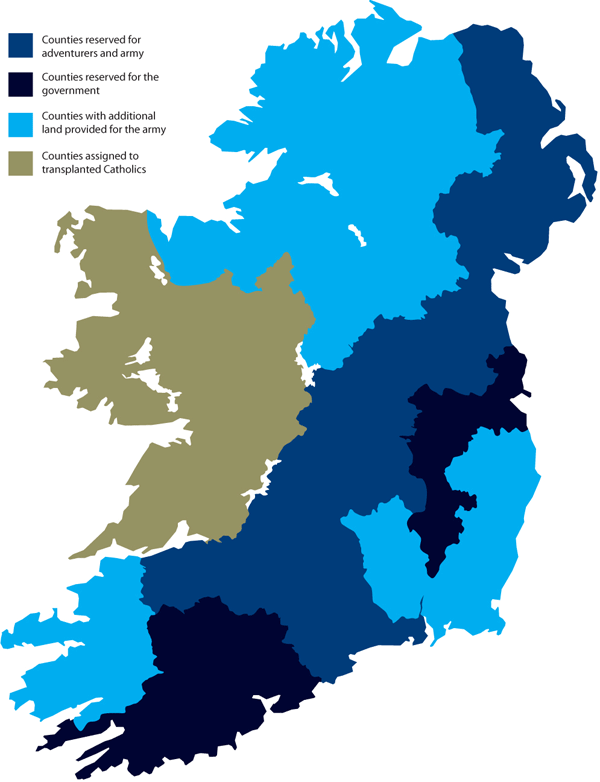
The final piece of the puzzle came after Cromwell's death. In 1660, the monarchy was restored with King Charles II. Irish Catholics hoped the new king would reverse the settlement and restore their lands. However, Charles was politically indebted to the Protestant interest in Ireland that had facilitated his restoration. The Act of Settlement of 1662 largely confirmed the Cromwellian land transfers, dashing Catholic hopes and cementing the new Protestant Ascendancy.
Cromwellian Conquest - Down Survey - Trinity College Dublin (The Cromwellian Settlement; Restoration Ireland and Long-term Impact)
Read the sections "The Cromwellian Settlement" and "Restoration Ireland and Long-term Impact." These sections detail the legal acts behind the confiscation and explain how the Restoration ultimately consolidated the changes.
(Reading time: approx. 6 minutes)
Conclusion
Today we have examined the pivotal and brutal Cromwellian conquest of Ireland. We've moved beyond the simple "curse of Cromwell" narrative to analyse the complex motivations behind the invasion, the brutal realities of the military campaign, and, most importantly, the revolutionary societal changes enacted by the Cromwellian Settlement.
Key Takeaways:
- Cromwell's invasion was driven by a potent mix of political, religious, punitive, and economic motives, all stemming from the English Civil War and the 1641 Rebellion.
- The massacres at Drogheda and Wexford, justified by Cromwell as divine retribution, became enduring symbols of English oppression in Irish nationalist memory.
- The Cromwellian Settlement was the most crucial outcome. It systematically dismantled the Catholic landowning class and created a new, dominant Protestant Ascendancy.
- This settlement fundamentally and permanently shaped sectarian divisions by linking land, wealth, and political power directly to religious identity. The social and economic structure of Ireland was now explicitly sectarian.
- The memory of the conquest created a powerful counter-narrative of Catholic victimhood, which stood in direct opposition to the Protestant memory of the 1641 massacres, deepening the island's divisions.
Preview of the Next Lesson:
The Protestant Ascendancy established by the Cromwellian Settlement would soon face its next great challenge. In our next lesson, we will analyse the significance of the Williamite War in Ireland (1689-1691). This conflict, which included the iconic Battle of the Boyne, would confirm the Protestant victory and lead to a new set of laws designed to ensure Catholic subjugation for the century to come.
Can't find a good explanation? Sign up and we'll make it for you
Sign up