
Hello! Welcome to your fourth lesson on the foundational history of Northern Ireland.
Introduction
Estimated time to complete: 60 minutes
In our last lesson, we traced the brutal, century-long Tudor conquest of Ireland. This process culminated in the defeat of the Gaelic lords at the Battle of Kinsale and the symbolic end of the old Gaelic order with the "Flight of the Earls" in 1607. This event left a power vacuum in Ulster and vast tracts of land confiscated by the Crown, setting the stage for one of the most consequential events in Irish history.
Today, we will examine that event. Our learning outcome is to define the 'Plantation of Ulster' and explain its long-term demographic and social impact.
This is not just another historical episode; it is the deliberate creation of a new society. For you, with your background in history and government, this lesson offers a fascinating case study in state-sponsored colonisation, social engineering, and the profound, centuries-long consequences of government policy. The Plantation of Ulster is arguably the single most critical event for understanding the demographic, political, and cultural landscape of modern Northern Ireland.
Recap of the Previous Lesson:
- The Tudor conquest ended with the defeat of Hugh O'Neill and his allies.
- The "Flight of the Earls" in 1607 saw the Gaelic leadership of Ulster flee to the continent.
- Their lands in Ulster were declared forfeit and seized by King James I.
1. The Context: Why Plant Ulster?
With the Gaelic lords gone and their lands in his possession, King James I (James VI of Scotland) had a unique opportunity. Ulster, the heartland of the recent Nine Years' War, was seen as a rebellious, "barbarous" region that needed to be permanently secured and 'civilised'. James, who had experience with what he considered troublesome Gaels in the Scottish Highlands, revived the policy of plantation, but on a scale and with a level of systematic planning never seen before.
To get a concise overview of the causes and the overall scheme, please watch the following video segment.
Focus on the context following the Nine Years' War, the Flight of the Earls, and King James I's plan for the plantation, including the different types of planters. (Viewing time: approx. 2 minutes)
2. Defining the Plantation: The Official Scheme
The Plantation of Ulster was a government policy, a detailed plan to re-engineer a province. It was not a haphazard migration but a structured colonial project.
At its core, the Plantation of Ulster was the organised colonisation of six counties in the province of Ulster with loyal, Protestant settlers from England and the Scottish Lowlands. The aim was to replace the "disloyal" Catholic Gaelic population with a new society that would be loyal to the Crown, Protestant in religion, and English in culture and law.
To understand the specific details of this ambitious government scheme, please read the following sections from a study pack on the Plantation. This resource provides excellent detail on the 'policy' aspect of the event.
The Plantation of Ulster Document Study Pack Staidéar ... (Ulster before Plantation; The Scheme for Plantation; The Grantees and London Companies)
Read the sections "Ulster before Plantation," "The Scheme for Plantation," and "The Grantees." Focus on:
- The six counties involved.
- The division of land into estates of different sizes.
- The three main categories of grantees: Undertakers, Servitors, and the 'deserving' Native Irish.
- The specific conditions attached to the grants, such as building defences and bringing over British tenants.
- The special role of the London Companies in planting County Londonderry.
(Reading time: approx. 12 minutes)
The map below clearly shows the six counties that were part of the official Plantation scheme, known as the "escheated counties," alongside the counties of Antrim and Down, which were undergoing a separate, private plantation by Scottish landlords at the same time.
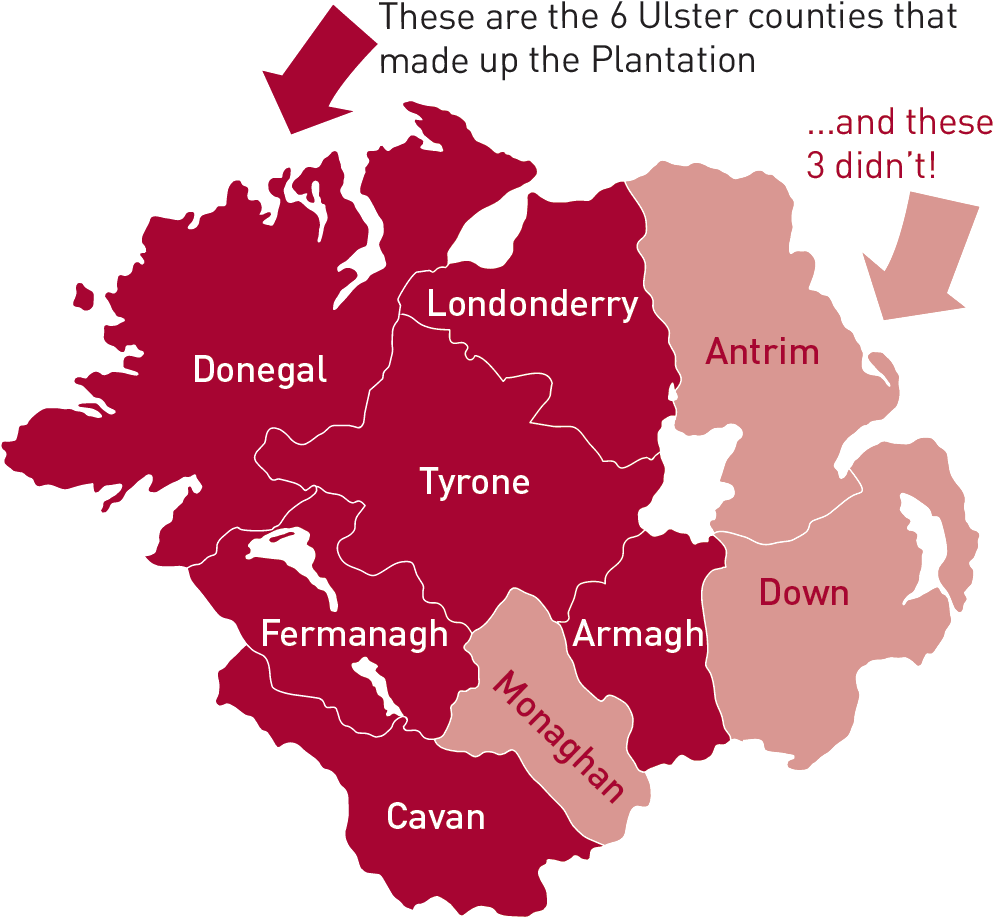
This map shows the six counties of the official Plantation of Ulster: Donegal, Coleraine (renamed Londonderry), Tyrone, Armagh, Fermanagh, and Cavan.
3. The Reality on the Ground: A New Society and Landscape
The plan on paper was clear: remove the Irish and replace them with British settlers. The reality was far more complex.
Many Undertakers found it difficult and expensive to attract tenants from Britain and discovered that the native Irish, desperate to remain on their ancestral lands, were willing to pay higher rents. While the policy did not succeed in completely removing the native population, it did succeed in dispossessing them. The Irish who remained were largely relegated to the status of landless labourers or tenants on the poorest quality land, often in upland and boggy areas.
This created a new, religiously and ethnically defined social hierarchy.
At the same time, the Plantation dramatically reshaped the physical and economic landscape of Ulster.
Please read the following sections, which describe the implementation of the plantation and its immediate effects.
How the Plantation of Ulster Transformed Irish Society (Impact on the Gaelic Irish; Expansion and Growth)
Read the sections "Impact on the Gaelic Irish" and "Expansion and Growth." Focus on the segregation of the native population onto poorer land and the development of new towns, fortifications, and a commercial economy. (Reading time: approx. 5 minutes)
The video below offers a powerful narrative of this process, encouraging you to consider the perspectives of both the incoming settlers and the dispossessed Irish.
Watch this segment for a vivid description of the plantation process and the immediate social tensions it created. The presenter does an excellent job of conveying the human experience behind the policy. (Viewing time: approx. 3 minutes, 40 seconds)
4. The Long-Term Impact: A Legacy of Division
The Plantation of Ulster was the most successful of the Irish plantations, and its consequences have profoundly shaped the history of the island for the last 400 years.
1. Demographic Transformation:
The most direct and enduring legacy was the creation of a large, concentrated Protestant community in the north-east of Ireland. The influx of tens of thousands of English and, in particular, Scottish Presbyterian settlers created a new demographic reality. This community was distinct in religion, culture, and political allegiance from the majority Catholic population of the rest of the island.
2. Enduring Sectarian Division:
The plantation established a society structured along sectarian lines. Land ownership, political power, and economic advantage were concentrated in the hands of the new Protestant settler class. The native Catholic Irish were largely dispossessed and marginalised. This fusion of religious identity with economic and political status created deep-seated resentment and division that would become a defining feature of Ulster society.
3. A Foundation for Future Conflict:
These divisions inevitably led to conflict.
- The 1641 Rebellion: Less than a generation after the plantation began, a major rebellion broke out, partly driven by dispossessed Catholics seeking to reclaim their land. The massacres of Protestant settlers during this rebellion became a foundational trauma in the Ulster Protestant psyche, fostering a "siege mentality" that persists to this day.
- The Williamite War (1689-91): The descendants of the planters sided with the Protestant King William of Orange against the Catholic King James II. Events like the Siege of Derry and the Battle of the Boyne became—and remain—central pillars of Ulster Unionist identity and commemoration.
- The Partition of Ireland (1921): The demographic reality created by the plantation was the primary reason for the partition of Ireland in 1921. The six counties with a significant Protestant population were carved out to create Northern Ireland, ensuring a continued Unionist majority within the new state.
- The Troubles (c. 1968-1998): The grievances, inequalities, and segregated identities established by the plantation were a fundamental root cause of the violent conflict of the late 20th century.
To tie all these long-term consequences together, please read the concluding section of the article from The Collector.
How the Plantation of Ulster Transformed Irish Society (Effects Still Felt Today)
This section, "Effects Still Felt Today," explicitly connects the plantation to the 1641 Rebellion, the Williamite War, the partition of Ireland, and the Troubles. It perfectly summarises the long-term impact. (Reading time: approx. 3 minutes)
As the presenter of the Scotland History Tours video astutely points out, the political dilemmas created by this 400-year-old policy are still being grappled with today, even in contexts like Brexit.
This final clip makes the direct link between the legacy of the Plantation and the complex political challenges of modern Northern Ireland. (Viewing time: approx. 2 minutes)
Conclusion
Today we have defined the Plantation of Ulster as a systematic, state-sponsored colonial project and traced its profound and lasting consequences. We have seen how a 17th-century government policy did more than just move people around—it created a new society, a new landscape, and a legacy of division that has defined the history of Northern Ireland.
Key Takeaways:
- The Plantation of Ulster was the organised colonisation of six Ulster counties with Protestant settlers from England and Scotland, following the Tudor conquest and the Flight of the Earls.
- The scheme was a detailed government policy to create a loyal, Protestant society by confiscating land from the native Catholic Irish and granting it to Undertakers, Servitors, and the London Companies.
- In practice, the plantation resulted not in a total replacement of the population, but in the dispossession and segregation of the native Irish, creating a new social hierarchy based on religion and ethnicity.
- The long-term demographic impact was the creation of a large, permanent Protestant community in the north-east of Ireland.
- The long-term social impact was the establishment of deep-seated sectarian divisions and a legacy of conflict, from the 1641 Rebellion to the 20th-century Troubles, which was the ultimate justification for the partition of Ireland.
Preview of the Next Lesson:
The Plantation of Ulster created a powder keg. In our next lesson, we will examine the first major explosion: the 1641 Irish Rebellion. We will explore the causes of this brutal conflict and its key events, which became foundational to the historical memories and identities of both communities in Ulster.
Can't find a good explanation? Sign up and we'll make it for you
Sign up