
Good to see you again. In the previous lesson, you learned to measure mass and volume, choose a method for regular or irregular objects, and find density from the gradient of a mass–volume graph. This final lesson connects density to everyday behaviour: why warm air rises, why ice floats, why steel ships can float, and how to calculate how much of a floating object is underwater.
By the end, you should be able to explain density changes using particles, compare densities to predict sinking or floating, and use a density ratio to find the submerged and visible fractions of a floating object.
1. Temperature, particle spacing, and density
Start with the equation you already know:
Density changes if the mass changes, the volume changes, or both. In most temperature questions, consider the same amount of substance: its mass stays constant, but its volume can change.
When a substance is heated, its particles gain kinetic energy and move or vibrate more. Their average spacing tends to increase, so the substance expands.
- Same mass
- Larger volume
- Lower density
When it cools, the reverse usually happens: particle spacing decreases, volume decreases, and density increases.
The word usually matters. Water has an important exception that often appears in tests.
What is density and how is it different for solids, liquids and gases? - BBC Bitesize
Read BBC Bitesize’s explanation of particle arrangements and density changes. It gives the particle-level explanation needed for temperature and state-change questions, then applies relative density to floating and rising.
In the section “Does changing the temperature or the state of a material change its density?”, read the heating explanation. Focus on the chain: heating increases particle spacing, which increases volume while mass stays unchanged. Then, in “Sinking and floating,” read the floating examples. Notice that “float” applies in gases too: hot air rises because it is less dense than colder surrounding air.
Changes of state
The same particle-spacing idea explains changes of state.
| Change | Particle spacing and volume | Usual density change |
|---|---|---|
| Solid melts to liquid | Particles can move more freely; volume usually increases | Density decreases |
| Liquid freezes to solid | Particles usually become more closely packed | Density increases |
| Liquid evaporates or boils to gas | Particles become very far apart; volume increases enormously | Density decreases greatly |
| Gas condenses to liquid | Particles come much closer together | Density increases greatly |
For the same mass of material, gases are usually far less dense than liquids, and liquids are usually less dense than solids. This is why a balloon filled with hot air can rise: its average density becomes lower than that of the cooler air around it.
However, never write “solids are always denser than liquids.” Ice disproves that statement.
2. Water: the high-value exception
Most substances become denser as they cool and solidify. Water behaves differently near freezing.
- Liquid freshwater has its maximum density at about .
- Cooling water from to makes it denser.
- Cooling it further from to makes it slightly less dense.
- When water freezes, ice forms an open crystal structure, with more space between molecules.
- Ice therefore has a lower density than liquid water, so it floats.
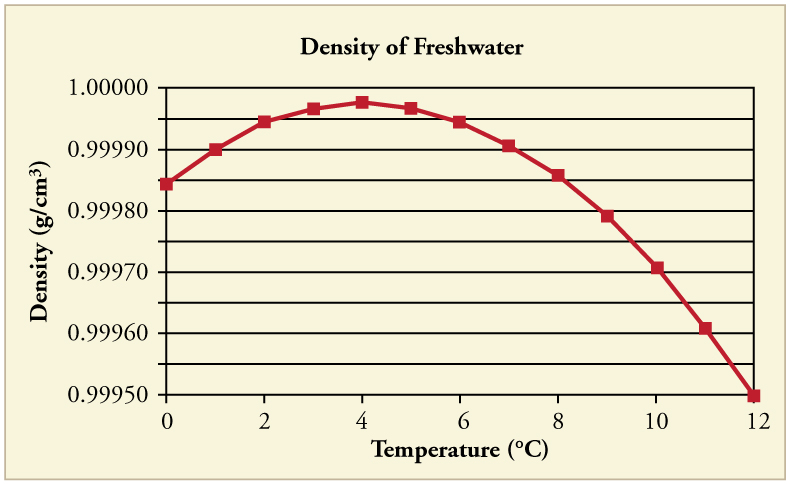
This has an important environmental consequence. In winter, surface water cools first. Water at sinks because it is denser than the water around it. Once the surface cools below , it becomes less dense, stays at the top, and may freeze. The ice floats and forms an insulating layer, leaving liquid water beneath it.
Test-ready explanation:
Water reaches its maximum density at . Below this temperature, its molecules arrange into a more open structure, increasing volume for the same mass. Therefore its density decreases. Ice is less dense than liquid water, so it floats.
Watch “What Is Density?” by The Organic Chemistry Tutor for a concise visual review of the ice-water exception, density comparisons, floating, and warm air rising.
Watch ice floating for the key comparison between ice, water, and iron. Then watch floating fractions for the link between a density ratio and the amount submerged. Finish with warm air, focusing on the constant-mass, changing-volume explanation.
3. Sink, float, or remain suspended
To predict what happens when an object is put into a liquid, compare its density with the liquid’s density.
| Relative densities | What happens |
|---|---|
| The object sinks | |
| The object floats | |
| The object is neutrally buoyant: it can remain suspended |
For example, freshwater has density approximately:
An object of density floats in freshwater. An object of density , such as aluminium, sinks in freshwater.
The comparison must always be with the fluid involved, not merely with water:
- Steel sinks in water because steel is denser than water.
- Steel can float in mercury because mercury is denser than steel.
- A ship floats because the density of the whole ship, including its air-filled spaces, is less than the density of water.
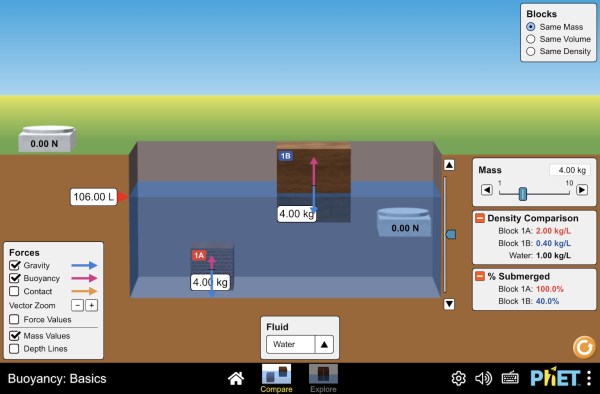
A useful way to think about this is that shape can alter an object’s average density. A solid steel ball has little volume for its mass, so it sinks. The same steel reshaped into a hollow ship encloses much more volume without adding much mass, lowering the average density.
The force explanation
There are two main vertical forces on an object in a fluid:
- Weight, acting downward.
- Buoyant force (upthrust), acting upward because the fluid pushes on the object.
For an object that is initially fully submerged:
- If weight is greater than buoyant force, it accelerates downward and sinks.
- If buoyant force is greater than weight, it rises.
- If the forces are equal, it is neutrally buoyant.
A floating object settles at a depth where the upward buoyant force exactly balances its weight. That force balance leads directly to the fraction-submerged formula.
Physics Tutorial - Fluids - Pressure - Sinking and Floating
Read the Physics Classroom explanation to connect density comparisons to the forces of weight and buoyancy. The final portion derives the formula for the fraction of a floating object below the surface.
In “What Makes an Object Sink or Float?”, read the force comparison, then follow the three cases of sinking, floating, and neutral buoyancy. In “Percent Submerged,” read from the iceberg discussion. Focus on why a floating object is in equilibrium: buoyant force equals weight.
4. Calculating the fraction below and above the surface
For a floating object:
This only applies if the object floats freely in one fluid. Do not use it blindly for an object that sinks, is held underwater, or rests on the bottom.
To convert a fraction to a percentage:
The fraction above the surface is what remains:
Or, as a percentage:
Why this formula works
For a floating object, the upward buoyant force equals its weight.
The buoyant force depends on the density of the fluid and the submerged volume:
The object’s weight depends on its density and its total volume:
Since the object floats:
Dividing by , , and gives:
You do not usually need to derive this in a Grade 10 test, but understanding it helps you remember it correctly: a denser object needs more of its volume underwater to displace enough fluid to balance its weight.
Worked example: wooden block in water
A wooden block has density:
It floats in freshwater of density:
First, confirm that it floats:
Now find the submerged fraction:
So:
The fraction above water is:
Therefore:
Worked example: ice in freshwater
Ice has density:
Freshwater has density:
Therefore:
This is the physics behind the phrase “the tip of the iceberg.”
Same object, different liquid
Ice floats slightly higher in seawater because seawater is denser than freshwater.
So about is submerged and about is above the seawater surface.
Key rule: A floating object sits higher in a denser liquid. It needs to displace less volume of that denser liquid for the buoyant force to equal its weight.
How To Calculate The Fractional Volume Submerged & The Density of an Object In Two Fluids
Watch “How To Calculate The Fractional Volume Submerged & The Density of an Object In Two Fluids” by The Organic Chemistry Tutor to see the fraction-submerged equation derived and then used in calculations.
Watch iceberg method for the derivation and a seawater example. Then watch reverse calculation to see how a known submerged percentage can be used to find an object’s density. You can stop there; the later two-fluid problem is beyond the core test skill.
5. Common test traps and how to avoid them
“Heavy things sink”
Not necessarily. Density, not mass alone, determines whether something sinks or floats.
A large wooden log can be much heavier than a small steel pin, but the log floats and the pin sinks in water.
“All solids sink in liquids”
False. Ice is solid water, yet it floats on liquid water because its density is lower.
Using the fraction formula for a sinking object
If:
the calculation gives a fraction greater than , which would mean more than submerged. That is your warning that the object does not float: it sinks and becomes fully submerged.
Forgetting that water is unusual
The safest statement is:
Most materials become less dense when heated and more dense when cooled. Water is unusual near and when it freezes: ice is less dense than liquid water.
Mixing up above and below
Once you have found the submerged fraction, always subtract from , or from , to find the amount above the surface.
6. A rapid exam-answer structure
For an explanation question, use cause, volume, density, result:
When the substance is heated, its particles move more and become further apart. Its volume increases while its mass stays the same, so its density decreases. It is then less dense than the surrounding fluid and rises or floats.
For a sinking-or-floating question:
- State both densities with units.
- Compare them.
- State the outcome.
For example:
The object has density , which is less than water’s density of . Therefore, it floats.
For a fraction question:
- Check that the object is less dense than the liquid.
- Use the density ratio for the fraction submerged.
- Convert to a percentage if requested.
- Subtract from for the percentage above the surface.
You have now completed the density test sprint. The central ideas are:
- Heating usually increases volume at constant mass, so density decreases.
- Changes of state alter particle spacing and therefore density.
- Water is exceptional: it is densest at about , and ice is less dense than liquid water.
- Compare object density with fluid density to decide whether it sinks, floats, or is neutrally buoyant.
- For a freely floating object:
For tomorrow, make sure you can explain each answer using density comparisons, not just state “it floats” or “it sinks.”
Can't find a good explanation? Sign up and we'll make it for you
Sign up