
End-to-End Oracle Cloud SCM Planning and Module Integration
Hello. This capstone module turns the detailed configuration and troubleshooting knowledge from the course into concise senior-consultant interview communication. The aim is not to list Oracle features; it is to explain a coherent planning solution, identify the integration boundaries, and show the controls that make the solution trustworthy.
In this lesson, you will build a five-minute explanation that connects source transactions, collections, Demand Management, Supply Planning, Replenishment Planning, execution, and feedback. By the end, you should be able to adapt the explanation to a manufacturer, distributor, or retail-style inventory scenario without implying that every customer needs every Planning module.
A useful 40-minute plan is:
- Study the two short Oracle references for 12 minutes.
- Work through the solution narrative and model answer for 15 minutes.
- Tailor and deliver the answer aloud twice for 10 minutes.
- Use the self-review checklist for 3 minutes.
Start with the architecture, not the modules
A strong end-to-end explanation starts with the business outcome: the organization needs a reliable, time-phased view of expected demand and a feasible, executable response to that demand.
Oracle Planning works because it separates three concerns:
- Demand Management estimates future demand and provides governed forecast measures.
- Supply Planning determines how to satisfy demand across a supply network, considering inventory, sourcing, lead times, material structures, resource capacity, and supply constraints.
- Replenishment Planning determines inventory replenishment for item-location combinations using replenishment policies, service targets, safety stock, reorder points, calendars, sourcing, and order constraints.
These functions use planning data, not isolated local spreadsheets. Source data is collected into the planning data repository, where plans can use a consistent representation of item, organization, customer, supplier, calendar, demand, and supply information.
How You Collect Different Data Types for Supply Chain Planning
Read Oracle’s overview to anchor your interview explanation in the distinction between reference, demand, and supply data, and in the applications that own each type of data.
In the sections “Reference Data,” “Demand Data,” and “Supply Data,” begin with the three data categories. Then focus on why items, organizations, customers, suppliers, and calendars are prerequisites for planning. Read the demand-source discussion from “Demand Data” through the statement on shipment history, and finish the “Supply Data” subsection, especially the supply inputs from Inventory Management, Manufacturing, and Purchasing. As you read, classify each data element as a planning input, a planning output, or an execution transaction.
In an interview, this source-to-repository boundary matters. It demonstrates that you understand that a poor plan is often a data, collection, or master-data problem before it is an algorithm problem.
The data foundation in one sentence
Use this formulation:
“We collect validated reference data, open demand, historical demand, inventory, and open supply from the Fusion execution applications into the planning data repository; Demand Management turns demand signals into a forecast, and supply or replenishment plans turn the approved demand and supply position into actionable recommendations.”
That sentence gives a clear system boundary. Then explain the modules.
Explain the demand-to-supply connection
Demand Management takes historical and current demand signals and produces a forecast at the agreed planning grain, such as item, customer, organization, and week or month. A functional consultant must establish the forecast’s scope, measures, hierarchy, time levels, forecast method, and review workflow.
The key governance distinction is between a forecast that planners are still adjusting and a forecast that has been approved for downstream use. The approved forecast gives Supply Planning and Replenishment Planning a stable demand signal for an agreed planning cycle.
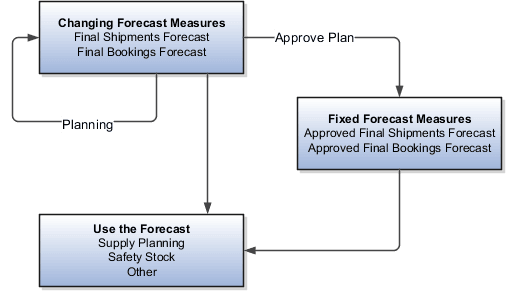
When explaining this, avoid saying that forecasting simply “creates demand.” Demand already exists in several forms:
- Shipment or booking history helps generate the forecast.
- Sales orders are current, more certain demand.
- Transfer orders can represent internal demand between locations.
- Forecast represents expected future demand not yet covered by firm orders.
The planning design must decide how these signals interact. In particular, forecast consumption prevents a firm order from being treated as additional demand on top of the forecast it represents. That is a high-value point in interviews because it shows you recognize the double-counting risk.
Transfer orders need equally deliberate treatment. If both source and destination organizations are planned together, planning can already model the transfer relationship; creating a separate transfer forecast could duplicate demand. But when the business needs to forecast demand at a source organization without planning the destination organization, a transfer forecast can be appropriate.
Set Up Forecast Consumption for Transfer Orders
Read this Oracle guidance as a concrete example of cross-module demand design. It shows that transfer-order treatment depends on plan scope and is not a simple “include everything” decision.
First read the opening section “Set Up Forecast Consumption for Transfer Orders.” Focus on the scope decision: whether source and destination organizations are both in the plan changes whether a transfer forecast is appropriate. Then read “Consumption of Forecasts Based on Transfers by Planning Central and Supply Planning,” beginning at the downstream consumption explanation. Notice that Supply Planning receives the demand-plan forecast and uses transfer demand to consume it at the transfer-from organization when the relevant option is enabled.
A senior-level answer does not need to recite page names or setup fields here. It should say: “I confirm the demand grain, plan scope, and consumption design so sales orders or interorganization transfers do not inflate net demand.”
Choose the right downstream planning path
After Demand Management produces a forecast, the business may use Supply Planning, Replenishment Planning, or both. The choice depends on the operating model.
Supply Planning is appropriate when the business needs a network-wide, time-phased supply response. It can evaluate:
- on-hand, in-transit, and open supply;
- make, buy, and transfer sourcing;
- bills of material and work definitions;
- supplier and manufacturing lead times;
- capacities and material constraints; and
- planned supply recommendations such as purchase, transfer, or work orders.
Replenishment Planning is appropriate when the core business problem is maintaining inventory availability at item-location level according to a replenishment policy. It is commonly central for distribution, retail, spare-parts, and high-volume replenishment models. The plan calculates projected inventory and recommends replenishment based on policies such as safety stock and reorder points, as well as sourcing, lead times, calendars, and order modifiers.
The two are complementary rather than automatically interchangeable. For example:
- A distributor may use Demand Management to forecast demand at distribution centers and Replenishment Planning to maintain inventory availability at warehouses or stores.
- A manufacturer may use Demand Management for the demand signal and Supply Planning to translate it into constrained component procurement and production recommendations.
- A multi-echelon enterprise may use Replenishment Planning for downstream stocking locations and Supply Planning for upstream manufacturing and procurement, with deliberate scope and handoff design.
The following integration diagram is useful because it places Buyer Planning and Procurement in the execution portion of the story.
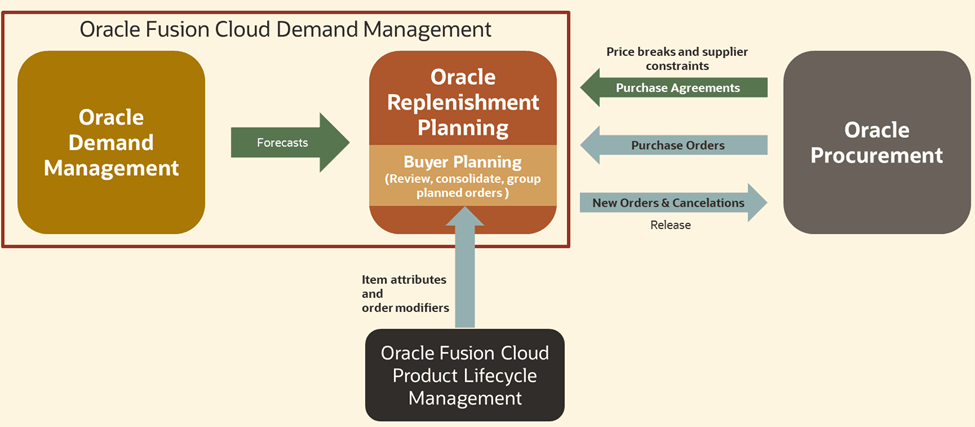
In your explanation, be accurate about what the diagram suggests:
- Product Lifecycle Management contributes item attributes and order modifiers that influence planning behavior.
- Procurement supplies commercial and execution information such as purchase agreements, supplier constraints, and purchase-order status.
- Buyer Planning supports the review, consolidation, and grouping of planned orders before procurement action.
- Execution results, such as purchase orders, receipts, inventory movements, and manufacturing progress, become new planning inputs after collection.
This is a closed planning cycle, but it is not fully automatic. Review and release controls remain important, especially where supplier commitments, capacity feasibility, or exception resolution require planner judgment.
A five-minute answer structure
Use five deliberate moves. Each move serves a different interview purpose.
| Approximate time | What to cover | What it proves |
|---|---|---|
| 0:00–0:35 | Business objective and solution scope | You start from requirements, not screens |
| 0:35–1:20 | Source systems, collection, and planning repository | You understand data lineage |
| 1:20–2:05 | Demand Management and forecast approval | You understand demand governance |
| 2:05–3:25 | Supply Planning and/or Replenishment Planning | You can select modules based on operating model |
| 3:25–5:00 | Release, execution feedback, controls, and implementation approach | You understand delivery and operational ownership |
Do not attempt to mention every setup object in five minutes. A senior response is selective: it communicates the architecture, the main dependencies, a control point, and the operational result.
Model five-minute response
Use the following as a spoken framework, not a script to memorize word for word. Replace the example operating model with the scenario in the interview question.
“I would design the Oracle Fusion SCM Planning solution around a single demand-to-execution cycle. The objective is to create a trusted demand signal, translate it into inventory and supply actions, and continuously refresh the plan with execution results.
The foundation is the planning data repository. We collect reference data such as items, organizations, calendars, customers, suppliers, sourcing relationships, and relevant item planning attributes. We also collect demand and supply transactions. Demand inputs include historical shipments or bookings and open sales orders. Supply inputs include on-hand inventory, reservations, transfer orders, in-transit supply, purchase orders, and manufacturing work orders. Before building plans, I validate that the item-organization setup, sourcing, lead times, calendars, and order modifiers support the intended flow.
In Demand Management, we configure the demand plan at the right level of detail, for example item, customer, organization, and week. The plan uses demand history and any agreed business adjustments or causal inputs to generate a forecast. Planners review the changing forecast measures, investigate exceptions and forecast accuracy, and approve the final forecast measure for downstream planning. I also define forecast consumption correctly, so firm sales orders consume the forecast in the applicable buckets rather than being added to it.
From there, I choose the downstream plan based on the operating model. For a manufacturing or complex distribution network, Supply Planning uses the approved forecast, sales orders, inventory, open supply, sourcing rules, bills of material, work definitions, capacities, and lead times to recommend make, buy, or transfer supply. It gives planners exceptions and pegging to explain shortages and recommendations.
For policy-driven inventory locations, I use Replenishment Planning. It converts the demand signal and current inventory position into replenishment recommendations based on the item-location policy, service level or safety-stock requirement, reorder point, sourcing, lead time, calendar, and order constraints. In a connected model, replenishment can manage downstream inventory availability while Supply Planning manages upstream production or procurement feasibility.
Recommendations are not the end of the process. Planners review exceptions and release eligible planned orders. Buyer Planning can help consolidate and group purchase recommendations, while Procurement manages supplier agreements, purchase orders, and releases. Manufacturing and Inventory execute the resulting work, receipts, and movements.
Finally, that execution data is collected back into planning for the next cycle. My main controls are collection monitoring, master-data validation, approved forecast governance, forecast-consumption design, plan exceptions, and reconciliation from forecast through demand, inventory, supply, and released orders. That gives the client a traceable process rather than separate demand, supply, and replenishment plans.”
Notice the deliberate qualifications:
- “I choose the downstream plan based on the operating model.”
- “In a connected model” rather than claiming all companies run both plans.
- “Eligible planned orders” rather than implying unconditional release.
- “My main controls” to show implementation ownership, not merely process knowledge.
Make the response sound like implementation experience
A functional-consultant answer becomes senior-level when it identifies dependencies and trade-offs. Add only one or two of these statements, where relevant:
| If the interviewer emphasizes... | Add this point |
|---|---|
| Data quality | “I start with collection completeness and planning master data because an incorrect calendar, lead time, sourcing assignment, or item attribute can look like a planning-engine issue.” |
| Forecast versus orders | “I confirm the forecast-consumption design by demand type and time bucket so near-term sales orders do not cause a second demand signal.” |
| Internal transfers | “I validate whether both ends of an internal transfer are in plan scope before including transfer forecasts, because the wrong design can double-count demand.” |
| Procurement | “I distinguish the planning recommendation from procurement execution: constraints and agreements affect what can be planned, while release and purchasing processes create the executable document.” |
| Replenishment | “I separate forecasting demand from setting the inventory response; the forecast estimates future consumption, while replenishment policy determines the stock and order response at each location.” |
| Implementation delivery | “I establish reconciliation criteria before testing: collected source values, forecast measures, net demand, projected inventory, planned supply, and released order quantities must be traceable across the process.” |
Avoid overclaiming. For example, do not say that Demand Management automatically resolves supply constraints, or that Replenishment Planning replaces manufacturing planning in every environment. State the business decision, the planning scope, and the governing setup instead.
Delivery practice: make it interview-ready
Use your practice environment or a simple one-page diagram while rehearsing. Sketch five labeled areas: source applications, planning data repository, Demand Management, Supply or Replenishment Planning, and execution. Under each area, add only the two or three data objects you would mention aloud.
Then record two spoken attempts:
- First delivery: use the model structure, speaking at a measured pace. Aim for four and a half to five minutes.
- Second delivery: change the scenario to a business you choose, such as a make-to-stock manufacturer with regional distribution centers. State why Supply Planning, Replenishment Planning, or both are appropriate.
Use this self-review checklist afterward:
- I opened with the business objective, not a product list.
- I named the planning data repository and the source data categories.
- I explained forecast approval and consumption.
- I distinguished Supply Planning from Replenishment Planning.
- I described recommendation review, release, and execution feedback.
- I included at least one control against bad data or double counting.
- I did not imply that all Planning modules must always be deployed together.
- I ended with traceability and the recurring planning cycle.
Key takeaways
An effective end-to-end explanation has a clear backbone:
- Collections bring reference, demand, and supply data into the planning data repository.
- Demand Management creates and governs the forecast demand signal.
- Supply Planning plans network supply feasibility; Replenishment Planning plans policy-driven inventory replenishment; many solutions use one, while some deliberately connect both.
- Forecast consumption and transfer-order design are important safeguards against double-counting demand.
- Planning recommendations require review and release before Procurement, Manufacturing, and Inventory execute them.
- Execution results are recollected, allowing the next planning cycle to reflect reality.
Next, you will practice structuring a configuration-design answer: clarifying the requirement, stating assumptions, and explaining the trade-offs before recommending Oracle setup decisions.
Can't find a good explanation? Sign up and we'll make it for you
Sign up