
Hello. You now have a controlled simulated EDV package baseline, a named Onshape version, and a Baseline Manifest. The next professional habit is to use that configuration to make a decision—not merely to present CAD.
A design review is a structured decision forum. Its purpose is to determine whether a defined product baseline is mature enough for a stated next step, what conditions apply, and who owns the work needed to close remaining uncertainty. In this course, the review is explicitly based on the assumed Rivian-built Amazon EDV context, not on proprietary vehicle information.
By the end of this lesson, you will be able to prepare and run a concise preliminary design review (PDR) or critical design review (CDR) using five connected controls: a controlled presentation, decision log, risk register, assumptions log, and action tracker.
A review is a decision against a controlled baseline
The previous lesson distinguished an editable workspace from a controlled version, a released revision, and a baseline. A review must refer to one of those controlled configurations. Otherwise, attendees may be discussing different CAD states, different requirement interpretations, or different sets of open issues.
For the current simulated vehicle-context review, use:
- Review ID:
EDV-REV-PDR-001 - Review purpose: authorize the assumed EDV package context for component concept development
- Product baseline:
BASE-VEH-G1-01 - CAD authority:
EDV-SIM-VEH-PKG,V0.2_G1_Package_Baseline - Assumptions authority:
EDV-SIM-VEH-ASM-001 Rev A - Interface authority:
EDV-SIM-VEH-ICM-001 Rev A
The review deck is itself a controlled document. For example, label the title slide and the exported PDF:
EDV-REV-PDR-001 Rev A
PDR candidate presentation
Baseline:BASE-VEH-G1-01
Date, author, and review chair
That label does not release the CAD or authorize tooling. It tells the review board exactly what evidence was considered when it made its decision.
PDR and CDR answer different questions
Both reviews use the same control structure, but their expected maturity differs.
| Review | Core decision | Evidence expected for this course |
|---|---|---|
| Preliminary Design Review (PDR) | Is the proposed technical direction credible enough to proceed into detailed design? | Requirements baseline, concept rationale, package and interface definition, initial feasibility, key trades, assumptions, risks, verification approach, development plan |
| Critical Design Review (CDR) | Is the detailed definition mature enough to proceed into the authorized build, validation, or release activity? | Mature CAD and interfaces, drawings, manufacturing assessment, detailed verification evidence or plan, unresolved-risk disposition, configuration status, approval conditions |
A PDR should not pretend that every dimension, supplier, mold feature, and test result has been finalized. Conversely, a CDR should not rely mainly on broad concept sketches and unsupported confidence statements.
For the present G1 vehicle-context baseline, a PDR is the appropriate review. The decision is not “the EDV is designed.” It is closer to:
Authorize the ECU housing, door-trim carrier, and HVAC-outlet teams to begin component concept design using
BASE-VEH-G1-01, subject to stated package-assumption closure conditions.
This wording defines the scope and prevents later misuse of a concept baseline as a production-authorized vehicle definition.
Use independent-review discipline without copying a NASA process
NASA’s Standing Review Board Handbook is not an automotive standard and should not be treated as one. Its review logic is nevertheless useful: assess readiness before the event, review against stated criteria, record findings clearly, and use closed-loop actions.
[PDF] Standing Review Board Handbook - NASA Technical Reports Server
Read the selected sections of NASA’s Standing Review Board Handbook. Use it for transferable review discipline—readiness, evidence-based assessment, and closed-loop actions—not as an automotive compliance requirement.
In Chapter 4, Section 4.2 (pp. 26–27), read the readiness-assessment discussion. Notice that readiness checks whether the necessary products exist at the expected maturity; it is not the technical decision itself. Then in Section 4.8.2 (p. 34), read the review-conduct model. Focus on sequential evidence, real-time questions, and the disciplined handling of detail that cannot be resolved immediately. Finally, read Section 5.4, “Requests for Action, Findings, and Recommendations” (pp. 53–54), especially the closed-loop action process. Relate “RFA” to the course action tracker.
A useful adaptation for an automotive component team is:
- Check review readiness. Confirm that the baseline, requirements, interfaces, risk and assumptions records, and intended decisions are available.
- Present claims with evidence. A requirement is not “covered” because it appears on a slide; the slide should link to the requirement, analysis, package model, drawing, trade study, or planned verification.
- Classify outcomes. Separate decisions, risks, assumptions, existing issues, and actions.
- Close the loop. An action is complete only when its evidence is reviewed and accepted by the person or function entitled to accept it.
The five connected review controls
A reliable review does not bury every uncertainty in a presentation. It uses separate records with different purposes, then links them through IDs.
1. Controlled presentation: the argument
The presentation is the narrative used to support the decision. It should explain:
- what is being decided;
- which baseline is under review;
- which requirements and interfaces drive the design;
- what evidence supports the technical direction;
- what remains uncertain;
- what decision and conditions are requested.
A practical PDR deck for a component project can be 10–14 slides:
- Title, purpose, decision request, and baseline reference
- Program context and scope boundaries
- Requirements status and traceability summary
- Package, interfaces, and ownership
- Concept architecture and selected approach
- Trade-study summary and rationale
- Manufacturing and assembly feasibility
- Preliminary verification strategy
- Top risks, assumptions, issues, and dependencies
- Schedule, key gates, and supplier or cross-functional inputs
- Decision request, conditions, and proposed actions
- Appendix or evidence index
Each slide should answer a reviewer’s likely question: What is the claim, what evidence supports it, and what configuration does that evidence describe?
Avoid weak review language such as “CAD is mostly complete” or “manufacturability looks good.” Replace it with evidence-based statements:
- “The concept fits within the
V0.2_G1_Package_Baselinekeep-out boundaries at nominal condition; tolerance and service-envelope verification remain open underACT-EDV-014.” - “The chosen concept preserves the assumed harness approach direction; connector ownership and final mating geometry remain assumptions
ASM-VEH-007andASM-VEH-008.” - “This review requests authorization for concept development only, not tooling release or production validation.”
2. Decision log: the organization’s memory
A decision is an intentional choice between alternatives made by an authorized person or group. The decision log preserves the context so that a later engineer does not have to reconstruct why the design took a particular path.
| Field | Example |
|---|---|
| Decision ID | DEC-VEH-001 |
| Decision statement | Use BASE-VEH-G1-01 as the authorized simulated vehicle package reference for component concept work. |
| Decision type | Gate / configuration |
| Alternatives considered | Continue with unbaselined workspaces; delay all concepts pending additional data |
| Rationale | A controlled concept baseline enables traceable development while preserving explicit limits on its intended use. |
| Evidence | Baseline Manifest, interface matrix, assumptions log, PDR deck |
| Authority | Simulated Vehicle Integration Lead |
| Decision date | Enter actual review date |
| Affected objects | CFG-VEH-001 Rev A, package CAD version, three component projects |
| Conditions | High-impact package assumptions must be resolved before detailed-design release. |
Do not use the decision log as a task list. “Check the connector clearance” is an action. “Adopt a 20 mm connector service clearance requirement after package confirmation” may become a decision once authorized.
3. Assumptions log: uncertainty temporarily treated as true
An assumption is an unverified proposition the team is using to proceed. It is not a fact, and it is not automatically a requirement. Every significant assumption needs an owner and a planned validation or retirement route.
| Field | Example |
|---|---|
| Assumption ID | ASM-VEH-014 |
| Statement | The simulated ECU mounting region provides at least 35 mm nominal clearance above the cover envelope. |
| Basis/source | Course package model; no production vehicle data available |
| Confidence | Low |
| Affected work | ECU housing package, connector orientation, service-removal study |
| Owner | Vehicle Packaging Lead |
| Validation method | Confirm against controlled packaging input or revise component envelope |
| Needed by | Before ECU detailed-design baseline |
| Status | Open |
The high-risk habit to avoid is silently converting an assumption into “truth” because several CAD features have been built around it. A good review makes assumptions visible early enough that the team can change course cheaply.
4. Risk register: a future uncertain adverse event
A risk is a potential future event or condition with an adverse effect. It is not the same as an issue.
- Risk: “The mounting bracket interface may shift after body-team package refinement, causing an ECU interference.”
- Issue: “The current package model intersects the proposed ECU service-removal path.”
A useful risk record contains a cause, event, and effect:
Because the mounting-interface geometry is assumption-based, the bracket may move during package refinement, which could invalidate the ECU mounting scheme and delay detailed design.
Use a consistent scoring system. For this course, score likelihood and impact from 1 to 5, then calculate:
The score supports prioritization; it does not replace engineering judgment. A low-likelihood electrical-safety concern may still warrant immediate escalation because its consequence is unacceptable.
| Field | Example |
|---|---|
| Risk ID | RSK-VEH-006 |
| Cause, event, effect | Assumption-based bracket geometry may change, causing ECU-mount interference and redesign. |
| Likelihood | 4 |
| Impact | 4 |
| Exposure | 16 |
| Trigger | Approved package update changes hardpoint coordinates by more than the allocated envelope. |
| Mitigation | Use a master skeleton with controlled mounting references and preserve adjustment space where functionally acceptable. |
| Contingency | Repackage ECU orientation and issue an ECO if the interface change exceeds the allocated envelope. |
| Owner | ECU Design Lead |
| Residual risk | To be reassessed after package confirmation |
| Status | Open |
5. Action tracker: the closure mechanism
An action is a discrete piece of work needed to resolve a review finding, condition, risk response, or information gap. It needs a deliverable—not merely a vague promise.
| Field | Example |
|---|---|
| Action ID | ACT-VEH-012 |
| Source | RSK-VEH-006, PDR condition 2 |
| Action | Publish a revised interface-control record confirming ECU mounting-point coordinates, keep-outs, and ownership. |
| Owner | Vehicle Packaging Lead |
| Due date | Enter planned date |
| Evidence expected | Controlled interface-control matrix and approved package-model version |
| Verifier / acceptor | ECU Design Lead and Vehicle Integration Lead |
| Status | Open |
| Closure criteria | Both approvers confirm that the record resolves the PDR condition or formally escalates the remaining variance. |
A closed action must have evidence, a verifier, and an explicit closure decision. “Discussed with the team” is not closure.
A RAID view helps expose what is different
The RAID matrix is a useful single-page review view because it places Risks, Assumptions, Issues, and Dependencies together. Its main limitation is that it should not replace the detailed records where a risk mitigation, decision rationale, or verification result needs stronger traceability.
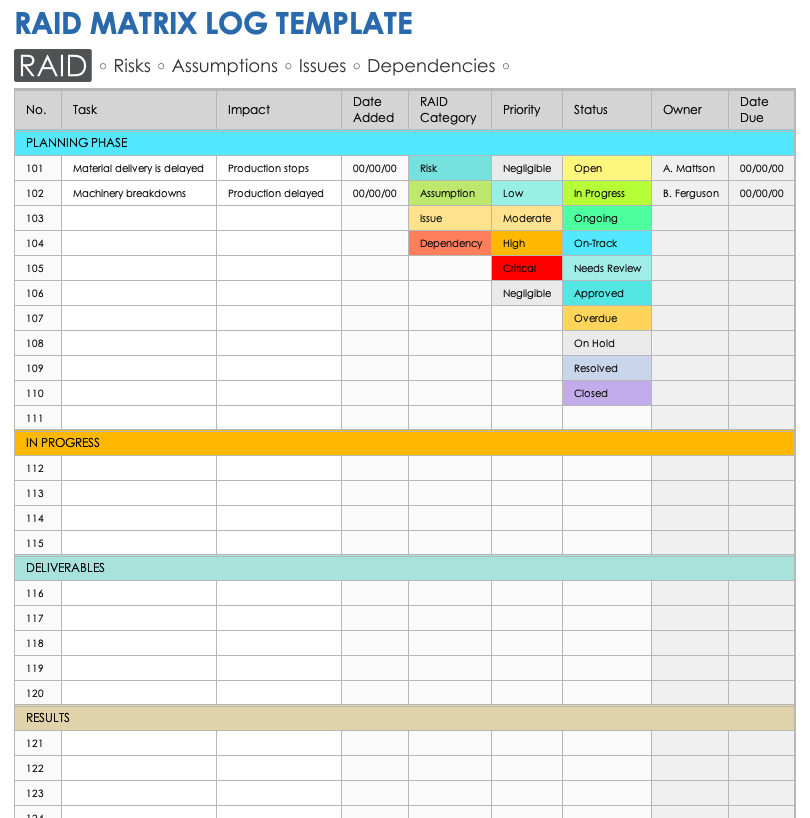
Use the categories precisely:
| Category | Meaning | EDV-context example |
|---|---|---|
| Risk | Future uncertain threat | HVAC outlet bezel could clash with a later instrument-panel update. |
| Assumption | Unverified condition currently used for design | A nominal duct-center location is accepted for concept packaging. |
| Issue | Existing problem requiring containment or correction | Current nominal door-carrier envelope conflicts with a known window-regulator keep-out. |
| Dependency | An external input, decision, or deliverable needed by the work | The ECU team requires connector-envelope data from electrical integration. |
One item can be linked across records without being duplicated carelessly. For example:
ASM-VEH-014records that the ECU clearance is assumed.RSK-VEH-006records the adverse consequence if that assumption proves wrong.ACT-VEH-012assigns confirmation of the mounting geometry.DEC-VEH-001records the conditional authorization to proceed despite the open assumption.
The IDs create the traceability chain.
Review the relevant descriptions in Smartsheet’s Free Design Review Templates. Treat these as adaptable checklist ideas, not as an automotive gate definition or evidence of compliance.
Under “Preliminary Design Review Checklist,” read the PDR checklist description. Notice the inclusion of entry and exit criteria, deliverables, risks, agenda, and requests for action. Then read the “Engineering Design Review Checklist” description, from the engineering-review scope. Compare its focus on physical-product specifications, safety, environment, compliance, handling, and assembly with the evidence your automotive-component reviews will require.
Prepare the review before the meeting begins
A meeting cannot compensate for an uncontrolled or incomplete package. Before inviting reviewers, create a one-page Review Charter. This is a lightweight course adaptation of a formal terms-of-reference document.
| Charter field | What to define |
|---|---|
| Review ID and type | EDV-REV-PDR-001, Preliminary Design Review |
| Purpose | The specific decision sought |
| Scope | Included components, interfaces, and configuration |
| Exclusions | What the review explicitly does not authorize |
| Baseline | Baseline Manifest ID, CAD version, requirements and interface records |
| Entry criteria | Evidence required before the meeting can begin |
| Exit criteria | Conditions for proceeding, holding, or repeating the review |
| Decision authority | Role authorized to accept, conditionally accept, or reject the request |
| Core reviewers | Engineering, packaging, manufacturing, quality, electrical, service, supplier interface as applicable |
| Recorder / configuration owner | Person responsible for minutes, actions, and final record |
| Ground rules | Evidence over opinion; assumptions declared; actions have owners and dates; no silent scope change |
PDR readiness checklist for the simulated EDV program
Use the following as your entry criteria. If a needed item is missing, either delay the review or visibly record a waiver and its risk.
- The review purpose and requested decision are written in one sentence.
- The product configuration is identified by baseline and exact CAD version.
- The requirements baseline and traceability status are available.
- Assumption-based vehicle inputs are clearly labelled with source and confidence.
- Interfaces have named owners and unresolved ownership conflicts are visible.
- At least one feasible concept is available, with its selection logic or open trade.
- The top technical, manufacturing, schedule, and integration risks are recorded.
- The review deck, RAID summary, decision log, and action tracker have consistent IDs.
- Required reviewers receive the package early enough to identify evidence gaps.
- A person has been assigned to capture decisions and actions during the meeting.
For this course, do not confuse “all reviewers attended” with “the review passed.” Attendance is evidence of participation. A gate decision must name the decision authority, outcome, conditions, and controlled record.
Run a 60-minute company-style PDR
A good review is facilitated, not simply narrated. The chair should protect the decision purpose and make sure technical disagreements are captured accurately rather than hurried aside.
Suggested agenda
| Time | Topic | Intended output |
|---|---|---|
| 5 min | Opening: purpose, scope, baseline, ground rules | Shared understanding of what decision is in scope |
| 5 min | Entry-criteria confirmation | Proceed, delay, or record a stated waiver |
| 10 min | Requirements, interfaces, and configuration status | Agreement on the governing inputs and open gaps |
| 15 min | Concept and feasibility evidence | Review of concept rationale, package fit, and key technical claims |
| 10 min | Risks, assumptions, issues, and dependencies | Prioritized RAID items and agreement on escalation needs |
| 10 min | Decision request and action review | Decision wording, conditions, owners, due dates, acceptance criteria |
| 5 min | Read-back and close | Confirmed record of decisions, actions, and next review point |
The review chair should ask focused questions:
- “Which requirement is this geometry intended to satisfy?”
- “Which baseline version does this clearance claim refer to?”
- “Is this a risk, an existing issue, or an assumption?”
- “What observable evidence will close this action?”
- “Who has authority to accept the residual risk?”
- “Does this condition limit concept development, detailed design, tooling, or release?”
When a reviewer challenges an assertion, avoid defending the slide immediately. First classify the result. A missing test plan may become an action. An uncertain package input may become an assumption and risk. A conflict between two required clearances may become an issue requiring a formal decision or trade study.
Make the final gate outcome unambiguous
Use one of four clear outcomes:
| Outcome | Meaning |
|---|---|
| Proceed | The baseline is adequate for the requested next activity. |
| Proceed with conditions | Work may continue within defined limits; listed actions must close before a stated later gate. |
| Hold | The evidence is insufficient or a significant issue prevents the requested progression. |
| Reconvene / delta review | A specified evidence update or design change requires a focused follow-up decision. |
For the current vehicle-context example, a credible result could be:
Outcome: Proceed with conditions.
BASE-VEH-G1-01is authorized for simulated component concept development. It is not authorized for detailed-design release, tooling commitment, or validation claims. High-impact package assumptionsASM-VEH-014throughASM-VEH-018require closure or approved re-baselining before the ECU, door-trim, or HVAC projects pass their component PDRs.
That decision is useful because it permits work while preventing false certainty.
Build your review record
Spend the final part of this lesson assembling a short simulated PDR package for the vehicle context. Create the five records below in a spreadsheet, document-control folder, or your course templates. Use links or file references to the controlled Onshape version rather than copying uncontrolled screenshots into several locations.
- Controlled presentation: Draft the 10–12 slide sequence and place the baseline ID in the footer of every slide.
- Decision log: Add
DEC-VEH-001and leave its final outcome blank until the review closes. - Assumptions log: Add three package assumptions from your previous vehicle-context model. State confidence, owner, and needed-by gate.
- Risk register: Add at least the risk created by each high-impact package assumption. Include a trigger and a planned response.
- Action tracker: Add actions that produce controlled closure evidence, such as an updated interface-control matrix or revised package version.
At the end of the review, issue a concise Review Record containing:
- the agenda and attendee roles;
- the final presentation PDF revision;
- the baseline manifest and evidence index;
- decisions made, including any conditions;
- open risks and assumptions;
- actions, owners, dates, and closure criteria;
- the next review or escalation point.
Store this record beside the Baseline Manifest. In a production PLM environment, many relationships would be represented by managed objects and workflows. In the Onshape-plus-template workflow used here, the discipline comes from stable identifiers, named versions, controlled documents, and explicit approval records.
Key takeaways
A company-style design review is a controlled decision process, not a CAD presentation.
- The review must identify the exact configuration being assessed, including the baseline and authoritative CAD version.
- A PDR tests whether a concept is credible enough for detailed development; a CDR tests whether the detailed definition is mature enough for an authorized build or release activity.
- The presentation explains the case; the decision log preserves authorized choices; the risk register manages uncertain future threats; the assumptions log exposes unverified inputs; and the action tracker closes gaps with evidence.
- Risks, assumptions, issues, dependencies, decisions, and actions are related but not interchangeable.
- “Proceed with conditions” is often the most realistic review outcome, provided the conditions, owners, evidence, and next gate are explicit.
Next, you will begin the polymer-selection and injection-molding-design module. The review discipline established here will carry forward: material choices, DFM rules, and manufacturing risks will need traceable evidence and clear design decisions rather than informal preference.
Can't find a good explanation? Sign up and we'll make it for you
Sign up