Hello! Welcome to the first lesson in our new module, Overcoming Buyer Hesitation in Copy.
In our last lesson, you created a powerful internal selling document. That one-pager was designed to proactively answer questions and overcome objections from stakeholders inside your champion's company. Today, we're going to broaden that focus. We'll learn how to spot the moments in public-facing copy where writers are skillfully dismantling the doubts that stop a buyer from moving forward.
Our learning outcome for this session is to identify common B2B objections (price, risk, switching cost, timing) in real-world copy examples. Understanding how to spot these objections is the essential first step before you can learn to write copy that overcomes them yourself.
1. Objections: A Sign of Interest, Not Rejection
When you were starting out in copywriting, you might have seen a skeptical comment or a question about price as a bad sign. In B2B, it's the opposite. Silence is what kills deals. Objections are a sign of engagement; they mean the buyer is seriously considering your offer and is looking for reasons to justify the purchase. Your job as a copywriter is to give them those reasons.
Let's start with a short video that makes a powerful case for welcoming objections instead of fearing them.
The 5 Biggest Customer Objections & How To SMASH Them With Killer Copywriting
In this clip from 'The 5 Biggest Customer Objections & How To SMASH Them' by Alex Cattoni, you'll hear why it's crucial to address buyer doubts head-on in your copy.
Please watch from the beginning until the 02:54 mark. Pay close attention to the idea that prospects are actively looking for proof that their objections are real.
As the video explains, your prospects have these doubts whether you mention them or not. By surfacing and resolving them, you control the narrative and build trust. Ignoring them leaves the buyer to fill in the blanks, and they will usually do so in the most negative way possible.
2. The "Big Four" B2B Objections in the Wild
For this lesson, we'll focus on four of the most common and powerful objections in B2B buying decisions. Let's look at each one and see how real copy tackles it.
A. Price
This isn't just about the sticker price being too high. It can also be a concern that a price is too low, suggesting poor quality. Most often, the objection is about value: "Is this worth the cost? What is the return on this investment?"
Example: Look at how Cigna + Oscar, a health insurance provider, handles the price and value objection on their landing page.
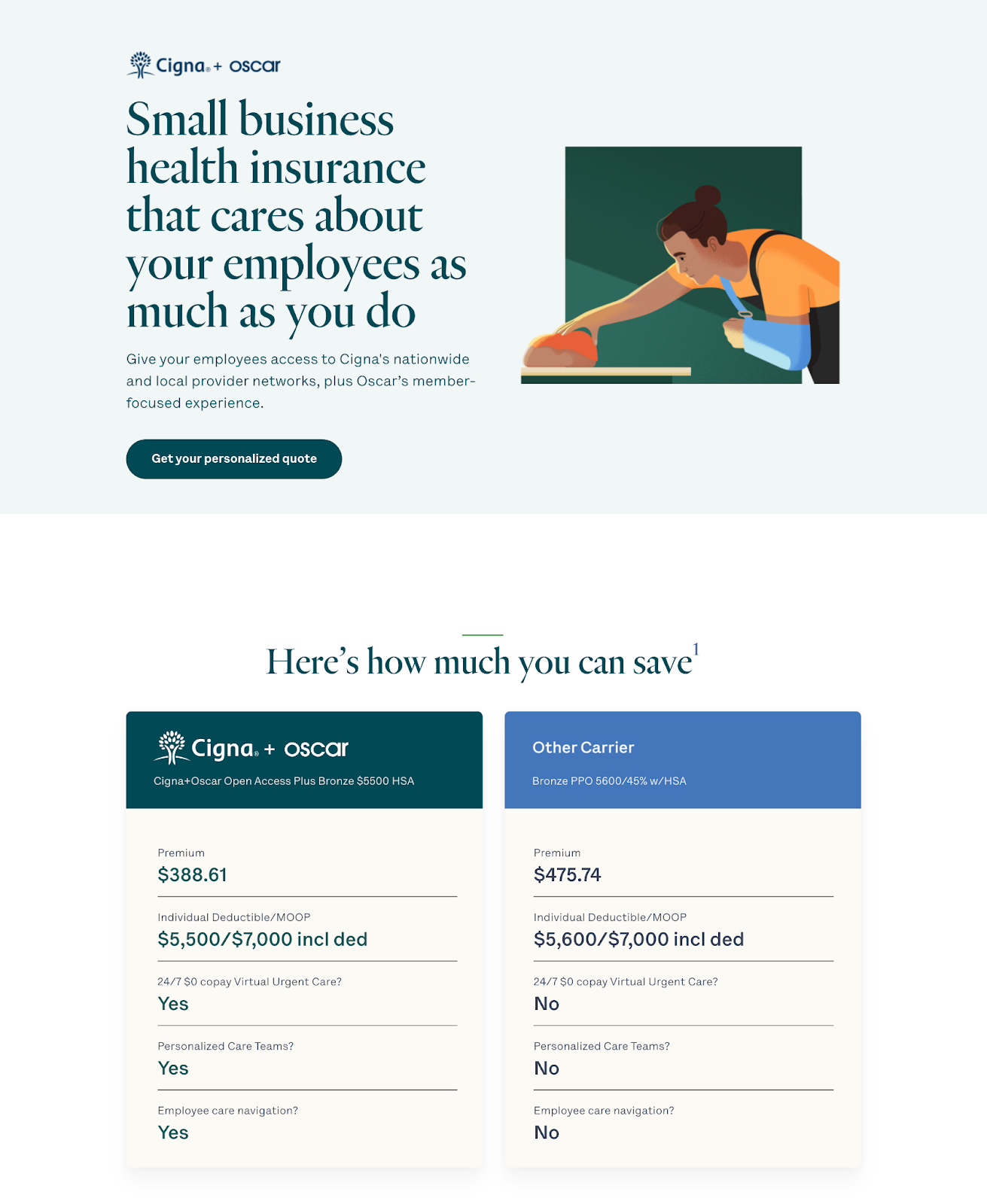
Here, the copy doesn't just state a price. It explicitly creates a comparison to handle the objection. The prospect immediately sees:
- A lower premium (addressing the "it's too expensive" concern).
- A lower deductible.
- More included features (Virtual Urgent Care, etc.).
This frames the conversation around value for money, not just cost. It directly answers the question, "Why should I pay for your plan instead of another?"
B. Risk
B2B buyers are intensely risk-averse. A bad purchase can cost them their reputation or even their job. Risk objections include:
- "What if this doesn't work for our specific situation?" (Skepticism)
- "Is this company credible? Can I trust them?" (Trust)
- "Is our data safe with this product?" (Security)
Example: The marketing agency ThunderClap has a fantastic, no-nonsense approach to handling these objections with what they call "field-tested microcopy."
Proven Landing Page Conversion Optimization Techniques
This resource, 'Proven Landing Page Conversion Optimization Techniques,' contains a highly practical table that pairs common SaaS objections with exact copy to counter them. It's a perfect cheat sheet for this topic.
Please read the section titled 'Common buyer objections and exact copy to reply with.' Focus on the objections related to security and the risk of the product not working.
As you saw in the table, the copy provides direct, concrete answers to risk-based objections:
-
Objection: “Is it secure?”
-
Answer: “SOC 2 Type II certified. Data encrypted at rest & in transit — see our Trust Center.”
This response uses specific, recognized standards (SOC 2 Type II) to build credibility and alleviate security fears. -
Objection: “What if it doesn’t work?”
-
Answer: “30-day money-back guarantee / Cancel anytime.”
This is a classic risk-reversal tactic. It removes the financial risk of making a bad decision.
C. Switching Cost & Difficulty
This is a massive hurdle in B2B. Even if your product is better, the perceived pain of switching from an existing tool or process can be a deal-breaker. Objections sound like:
- "This will take too long to set up."
- "My team will never learn how to use this."
- "This won't integrate with our existing systems."
Example: Let's look at how Monday.com, a CRM provider, tackles this on a landing page specifically designed for people who think CRMs are a hassle.
12 Great Copywriting Examples (Plus a Ton of Copywriting Tips)
The article '12 Great Copywriting Examples' by DemandCurve analyzes a Monday.com landing page that is a masterclass in objection handling. We'll focus on how it addresses the 'difficulty' objection.
Read section #11, 'Monday.com’s landing page.' Note how the copywriter identified the target's objections (e.g., 'Salesforce complicated') and how the copy immediately handles them.
The Monday.com copy systematically dismantles the difficulty objection:
- Objection: CRMs are too complicated.
- Answer: A CRM you'd “actually want to use.”
- Objection: It takes too long to get trained and onboarded.
- Answer: “Easy setup.”
- Objection: CRMs are inflexible.
- Answer: “Fast no-code CRM customization.”
Every line is engineered to soothe the buyer's fear of a difficult, time-consuming implementation project.
D. Timing & Need
This is often a subtle but powerful objection: "This is interesting, but it's not a priority for us right now." The copywriter's job is to create urgency by connecting the problem to a significant business cost.
Example: This email from Stripe is a brilliant example of creating urgency and proving the need for a better solution now.
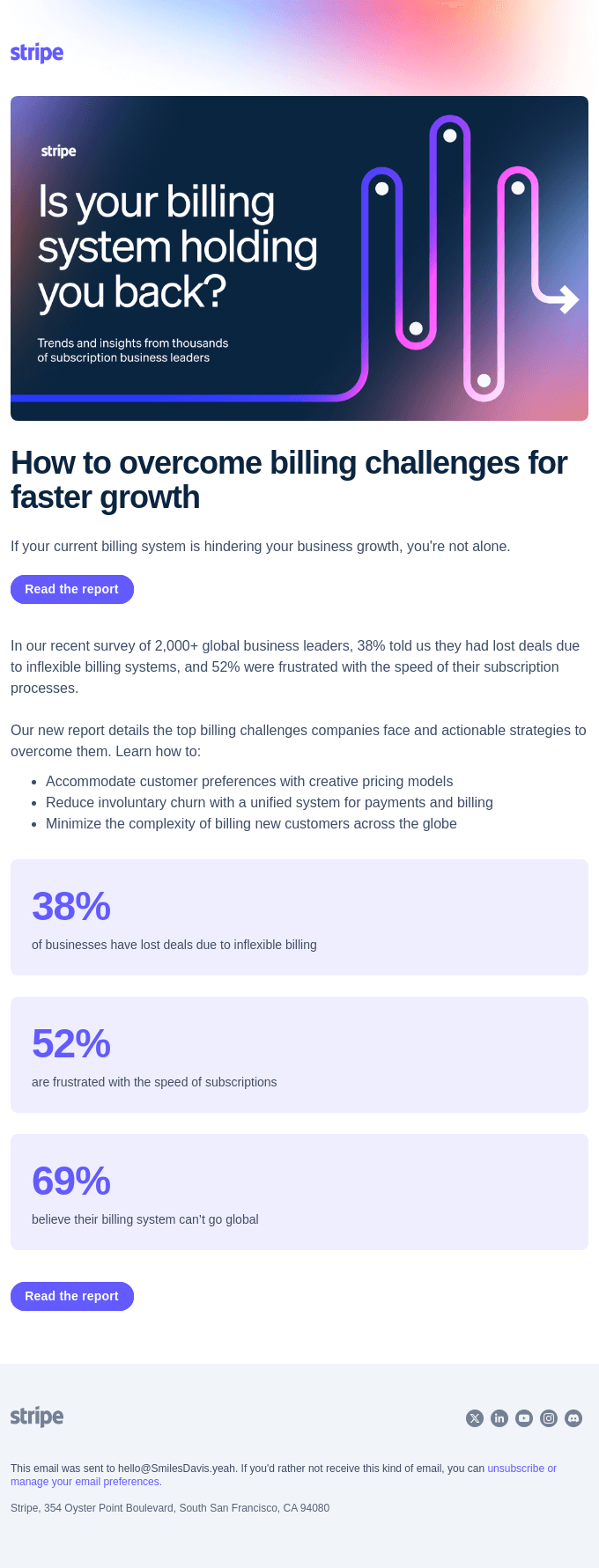
The copy here excels at manufacturing urgency:
- The headline, "Is your billing system holding you back?" immediately reframes billing from a simple back-office function to a potential growth-blocker.
- The statistics are the key: "38% lost deals due to inflexible billing" and "52% were frustrated with subscription speed."
This data transforms the timing objection. The issue is no longer something to "fix later"; it's a problem that is actively costing the business deals and frustrating customers today.
3. Your Turn: Identify the Objection
Let's do a quick hands-on exercise. The following video clip shows a landing page for an auto repair marketing suite. The copywriter makes a specific choice to reframe the concept of "advertising."
How this Landing Page Generated $4.5 Million
This clip from 'How this Landing Page Generated $4.5 Million' analyzes a specific section of copy.
Watch from 07:51 to 09:02. The presenter discusses how the copy avoids the word 'advertising' and instead talks about 'building an experience they love'.
Based on what you just saw, what underlying B2B objection is this copy trying to overcome by "reframing" advertising?
(Take a moment to think before reading the answer below.)
Answer:
The core objection is Risk/Skepticism. Many business owners are skeptical of advertising, viewing it as a necessary evil that is often expensive, ineffective, or even deceptive. By reframing the activity as "building an experience they love," the copy sidesteps that baked-in skepticism. It bypasses the buyer's mental block against "advertising" and presents the solution in a more positive and outcome-focused light.
Conclusion
Great work today. You've learned to look at copy through the critical lens of buyer hesitation. Instead of just seeing words on a page, you can now start to identify the invisible conversation happening between the copywriter and the prospect's doubts.
Key Takeaways:
- Objections are buying signals in B2B and must be addressed, not ignored.
- The four major B2B objections are Price (value), Risk (trust, security, skepticism), Switching Cost (difficulty, implementation), and Timing (urgency, need).
- Effective copy counters these objections with specific tools: direct comparisons, social proof, risk-reversals (guarantees), data, and strategic reframing.
Preview of the Next Lesson:
Now that you can spot these objections in the wild, your next task is to learn how to counter them in your own writing. In our next lesson, you will write copy that preemptively addresses a specific B2B objection for a given product scenario.