
Good to see you again. In the previous lesson, you developed an ERCOT-specific method: start with applicability, verify the controlled revision, follow cross-references, and distinguish a governing obligation from a template or guidance document.
The same discipline applies in the Western Interconnection, but the document landscape is less centralized. A proposed solar or BESS project may sit under a NERC Reliability Standard, a WECC regional standard or criterion, a Planning Coordinator procedure, a transmission provider tariff, and a project-specific interconnection agreement at the same time. The task is not to collect every document with “WECC” in its title; it is to locate the current, applicable sources for the exact POI and study question.
In this lesson, use this representative assignment:
Task: A developer proposes a MW solar plant with a MW BESS at a new kV POI in the Western Interconnection. Identify the current WECC, NERC, and local transmission-provider documents needed to define the project’s interconnection-study, modeling-data, and facility-requirement obligations.
By the end, you should be able to produce a defensible source map for that task, while clearly marking the items that depend on the named transmission provider, Planning Coordinator, or executed project agreement.
Begin with geography, then identify the responsible entities
“The West” is not a single interconnection process. The Western Interconnection spans a broad synchronized grid, but individual projects are governed through local transmission providers, Planning Coordinators, Balancing Authorities, state or provincial regulators, and sometimes an ISO or RTO.
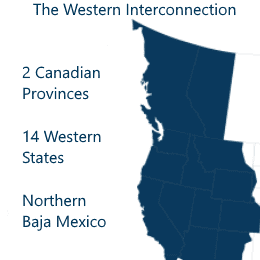
For the stated solar-plus-BESS task, first establish five facts from the interconnection request, POI one-line, utility correspondence, or study agreement:
| Fact to identify | Why it matters |
|---|---|
| Exact POI and voltage level | Establishes which transmission system and facility standards apply. |
| Transmission Owner | Identifies who owns the line, substation, or network receiving the project. |
| Transmission Provider | Identifies the entity administering transmission service and often the interconnection process. |
| Planning Coordinator and Transmission Planner | Identifies the model-data procedures and regional planning process relevant to the area. |
| Governing interconnection process | Determines whether the project follows a tariff, ISO process, public-power process, state-approved procedure, or a project-specific pathway. |
These roles can be held by one organization, but do not assume that they are. A utility may own the nearby line, another entity may administer transmission service, and a different entity may coordinate planning models for the area.
This distinction matters directly in model work. The project developer and OEM may provide plant data, but the Planning Coordinator and Transmission Planner define the applicable reporting procedures and required case formats. The utility or transmission provider may separately impose its own interconnection model, protection, control, and commissioning requirements.
The document stack: baseline, regional layer, local process, project contract
A practical way to avoid mixing authorities is to sort documents by their role before you read them in detail.
| Layer | Main question it answers | Typical examples for this task |
|---|---|---|
| NERC Reliability Standards | What reliability obligations and data processes apply to registered entities? | Transmission planning performance, facility interconnection studies, facility connection requirements, and system-modeling data. |
| WECC regional standards or criteria | Does the Western region add a regional requirement, variance, or criterion? | WECC transmission-planning, voltage/reactive-control, governor-droop, or protection-related regional material. |
| Transmission-provider documents | How does this provider process the request and what technical criteria does it apply? | Tariff, generator interconnection procedure, planning criteria, facility connection requirements, study scope, and modeling guide. |
| Project-specific documents | What has this project actually agreed to submit, build, pay for, and operate? | Study agreement, interconnection agreement, facilities agreement, data-request package, and study assumptions. |
Think of this as a source hierarchy for navigation, not a simplistic rule that one document always overrides another. A project agreement can impose binding project obligations, but it cannot remove an applicable reliability obligation. If a utility criterion, agreement, and regional requirement appear inconsistent, preserve the citations and escalate the conflict rather than deciding it by inference.
Locate current WECC material without treating a list as a requirement
WECC is an important regional source, but its standards page is an index. It contains active documents, historical versions, documents with future effective dates, and region-specific material for particular jurisdictions. The presence of a title in a list does not establish that it applies to the proposed kV project.
Standards | Western Electricity Coordinating Council
Read the official WECC Standards page as a controlled starting point. Its value is not that it gives a complete project answer, but that it shows how WECC organizes regional standards and directs users to the NERC standards repository.
On the main standards listing, scan the first table and note that it includes regional material such as WECC standards, including voltage/reactive-control material. Then examine the later table containing the regional planning criterion, from the regional criterion list. Do not decide applicability from the title alone. Finally, read the short explanation beginning the NERC relationship, then use the NERC Standards link shown on the page as the official route to verify current NERC documents.
For the solar-plus-BESS task, record the following from the WECC index before you open any individual PDF:
- Exact title and identifier. For example, distinguish a WECC regional criterion from a NERC Reliability Standard with a WECC regional variance.
- Status. Determine whether the document is effective, superseded, retired, pending, or scheduled for a future effective date.
- Jurisdiction. Confirm that the project is in the jurisdiction addressed by the document. The page includes material specific to British Columbia and Mexico, which would not automatically apply to a U.S. project.
- Functional connection. Ask whether the document concerns your present task: interconnection planning, model data, voltage/reactive obligations, protection, or operations.
- Controlling text. Open the document itself and verify its revision history, effective date, applicability section, requirements, and implementation language.
The listed TPL-001-WECC-CRT-4 Transmission System Planning Performance document is a useful flag for a transmission-planning task. It does not mean that every developer must independently apply every provision of that criterion to every sensitivity study. The relevant question is whether the local Planning Coordinator or Transmission Planner uses it in the governing planning process and whether the project is within its stated scope.
Similarly, the listed voltage and reactive-control material should prompt you to check local POI voltage-control and reactive-power requirements. It is not a substitute for the specific utility’s facility-connection requirements, reactive-capability expectations, or plant-controller settings.
A WECC retrieval protocol
When a WECC source appears potentially relevant, use this sequence:
- Open the document from WECC’s controlled listing.
- Save the original file in a read-only reference folder.
- Record its title, version, effective date, and download date.
- Read the Applicability and Requirements portions before extracting a technical rule.
- Record whether it is a mandatory regional standard, regional variance, criterion, guidance document, or reference material.
- Search the local transmission-provider criteria and study scope for explicit adoption or cross-reference to it.
The last step is particularly important. A regional criterion may be technically relevant but applied through the local planner’s documented planning process.
NERC: locate the reliability framework and the modeling-data pathway
For this task, several NERC document families are likely candidates for the initial source map:
- Facility connection and interconnection-study standards, often relevant to the POI, facility design, and study process.
- Transmission planning performance standards, relevant to base-case assumptions, contingencies, and system performance.
- Modeling and data standards, relevant to the information supplied for steady-state, dynamic, and short-circuit studies.
- Protection, voltage/reactive-control, and disturbance-monitoring standards, where the project’s equipment and registered-entity roles bring them into scope.
Do not assume every standard in those families applies directly to the developer. NERC standards attach requirements to registered functional entities. A proposed project may be an applicant today and become associated with a Generator Owner, Generator Operator, or other registered entity later. In practice, its obligations to furnish data or meet technical requirements may also arise contractually through the interconnection process.
MOD-032-1 is the most useful starting document for understanding the model-data flow. It does not tell you the exact PSS®E version, filename convention, or OEM library required by a particular utility. Instead, it establishes the reliability-standard framework under which the Planning Coordinator and Transmission Planner develop those local data requirements and reporting procedures.
MOD-032-1 — Data for Power System Modeling and Analysis
Read selected portions of NERC MOD-032-1 to understand who develops model-data procedures, who supplies data, and why a Western utility can legitimately require coordinated steady-state, RMS dynamic, and short-circuit information from an interconnection project.
On pages 1–2, read the purpose and functional entities. Identify the roles that matter to the proposed POI: Generator Owner, Resource Planner, Transmission Owner, Transmission Planner, Planning Coordinator, and Transmission Service Provider. Then read Requirements R1 and R2 on pages 2–3, beginning at R1 and continuing through R2. Focus on the division of responsibility: the Planning Coordinator and Transmission Planner establish data requirements and procedures, while listed entities submit steady-state, dynamics, and short-circuit data according to those procedures. Finally, read Attachment 1 on pages 12–14, from the reporting-data table. Compare the data categories with the information normally requested for a solar-plus-BESS project: generator capabilities, transformer data, regulated-bus and voltage setpoint information, dynamic-model information, and positive-, negative-, and zero-sequence data.
What MOD-032 changes in your document search
The key logic is:
- NERC requires the Planning Coordinator and Transmission Planner to develop model-data requirements and reporting procedures.
- Those local procedures specify the operational detail: formats, level of model detail, scenarios, and submission schedule.
- The project therefore needs both the NERC framework and the local provider or planner’s current procedures.
For the stated task, MOD-032 Attachment 1 gives you a useful preliminary data inventory:
| Study representation | Examples of data to request or verify |
|---|---|
| Steady-state | MW and MVAr capability, active/reactive limits, GSU and collector-equivalent data, station service, regulated bus, voltage setpoint, status, normal and emergency ratings. |
| RMS dynamic | Renewable-plant dynamic model, controller and protection information, parameter names and values, block diagrams for user-written models, and model-version information. |
| Short circuit | Positive-, negative-, and zero-sequence network data, transformer winding and grounding information, and other requested system data. |
Later modules will convert this inventory into a full technical-data request checklist and use it in PSS®E and PSCAD models. At this point, its purpose is narrower: it helps you recognize that a request for a .dyr file alone is not a complete modeling-data request.
Locate the local transmission-provider documents
The exact transmission-provider package cannot be identified until the POI owner and process administrator are known. That uncertainty is not a weakness in your source map; it is a finding that must be resolved early.
For a U.S. Western project, search the named provider’s controlled tariff and interconnection materials for these document families.
| Document family | What to locate | Why it is relevant |
|---|---|---|
| Tariff or governing interconnection procedure | Current effective tariff, generator interconnection procedure, and agreement form where applicable | Defines queue entry, study stages, deposits, milestones, rights, responsibilities, and agreement structure. |
| Planning criteria | Current planning-performance criteria and contingency assumptions | Defines how thermal, voltage, stability, and outage performance are assessed in the provider’s planning studies. |
| Facility connection requirements | Current technical requirements for POI, substation, protection, voltage/reactive capability, communications, metering, and operations | Turns a high-level interconnection request into an acceptable physical and control design. |
| Modeling-data and study guide | Current PSS®E, short-circuit, RMS-dynamic, and possibly EMT requirements | Defines formats, software versions, plant-model expectations, data templates, and validation requirements. |
| Project-specific study materials | Study agreement, scope, base cases, contingency list, data request, and assumptions log | Defines the actual study to be performed for this queue position and project configuration. |
Do not assume every provider uses a FERC-style tariff pathway
Many transmission providers administer interconnection through an Open Access Transmission Tariff. Others are ISO-administered, federally owned, municipal, cooperative, or state-regulated systems with a different document structure. A large-load project may also follow a different process from a generation project.
For the solar-plus-BESS task, the first local-process decision is whether the BESS is being studied as part of a generating facility, as a separately metered storage facility, or under another project classification. That classification can affect the interconnection application, study assumptions, dispatch treatment, and required agreements.
Use the following source-location workflow:
- Identify the process owner named in the interconnection request or POI correspondence.
- Find the provider’s controlled interconnection landing page, rather than relying on a consultant’s archived tariff PDF.
- Locate the currently effective tariff or procedure and verify its revision, effective date, and regulator or governing-body approval status.
- Locate the provider’s technical documents separately. Interconnection procedures often state when data are due but refer elsewhere for detailed model and facility requirements.
- Retrieve the project-specific study package. This can include the executed study agreement, scope, base-case descriptions, contingencies, cluster assumptions, and data-request templates.
- Record inaccessible or confidential material explicitly. A missing CEII-controlled model, unpublished study assumption, or confidential planning criterion is an access constraint, not a reason to substitute a public approximation without disclosure.
In a future SPP cluster-model workflow, this same discipline will be used to obtain authorized case packages and reproduce a supplied reference solution. The regional names change, but the professional control point remains the same: study an authorized version, preserve its provenance, and document each modification.
Build a source map before building an applicability register
The next lesson will formalize an applicability register. For now, produce a source map that proves you know where to look and what remains unknown.
Use one row per document family, not one row per every possible standard.
| Task question | Source to locate | Current-status check | Initial applicability test |
|---|---|---|---|
| Who administers the interconnection request? | Local tariff, interconnection procedure, or ISO process manual | Effective revision and approval status | Is this the procedure named by the POI owner or process administrator? |
| What system performance criteria govern the study? | NERC planning standard, applicable WECC criterion, and local planning criteria | Current revision, effective date, local adoption or cross-reference | Does it govern the local Planning Coordinator or Transmission Planner’s study process? |
| What facility requirements apply at the POI? | Local facility-connection requirements and project agreement | Current issued revision plus agreement version | Does it apply to a new kV generator/storage interconnection? |
| What model data must the project provide? | NERC MOD-032 framework plus local modeling-data procedure | Current NERC version and current local procedure | Is the project providing steady-state, dynamic, and fault data to the responsible entities? |
| Which WECC regional documents matter? | WECC controlled standards and criteria | Effective or inactive status within the document | Is the project within the stated jurisdiction and functional scope? |
| What has the project specifically committed to deliver? | Executed study and interconnection documents | Fully executed revision, amendments, and dates | Does the document impose a milestone, data submittal, technical assumption, or cost obligation? |
A concise finding for the sample project might read:
Finding: NERC MOD-032 establishes the framework for steady-state, dynamics, and short-circuit model-data reporting. The exact PSS®E and PSCAD deliverables cannot be identified from MOD-032 alone. Obtain the Planning Coordinator and Transmission Planner’s current data-reporting procedure and the transmission provider’s project data-request package.
Status: Verified framework; local procedure and project package pending.
Risk if unresolved: Model submittal may be technically complete but incompatible with the provider’s required format, detail, or scenario definitions.
That wording is stronger than claiming that a generic NERC attachment alone defines a utility’s model-submittal package.
A practical controlled-document check
Before you rely on any retrieved document, perform this short check:
- Source: Did it come from the official WECC, NERC, provider, regulator, or project data-room location?
- Identity: Does the PDF itself show the expected title and document identifier?
- Version: Is its revision, effective date, and status clear?
- Scope: Does its applicability language cover the POI, project type, and responsible entity?
- Relationship: Is it a requirement, criterion, procedure, template, guidance document, or contract?
- Cross-references: Which linked documents must also be opened before making a conclusion?
- Evidence: Can another engineer retrieve the same document and find the cited section?
This check is particularly useful when utility criteria arrive as email attachments. An attachment may be authoritative, preliminary, superseded, or only applicable to a particular queue study. Preserve the transmittal, filename, date received, and any stated applicability instruction.
Key takeaways
- The Western Interconnection is a regional grid, not one universal interconnection procedure. Start by identifying the exact POI, Transmission Owner, Transmission Provider, Planning Coordinator, and Transmission Planner.
- Use the WECC Standards page as a controlled index, then verify each candidate document’s effective status, jurisdiction, and applicability in the document itself.
- NERC MOD-032 provides the framework for steady-state, RMS-dynamic, and short-circuit model-data reporting. It points you to the crucial local procedures developed by the Planning Coordinator and Transmission Planner.
- For a solar-plus-BESS project, locate the local tariff or interconnection procedure, planning criteria, facility-connection requirements, modeling guide, and project-specific study package separately.
- Do not infer that a public standard, an archived PDF, or a template is the complete engineering acceptance basis.
- Record unknown provider-specific or CEII-controlled items as open actions rather than filling gaps with assumptions.
Next, you will turn these retrieved sources into an applicability register that records each requirement’s authority, revision, section, project connection, and mandatory or advisory status.
Can't find a good explanation? Sign up and we'll make it for you
Sign up