Hello! Welcome to your sixth lesson in the "Foundations of Venture and Acceleration" module.
In our last session, we focused on crafting a unique, AI-differentiated value proposition for your accelerator—the what and why of your offering. Now, we'll shift to the operational reality of delivering that value. This lesson addresses the critical question of how your program will run.
Today's learning outcome is to evaluate cohort-based versus rolling admission program structures. This isn't just a logistical detail; it's a fundamental strategic choice that impacts your firm's culture, operational model, and the type of founders you attract. As a solo GP planning to launch your own firm, understanding the trade-offs of each model is essential for designing a program that is both effective for startups and manageable for you.
1. The Two Dominant Models: A Fundamental Choice
At the highest level, accelerators and incubators structure their intake and programming in two primary ways: in fixed-time batches (cohorts) or on a continuous basis (rolling admissions). Your experience helping startups find product-market fit is relevant here; think of your program structure as a core feature of your "product." The right feature set depends entirely on the "customer" (the founder) you aim to serve.
This image provides a useful high-level comparison, often distinguishing accelerators from incubators based on this very characteristic.
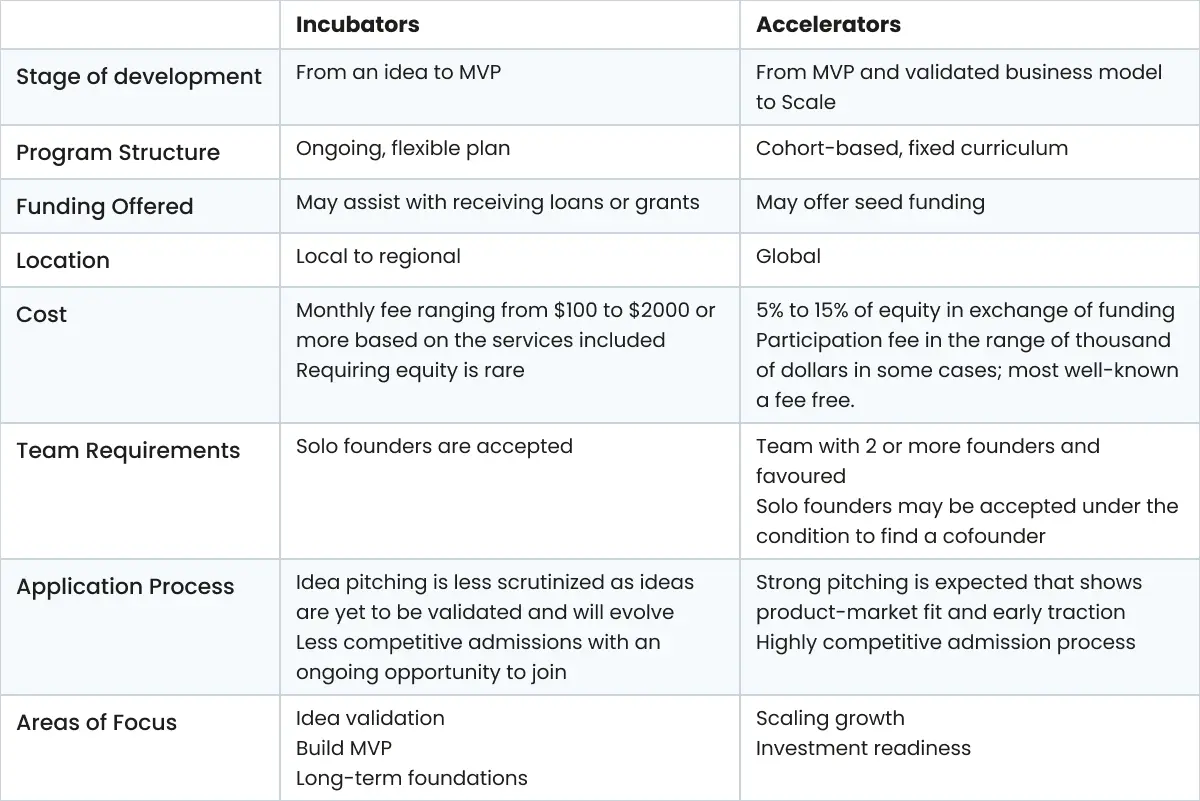
Let's formally define these two approaches.
The Cohort-Based Model
This is the "classic" accelerator model, popularized by programs like Y Combinator and Techstars. It operates like a university semester:
- Time-Bound: A fixed duration, typically 3-4 months.
- Batch Intake: A group of startups (a "cohort" or "batch") starts and ends the program at the same time.
- Structured Curriculum: The cohort progresses through a shared curriculum of workshops and mentorship sessions.
- Capstone Event: The program culminates in a "Demo Day," where startups pitch to a large audience of investors.
The Rolling Admission Model
This model is more akin to an ongoing consultancy or a research lab.
- Flexible Timeline: Startups apply and are accepted at any time. The duration of their engagement is often tailored to their specific needs and milestones.
- Individualized Support: The focus is on customized, 1-on-1 mentorship rather than a one-size-fits-all curriculum.
- Continuous Operation: There are no fixed "start" or "end" dates for the program as a whole.
To see a real-world example of a rolling admission model—specifically for an AI-focused firm—let's look at how the AI2 Incubator positions itself.
The FAQ page for the AI2 Incubator, a leading incubator for AI-first startups, clearly explains their choice of a rolling admission model.
Read the sections under the headings 'Program Basics' and 'Application Process'. Pay close attention to how they contrast their model with 'short, cohort-style bootcamps'.
AI2's explicit choice to avoid the cohort model in favor of "long-term, hands-on work" highlights that for certain types of startups, particularly in deep-tech fields like AI, a flexible and extended engagement can be more valuable.
2. A Strategic Framework for Evaluation
Choosing a model isn't about which is "better" in a vacuum, but which is the best fit for your specific strategy, value proposition, and operational constraints. As a solo GP, you must weigh these factors carefully.
The following table breaks down the pros and cons of each model across several key strategic dimensions.
| Strategic Dimension | Cohort-Based Model | Rolling Admission Model |
|---|---|---|
| Community & Network | Pro: Creates intense peer bonds and a strong sense of shared identity within a batch. Healthy competition can drive progress. | Con: Weaker initial cohort bond. Community builds more slowly over time as an "alumni network." |
| Founder Experience | Pro: Structured, clear schedule. High energy. Strong peer support. Con: Curriculum can feel generic. The fixed pace may be too fast for some, too slow for others. |
Pro: Highly customized support tailored to each startup's unique needs and timeline. Con: Can feel isolating. Founders miss out on shared learning and peer accountability. |
| Operational Efficiency (for a Solo GP) | Pro: Work is batched into intense cycles (recruiting, program, demo day), allowing for downtime in between. Con: Extremely high workload during the program. Managing 10+ companies at once is demanding. |
Pro: Workload is spread more evenly throughout the year. Allows for deeper engagement with fewer companies at a time. Con: Always "on." Constant context-switching between companies at different stages. |
| Deal Flow & Selection | Con: You might miss a great team that isn't ready during your application window. Creates artificial time pressure on founders to apply. | Pro: You can invest in an exceptional company the moment you find it, providing a significant advantage in a competitive market. |
| Investor Relations (LPs) | Pro: Demo Day is a powerful marketing event that showcases your portfolio to LPs and follow-on investors, creating a clear fundraising catalyst. | Con: Reporting to LPs is more continuous and individualized. Less "buzz" without a single capstone event. |
| Alignment with Startup Type | Best for: Startups at a similar, early stage that can benefit from a standardized playbook (e.g., GTM, fundraising prep). Common for B2C or simple SaaS. | Best for: Deep-tech, R&D-heavy startups with long, unpredictable development cycles (e.g., biotech, advanced AI research). |
Test your understanding!
Imagine two scenarios for your future accelerator:
- Scenario A: Your value proposition is to help non-technical domain experts quickly build and launch AI-enabled B2B SaaS products using no-code/low-code platforms. The program is focused on business model validation and go-to-market strategy.
- Scenario B: Your value proposition is to support PhD-level founders commercializing novel AI research (e.g., new model architectures). The focus is on long-term technical development and finding the first pilot customers.
Which admission model would you choose for each scenario, and why? Justify your choice based on at least two dimensions from the table above.
Show answer
-
Scenario A: A cohort-based model is likely the better fit.
- Alignment with Startup Type: The founders are at a similar stage and need a standardized playbook on business fundamentals. A structured curriculum would be highly efficient.
- Community & Network: A cohort of non-technical founders could provide invaluable peer support as they navigate similar challenges in building their first tech product.
-
Scenario B: A rolling admission model is almost certainly superior.
- Founder Experience: The development timeline for novel AI research is unpredictable. A fixed 3-month program would be arbitrarily restrictive. Customized, long-term support is essential.
- Deal Flow & Selection: Breakthrough research doesn't happen on a schedule. A rolling model allows you to engage with and invest in these unique teams whenever they emerge from their labs.
3. The Modern Trend: Customization and Hybrid Models
The classic dichotomy between cohort and rolling models is becoming blurred. Many modern programs are adopting hybrid approaches, taking the best elements of both.
This in-depth report on the Canadian accelerator ecosystem provides excellent insight into this evolution.
ACCELERATING CANADA'S START-UP ECOSYSTEM:
The report 'ACCELERATING CANADA'S START-UP ECOSYSTEM' discusses how program structures are evolving away from the rigid, traditional model.
Read the section titled 'Program Structure' on page 12. Focus on the subsections 'Timelines and Programming are Becoming More Customized and Flexible' and 'Rolling Cohorts are Becoming More Common'. Don't worry about the sector-specific details for now.
The key takeaways from the report are:
- Customization is Key: Even cohort-based programs are adding more customized offerings because they recognize "how different the needs of each company we accept are."
- Flexibility Wins: Rigid 3-4 month timelines are often insufficient to get companies truly investment-ready. As one investor in the report states, "I need to see a lot more than a pitch deck."
- Rolling Intake is Growing: Accelerators are shifting to a rolling acceptance model to avoid losing talented founders who don't fit into a rigid application cycle. As one manager noted, "A continuous program ensures that we can accept them whenever we meet them."
This suggests that for your solo-led firm, you are not bound by a rigid choice. You could design a hybrid model:
- Rolling admissions to capture great companies anytime.
- Quarterly "kick-offs" for new companies to meet the existing portfolio.
- A shared library of online curriculum content that companies can access on-demand.
- Weekly or bi-weekly "All Hands" meetings for the entire portfolio to share progress and build community.
This approach could offer the operational flexibility of a rolling model while still fostering the community benefits of a cohort.
Conclusion
You have now evaluated the two primary program structures for an accelerator. The choice between a cohort-based, rolling admission, or hybrid model is a direct extension of the value proposition you designed in the last lesson. It dictates the founder experience, your operational reality as a solo GP, and your firm's place in the market.
Key Takeaways:
- Cohort-based models create intense community and are operationally efficient in batches, but can be rigid and may not suit all startup types.
- Rolling admission models offer maximum flexibility and customization, which is ideal for deep-tech, but requires constant operational attention and a different approach to community building.
- The strategic decision depends on factors like your target founder profile, your operational capacity, and the specific value you promise to deliver.
- Hybrid models are an increasingly popular and powerful way to combine the benefits of both approaches, offering a promising path for a nimble, solo-led firm.
Preview of the next lesson:
With a clearer idea of your accelerator's value proposition and potential program structure, we will tackle the final piece of the foundational puzzle in our next lesson: "Outline the unit economics for running an accelerator program." Your choice of program model will directly influence your cost structure and revenue potential, which we will explore in detail.