
Hello! Welcome to your next lesson in the module on the economics of '21st Century Socialism'.
Introduction
In our previous lessons, we examined the Chávez government's attempts to control the Venezuelan economy through indirect means: setting price controls on goods and managing access to foreign currency via the CADIVI system. These policies were designed to influence the market from the outside.
Today, we turn to a more direct and radical form of intervention: the state's seizure of private assets, a policy known as expropriation. This lesson will address the learning outcome: Analyze the government's decision to expropriate a major foreign-owned agricultural company using a Positions vs. Interests framework for the government, the company, and farmworkers.
To do this, we will first learn a powerful analytical tool used in negotiation and policy analysis—the Positions vs. Interests framework. We will then apply it to understand the complex motivations behind the government's controversial land reform program.
1. The Framework: Positions vs. Interests
In any conflict or negotiation, the parties involved state what they want. This is their position. However, beneath these stated positions lie their underlying motivations, needs, fears, and goals. These are their interests. Understanding this distinction is crucial for moving beyond a simple clash of demands to see the deeper issues at play.
A common way to visualize this is the 'Iceberg Principle'.
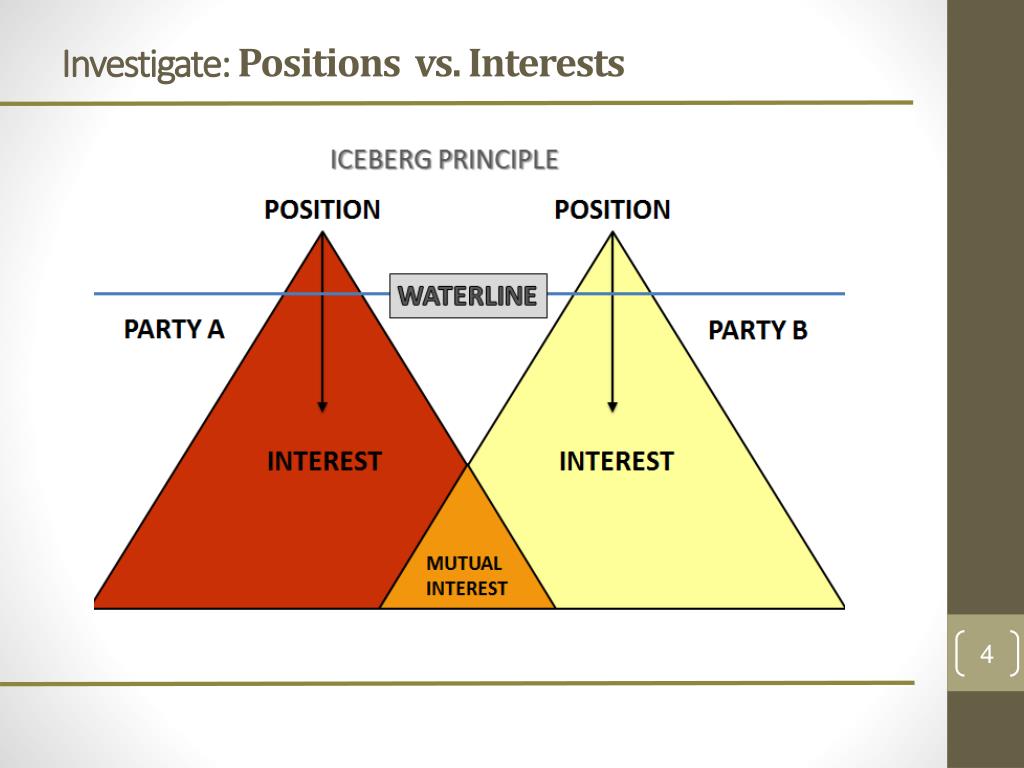
To get a firm grasp of this framework, please read the following material.
This article from Watershed Associates, a negotiation consulting firm, provides a clear and concise explanation of the difference between positions and interests. It's a practical tool often used in diplomacy and business, which may be familiar from your work in the civil service.
Please read the introduction and the two examples provided ('Project Management Example' and 'Buy-Sell Example'). Focus on how identifying the underlying interests allows for creative solutions that satisfy both parties, which would be impossible if they only stuck to their initial positions.
As the reading highlights, positions are often rigid and lead to impasse ("I want a 10% discount" vs. "The price is non-negotiable"). Interests, however, are more flexible and open up a wider range of solutions ("I need to stay under budget" vs. "I need to increase market share").
2. The Context: Land Reform in Venezuela
Now, let's apply this framework to the Chávez government's policy of expropriating agricultural land. To understand the government's interests, we must first understand the historical and ideological context in which these decisions were made. The policy was not conceived in a vacuum; it was a response to deep-seated issues in Venezuelan society.
Hugo Chavez: Venezuela's New Bandito or Zorro
This academic article, 'Hugo Chavez: Venezuela's New Bandito or Zorro', provides the essential background for our analysis. It details the historical land inequality, the economic rationale, and the ideological justification for the government's land reform program.
Please read the following three sections: Start with 'A BRIEF HISTORY ON LAND DISTRIBUTION IN VENEZUELA' (within Part II). This explains the extreme inequality in land ownership and how the 'Dutch Disease' we discussed in Module 1 devastated the agricultural sector. Next, read 'MISSION ZAMORA: THE NEW LAND REFORM PROGRAM OF VENEZUELA'. This section outlines the government's specific program, its legal basis in the constitution (Article 307), and the Ley de Tierras (Land Law) that enabled it. Finally, and most importantly for our analysis, read the section titled 'The Socialist Function Doctrine: REASONS FOR LAND REFORM' (within Part III). This explains the core ideological interest: the belief that private property is only legitimate if it serves a social function.
From this reading, we can extract several key factors that shaped the government's interests:
- Historical Inequality: A tiny fraction of the population owned the vast majority of farmland.
- Economic Underperformance: Much of this land was idle (latifundio), and the country was heavily reliant on food imports due to the oil-centric economy (Dutch Disease).
- Ideological Justification: The government adopted the Socialist Function Doctrine, which posits that the state has the right and duty to seize property that is not being used "productively" for the good of society. This provided a constitutional and philosophical basis for expropriation.
3. Analysis: Applying the Framework
Now we have the tools and the context. Let's analyze the decision to expropriate a major foreign-owned agricultural company, using the Hato El Charcote ranch (owned by the British Vestey Group), mentioned in the article, as our case study.
We will map the positions and interests of the three main actors.
| Actor | Position (What they say they want) | Interests (Why they want it - their underlying motivations) |
|---|---|---|
| The Chávez Government | "We are expropriating this under-utilized land to achieve social justice and food sovereignty, as is our constitutional right." | Political: Consolidate power by delivering on revolutionary promises to the poor; weaken the economic power of the old elite and foreign capital. Economic: Increase domestic food production; diversify the economy away from oil; reverse the effects of Dutch Disease. Social/Ideological: Rectify historical land inequality; empower landless farmworkers; put the "Socialist Function Doctrine" of property into practice. |
| The Foreign Company (e.g., Vestey Group) | "The government is illegally confiscating our private property. We demand the immediate return of our land or full, fair market-value compensation." | Economic: Protect a multi-million dollar asset; maintain profitability; avoid setting a precedent that jeopardizes other investments. Legal: Uphold the principle of private property rights under both Venezuelan and international law. Reputational: Demonstrate to shareholders and other governments that they will defend their assets. |
| The Farmworkers | "This land belongs to the people, not a foreign company. We need it to work and feed our families." | Economic: Gain access to land as a means of production; achieve economic independence and escape poverty. Social: Attain the dignity and security associated with land ownership; reverse a long history of being landless laborers. Political: Secure the benefits promised by a government they support; ensure the "Bolivarian Revolution" delivers tangible results for them. |
This analysis reveals why the situation was so intractable. The positions were in direct opposition: "Give us the land" versus "It's our land." There is no room for compromise there.
However, looking at the interests shows a more complex picture. The government wasn't just interested in one piece of land; it was interested in political consolidation, economic diversification, and ideological fulfillment. The company wasn't just interested in the land itself, but in the broader principles of asset security and legal predictability. The farmworkers were interested in economic survival and social dignity. While their interests still clashed, understanding them reveals the true nature of the conflict—it was a clash of worldviews, not just a dispute over a title deed.
Conclusion
Today we've moved from the government's indirect economic interventions to its most direct: expropriation. By using the Positions vs. Interests framework, we can perform a more nuanced analysis than simply taking public statements at face value.
Key Takeaways:
- Positions are what parties demand; Interests are the underlying reasons for those demands. Effective analysis requires looking "below the waterline" of the iceberg.
- The Chávez government's decision to expropriate agricultural land was driven by a powerful combination of interests: rectifying historical inequality, achieving economic goals like food sovereignty, and fulfilling an ideological commitment to the "Socialist Function Doctrine" of property.
- The interests of the government, the foreign company, and the farmworkers were fundamentally at odds, making a negotiated solution extremely difficult and highlighting the high-stakes nature of the government's policy.
Preview of the Next Lesson:
The government's interventions were not limited to the economic sphere. A huge part of its agenda involved massive social spending through programs called Misiones. In our next lesson, we will apply another analytical tool, Cost-Benefit Analysis, to evaluate one of the most famous of these programs: the 'Misión Barrio Adentro' health program.
Can't find a good explanation? Sign up and we'll make it for you
Sign up