
Hello. This first lesson establishes the architectural judgment that interviewers often probe before asking configuration details: which planning capability owns which decision, and when must plans be connected rather than run independently?
This module builds the end-to-end foundation for the course. Although you already have hands-on exposure to Demand, Supply, and Replenishment Planning, the focus here is to make the connections explicit enough to defend a design at senior-functional-consultant level. By the end, you should be able to hear a multi-organization scenario and select a justified combination of Oracle Demand Management, Supply Planning, Replenishment Planning, or connected plans.
Start with the business decision, not the module name
A common implementation mistake is to choose a module because the customer says “forecast,” “inventory,” or “supply.” Those words overlap. A better approach is to identify the decision that must be made.
| Business decision | Primary Oracle capability | Typical output |
|---|---|---|
| What demand should we expect by item, customer, location, and time? | Demand Management | Statistical or collaborative forecast, approved demand plan |
| What inventory should a location hold, and when/how much should it replenish under a policy? | Replenishment Planning | Replenishment recommendations based on policy, inventory position, lead time, and demand |
| How can the network meet demand given sourcing, lead times, material, supplier, manufacturing, and capacity constraints? | Supply Planning | Planned make, buy, and transfer recommendations; constraint-based supply response |
The important distinction is this:
- Demand Management creates and refines the demand signal. It does not decide whether a constrained plant can produce that forecast.
- Replenishment Planning determines how item-location combinations should be replenished to support inventory and service objectives. Its natural home is the distribution and retail side of the network.
- Supply Planning determines whether supply can satisfy demand across the network, including manufacturing, procurement, sourcing, and constraints.
A forecast is often an input to the other two modules. That does not mean Demand Management must always be implemented. If a company already supplies a reliable approved forecast from another system, Supply Planning or Replenishment Planning can consume it. Conversely, implementing Demand Management alone gives the business a demand plan, not executable supply recommendations.
A concise interview rule is:
Use Demand Management to answer “what will customers require?” Use Replenishment Planning to answer “how should each stocking location replenish?” Use Supply Planning to answer “what supply can the network actually provide?”
When a scenario requires more than one answer, it requires a connected design.
A practical selection framework
Classify the scenario through five design questions.
1. Who owns the demand signal?
Choose Demand Management when the business needs to:
- generate a statistical forecast from shipment or sales history;
- collaborate on forecast overrides;
- analyze forecast accuracy and bias;
- forecast at customer, channel, demand class, or product hierarchy levels;
- publish an approved forecast to downstream planning.
Demand Management is especially appropriate when forecasting itself is a governed business process, with forecast analysts, sales input, and approval cycles.
If demand is already provided as sales orders, a customer forecast, or a file-based forecast that the business accepts without Oracle forecast generation, Demand Management may not be necessary for the initial scope.
2. Is the central decision an inventory policy at item-location level?
Choose Replenishment Planning when the business needs policy-driven replenishment across locations such as stores, depots, or distribution centers. Typical signals include:
- many customer-facing locations;
- service-level and inventory objectives;
- different policies for fast movers, slow movers, seasonal items, or critical products;
- a need to segment item-location combinations;
- reorder point, safety stock, min-max, or periodic-review behavior;
- store/DC replenishment lead times and transfer relationships.
For example, a retailer with 500 stores supplied by regional DCs usually needs Replenishment Planning because the core question is not merely “can we manufacture?” It is “what should each store and DC replenish, given its policy and inventory position?”
3. Does the upstream network have meaningful supply constraints?
Choose Supply Planning when fulfillment depends on constraints or complex supply decisions, such as:
- finite manufacturing capacity;
- bills of material and component availability;
- supplier capacity, supplier lead times, or purchase constraints;
- alternate plants, suppliers, or DCs;
- make-versus-buy decisions;
- sourcing allocations;
- distribution routing and transfer recommendations;
- the need to see how shortages propagate through the network.
If the business expects the plan to tell it that a store target is impossible because the supplying factory lacks capacity or components, Replenishment Planning by itself is not enough. That calls for Supply Planning upstream.
4. Is the forecast tied to a fulfillment organization?
This question matters in multi-organization networks.
A local forecast identifies the organization expected to fulfill it. For example, a forecast for Item A at DC East is a local demand signal for DC East.
A global forecast has no predetermined shipping organization. It might be created by sales or marketing at an item and customer-region level while the company is still deciding which DC or plant will fulfill it. Supply Planning can distribute the unconsumed portion using sourcing rules and split percentages, provided the relevant release capability is available and configured.
5. Where must constrained supply become visible?
A plan can be technically connected but operationally useless if its constraint information does not reach the people making replenishment decisions. In a retail/manufacturing network, this is the key architecture question:
- Are stores and DCs allowed to replenish as though manufacturing were unlimited?
- Or must downstream recommendations reflect what constrained upstream supply can actually provide?
If the second statement is true, use a connected Replenishment Planning and Supply Planning design.
Selection patterns you should recognize quickly
| Scenario | Recommended design | Why |
|---|---|---|
| A consumer-goods company wants a monthly statistical forecast, then needs constrained production and procurement recommendations. | Demand Management + Supply Planning | Demand Management owns forecast creation and approval; Supply Planning converts the forecast into feasible supply decisions. |
| A retailer replenishes stores from DCs, with inventory policy, service-level, and store lead-time differences. Upstream supply is treated as available. | Replenishment Planning; optionally Demand Management as its forecast source | The primary decision is policy-driven item-location replenishment. |
| A retailer replenishes stores from DCs, but DC supply is limited by constrained manufacturing or suppliers. | Replenishment Planning + constrained Supply Planning | Replenishment Planning controls the downstream policy response; Supply Planning establishes what the upstream network can really supply. |
| A distributor has approved external forecasts and needs supplier, warehouse, and transfer planning. | Supply Planning | Forecast generation is outside scope; the need is supply balancing and recommendation creation. |
| Sales forecasts demand by customer or zone but cannot identify the fulfillment DC because the network is changing. | Demand Management + Supply Planning using global forecast distribution | Forecast is consumed at the global ship-to level; sourcing rules distribute remaining forecast to fulfillment organizations. |
| A business only wants forecast analytics and consensus forecasting, with no intent to create supply recommendations in Oracle. | Demand Management | The planning outcome is demand visibility and forecast governance, not supply execution. |
Two frequent wrong answers deserve attention:
-
“There is a forecast, so we need Demand Management.”
Not necessarily. The question is whether Oracle must generate, refine, and approve that forecast. Supply Planning can consume an approved external forecast. -
“There are multiple echelons, so Supply Planning alone is enough.”
Not necessarily. If the business needs differentiated inventory policies and replenishment behavior at a large number of stores or stocking points, Replenishment Planning remains the better downstream planning engine.
The connected replenishment and supply pattern
The most valuable multi-organization pattern for an interview is a constrained upstream manufacturing location supplying a DC, which in turn supplies stores.
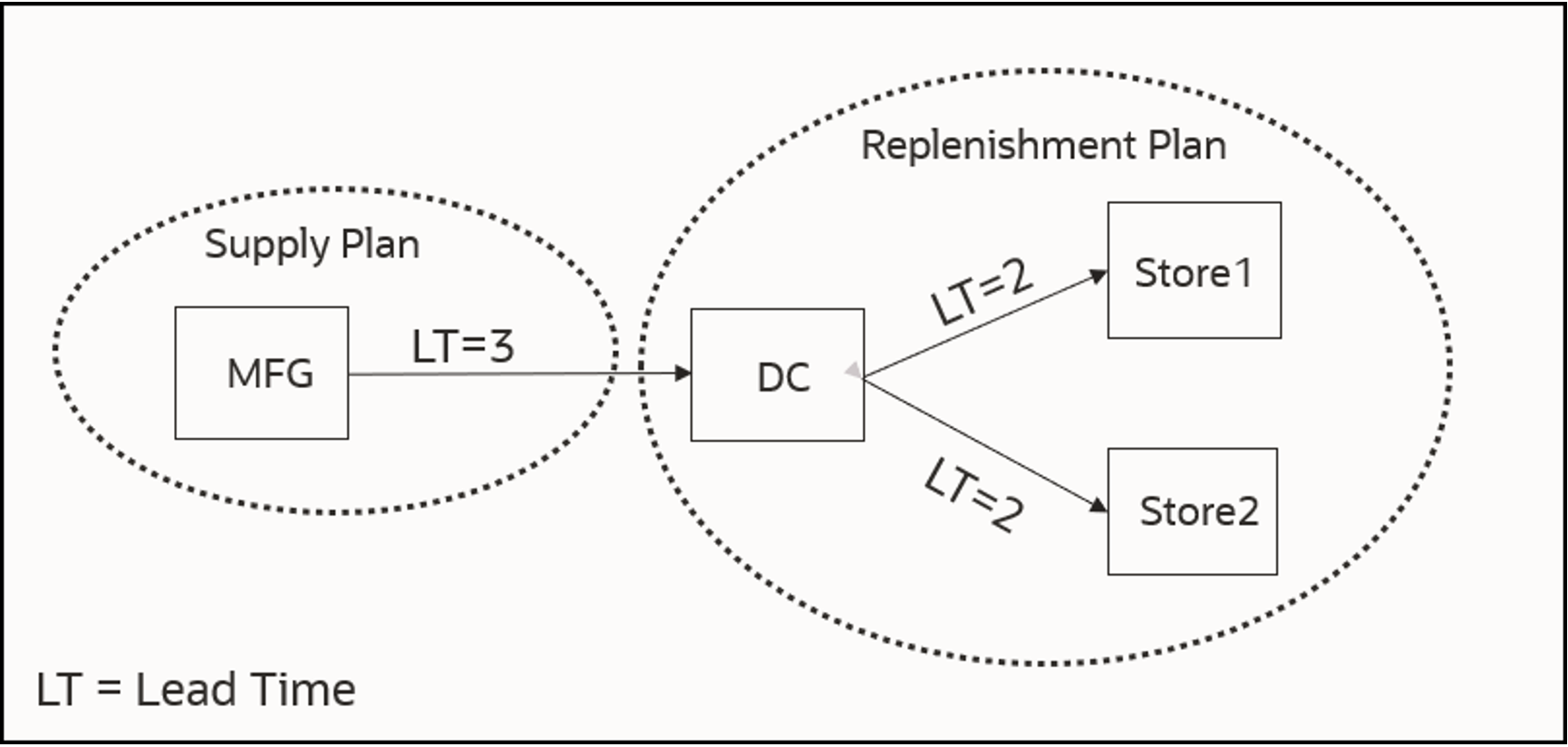
Here, the DC and stores are close to customer demand and need replenishment logic. The manufacturing site must account for supply constraints. Oracle can connect the plans so that downstream replenishment is not based on an unrealistic assumption of unlimited manufacturing supply.
Use a Supply Plan as a Supply Schedule in a Multiechelon Replenishment Plan
Read this Oracle readiness article to see the specific connected-plan design in which Supply Planning governs constrained upstream supply while Replenishment Planning governs DC and store replenishment.
In the opening section, read the scenario and purpose. Focus on why customer-facing locations and upstream manufacturing are deliberately assigned to different planning engines. Then continue in the same article, immediately after the “Organizations and Schedules Subtab on Supply Tab on Plan Options Page for Replenishment Plan” figure. Read the upstream allocation explanation, followed by the paragraphs beginning “Run the replenishment plan” and “The plan first performs.” Focus on the difference between the initial unconstrained demand propagation and the later constrained response.
The logic is best understood as a coordinated planning cycle:
-
Replenishment Planning calculates downstream requirements.
It performs its bottom-up view of demand from Store1 and Store2 toward the DC. At the DC, planned replenishment needs identify MFG as the source. -
Supply Planning evaluates upstream feasibility.
The replenishment plan can be selected as a demand schedule for the supply plan. Supply Planning treats the planned DC requirement as demand at MFG and applies manufacturing, supplier, material, and capacity constraints. -
Supply Planning produces constrained supply availability.
The constrained plan allocates available supply to the MFG-to-DC requirements. This supply plan is then made available to Replenishment Planning as a supply schedule. -
Replenishment Planning reruns with the supply schedule considered.
When the replenishment plan is run using Refresh with current data and Consider supply schedule, it uses constrained upstream supply rather than assuming MFG can always meet DC needs. -
Constraints propagate back downstream.
The constrained DC recommendations drive constrained recommendations to Store1 and Store2. A shortage at MFG can therefore affect what the DC can supply and, ultimately, what stores can receive.
This is not merely an interface between plans. It is a planning design that prevents downstream recommendations from promising inventory that upstream operations cannot provide.

A senior-consultant explanation should include both directions of the relationship:
- Replenishment plan as demand schedule for the supply plan: downstream replenishment requirements become upstream supply demand.
- Supply plan as supply schedule for the replenishment plan: constrained upstream supply becomes a limitation on downstream replenishment recommendations.
The configuration details, plan run sequence, and troubleshooting evidence will be developed later in the course. At this stage, the key architectural judgment is: use this connected pattern only when downstream replenishment must reflect upstream feasibility.
The global-forecast exception: demand without a ship-from organization
A useful advanced selection case is a company with several possible fulfillment facilities but no fixed fulfillment organization at forecast-creation time.
For example, marketing forecasts 10,000 units for a product in the North region. The company may fulfill from DC1, DC2, or a plant-direct channel, and the mix can change as facilities open, close, or become constrained. Assigning the entire forecast to one DC before supply planning would create a potentially artificial demand placement.
In this case, Oracle can support a global forecast:
- Demand Management publishes forecast demand without an inventory-organization context.
- Supply Planning consumes actual sales orders against the forecast at the selected ship-to level.
- The remaining forecast is distributed to fulfillment organizations according to sourcing rules and split percentages.
- Supply Planning then plans supply at the organizations that are assigned that residual forecast.
Plan for Forecast Demand that Doesn't Identify a Fulfillment Organization
Read this Oracle readiness note for the global-forecast scenario. Treat it as a deliberate exception to a normal organization-specific forecast, not as the default design for every multi-DC network.
In the opening section, read the business rationale. Notice that the demand is first consumed globally and only the unconsumed balance is assigned to fulfillment organizations. Then scroll to the “Global Forecast Distribution” subsection and read the distribution setup concept. Focus on the role of sourcing split percentages and the separate assignment set used for global forecast distribution.
Use this design only when the forecast genuinely has no reliable ship-from location. If sales, operations, or network design already knows that the forecast belongs to a particular DC, a local forecast is simpler, easier to reconcile, and usually preferable.
Also validate Oracle Cloud release availability and feature enablement in the target environment before making this part of the solution design. Readiness-note functionality is release-specific.
A concise interview design response
When asked, “Which planning modules would you implement for this network?” avoid starting with a list of Oracle features. Use a structured response:
-
State the business decision.
“The business needs store and DC replenishment recommendations while ensuring those recommendations reflect constrained manufacturing output.” -
Assign the planning ownership.
“Replenishment Planning should own store and DC policy-driven replenishment. Supply Planning should own the constrained manufacturing and upstream sourcing decisions.” -
Explain the connection.
“I would use the replenishment plan as a demand schedule to the supply plan, then expose the constrained supply plan as a supply schedule to the replenishment plan. This makes the constrained MFG supply available to the DC and stores.” -
Name the key dependencies.
“The design depends on aligned items and organizations, valid sourcing relationships, lead times, collected inventory and supply data, and a defined plan-run sequence.” -
State the business benefit and trade-off.
“The benefit is feasible downstream replenishment. The trade-off is greater orchestration and reconciliation discipline than a standalone replenishment plan.”
This structure demonstrates that you can translate a business problem into a functional architecture rather than simply naming modules.
Practice in your Oracle environment
Use your practice environment to create a one-page plan-selection design note for three scenarios:
- a forecast-driven manufacturer with two plants and constrained production;
- a retailer with one DC and several stores, with store-specific replenishment policies;
- a retailer with stores and DCs supplied by a constrained manufacturing organization.
For each scenario, document:
- the selected planning module or connected-plan combination;
- the plan scope by organization;
- the demand source;
- whether upstream constraints must be visible downstream;
- the key plan interface, if any;
- one reason why an alternative design would be weaker.
Keep the document business-oriented. Do not yet attempt full configuration. The next lessons build the data, collection, and master-data foundation needed to make any of these choices executable.
Key takeaways
- Demand Management owns forecasting and demand consensus; it is selected when Oracle must create, improve, and approve the demand signal.
- Replenishment Planning owns policy-driven inventory replenishment at item-location level, particularly for DC and store networks.
- Supply Planning owns constrained supply balancing across manufacturing, procurement, distribution, sourcing, and capacity.
- A connected Replenishment Planning plus Supply Planning design is appropriate when downstream replenishment must reflect constrained upstream supply.
- A global forecast is appropriate only when demand is not reliably associated with a fulfillment organization; sourcing rules distribute the remaining forecast for supply planning.
- Strong design answers begin with the business decision and network constraints, then explain plan ownership, interfaces, dependencies, and trade-offs.
Next, you will trace the planning data path from source systems through collections and the planning data repository, into plan runs and finally into released recommendations.
Can't find a good explanation? Sign up and we'll make it for you
Sign up