
Hello! Let's dive into the final lesson of our module on the planar kinematics of rigid bodies.
In our last session, you mastered the relative acceleration equation, , which is the cornerstone of acceleration analysis for any general planar motion. We ended with a brief look at a very common special case: a wheel rolling on a surface.
Today, we will focus entirely on that special case. Your learning outcome is to solve kinematics problems for bodies rolling without slipping. This is a fundamental skill in mechanical engineering, crucial for analyzing everything from a car's tires to the landing gear of an aircraft. We will establish the specific kinematic rules that govern this motion and then apply them using the relative motion equations you already know.
1. The "Rolling Without Slipping" Condition
"Rolling without slipping" is a constraint on the motion of a body. It means that at the exact instant of contact, the point on the rolling body touching the surface has zero relative velocity with respect to that surface. Think of it like a tire leaving a perfect, un-smeared footprint on the ground.
This condition has profound implications for the body's velocity. We can visualize the motion as a superposition of pure translation and pure rotation.
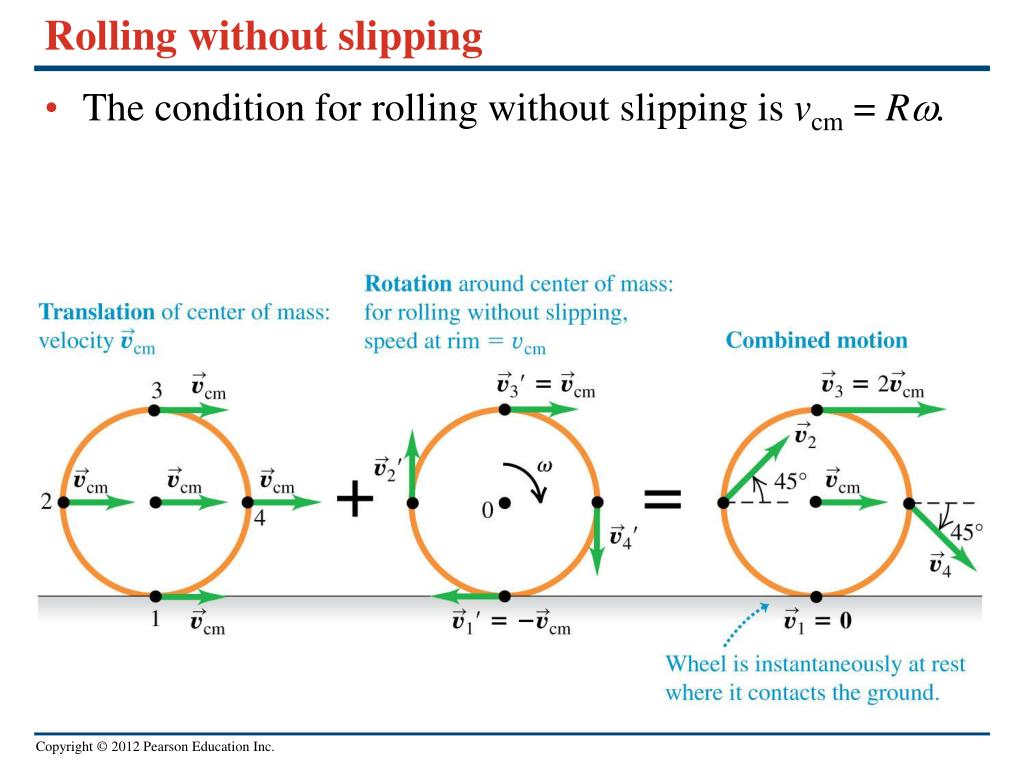
As the image shows, for a wheel rolling on a stationary surface:
- The translational velocity of every point is to the right.
- The rotational velocity of the contact point is to the left.
- For these to cancel and result in a zero velocity at the contact point, we must have .
This simple scalar relationship is the heart of "rolling without slipping" kinematics.
2. Deriving the Key Kinematic Relationships
The relationship between the linear motion of the center and the angular motion of the body can be derived from simple geometry. As the wheel rolls, the distance its center travels must equal the length of the arc that has touched the ground.
To see this derivation and the resulting formulas for velocity and acceleration, please watch the first part of the following video.
Rigid-Body Kinematics - Example: Rolling Without Slip
The video 'Rigid-Body Kinematics - Example: Rolling Without Slip' by Paul Ziade provides a clear geometric derivation of the key formulas for rolling without slipping.
Watch from the beginning to 05:00. The video explains that rolling is general planar motion and then geometrically shows how the displacement of the center, s_g, relates to the angle of rotation, heta. Pay close attention to how taking time derivatives of s_g = r heta gives us the velocity and acceleration relationships.
From this, we get three fundamental scalar equations for a body rolling on a stationary flat surface:
- Displacement:
- Velocity:
- Acceleration:
Here, , , and are the magnitudes of the linear displacement, velocity, and acceleration of the center of the wheel (point G), while is the radius. , , and are the magnitudes of the angular displacement, velocity, and acceleration.
For a more detailed textual derivation, you can also refer to the following resource.
Lecture 19. ROLLING WITHOUT SLIPPING
The document 'Lecture 19. ROLLING WITHOUT SLIPPING' provides an excellent text-based derivation of these same concepts.
Read page 22, under the 'Geometric Development' heading. This section covers the same ground as the video, deriving the constraint equation X_o = R heta and its time derivatives.
3. Velocity Analysis: Stationary vs. Moving Surfaces
The real power of these relationships comes when we combine them with the relative velocity equation you already know.
Case 1: Stationary Surface
As we established, the contact point C has zero velocity. This makes it the Instantaneous Center of Zero Velocity (ICZV). You can use this fact as a shortcut for velocity analysis, just as you did in a previous lesson.
- Velocity of the center:
- Velocity of the top point:
Case 2: Moving Surface
What if the wheel is rolling on a surface that is also moving, like a conveyor belt? The "no slip" condition still holds, but its meaning changes slightly: the velocity of the contact point on the wheel, , must be equal to the velocity of the surface it is touching, .
In this scenario, the contact point is no longer an ICZV. We must use the full relative velocity equation, , using the known velocity as our starting point.
The following video works through an excellent example of this case.
Dynamics - Rigid Body relative velocity example 2
The video 'Dynamics - Rigid Body relative velocity example 2' by Engineering Deciphered tackles a problem of a cylinder rolling on a moving conveyor belt.
Watch the entire video. The instructor does a great job of explaining why the velocity of the contact point (B) is the same as the conveyor belt's velocity. Then, he systematically applies the relative velocity equation to find the velocity of another point (A).
4. Acceleration Analysis
This is where we must be most careful. As we emphasized in the last lesson, the contact point is NOT an instantaneous center of zero acceleration.
If we analyze the acceleration of the contact point C for a wheel on a stationary surface using the relative acceleration equation (with the center G as our reference):
Assuming the wheel rolls right (, , ) and the contact point is at :
The acceleration of the contact point is directed vertically towards the center of the wheel! It is not zero.
So, how do we solve acceleration problems?
- Use the scalar equation to find the acceleration of the center of the wheel, .
- Use as the known "base" acceleration in the full relative acceleration equation to find the acceleration of any other point on the body.
Let's return to the first video to see this procedure in action.
Rigid-Body Kinematics - Example: Rolling Without Slip
This example from the Paul Ziade video applies the concepts we've just discussed to find the acceleration of a point on a rolling disk.
Watch from 06:22 to 16:20. Notice how he first establishes the acceleration of the center of mass (G) using the rolling condition. He then uses that as the known acceleration \vec{a}_G in the relative acceleration equation \vec{a}_B = \vec{a}_G + \vec{a}_{B/G} to solve for the acceleration of point B.
Test your understanding!
The 0.5-m radius wheel shown below rolls to the left without slipping. Its center has a constant velocity of m/s.
Determine the acceleration of point A at the top of the wheel.
Show answer
-
Analyze Angular Motion:
- The wheel rolls left, so the velocity of the center is m/s.
- Since it's rolling without slipping, . The wheel must be rotating clockwise to move left.
- rad/s. In vector form, rad/s.
- The problem states the velocity is constant. This means the acceleration of the center is zero: .
- Since , this also implies the angular acceleration is zero: .
-
Set up the Relative Acceleration Equation:
We want to find . We know . So we can write: -
Substitute Known Values:
- rad/s
- The position vector from O to A is m.
-
Calculate:
The acceleration of point A is 8 m/s² directed downwards, towards the center of the wheel. This is a purely normal acceleration, which makes sense since the angular acceleration is zero.
Conclusion
This lesson completes our study of kinematics. You've progressed from simple particle motion to the complex general planar motion of rigid bodies, and now to the important special case of rolling.
Key Takeaways:
- The "rolling without slipping" condition provides a kinematic constraint linking linear and angular motion.
- For a body rolling on a stationary surface: and . The contact point is the ICZV.
- For a body rolling on a moving surface: The velocity of the contact point on the body matches the velocity of the surface.
- The acceleration of the contact point is not zero. It has a normal component directed towards the center of the body.
- The relative motion equations are your primary tools. The rolling condition provides the key relationships needed to solve them.
Next Lesson Preview:
We are now ready to move from kinematics (the description of motion) to kinetics (the analysis of the forces and moments that cause motion). In the next module, we will begin our study of the Planar Kinetics of Rigid Bodies. Our very first step will be to define and learn how to calculate the mass moment of inertia. This property is the rotational equivalent of mass and is fundamental to applying Newton's second law to rotating bodies.
Can't find a good explanation? Sign up and we'll make it for you
Sign up