
Hello! Welcome back to our exploration of the science of dreaming.
In our last lesson, we examined the Emotional Regulation Theory, which proposes that dreaming acts as a form of "overnight therapy" to heal from past emotional experiences. This naturally leads to the question: if the brain is re-processing our experiences, which ones does it choose, and where does the content of our dreams—the people, places, and plots—actually come from?
Today, we'll answer that question by focusing on our next learning outcome: Describe the continuity hypothesis linking waking life to dream content. This theory suggests that the world of our dreams is not a random, isolated universe but is instead deeply and directly connected to our waking lives.
Understanding the source of our dream content is a crucial step in our journey. From a scientific perspective, it helps explain what dreams are made of. From the perspective of Jain philosophy and Preksha Dhyaan, knowing that our waking thoughts and concerns populate our dreams is fundamental. It suggests that the path to transforming the mind during sleep begins with transforming the mind during wakefulness.
The Core Idea: Dreams as a Continuation of Waking Life
The continuity hypothesis is one of the most well-supported theories in dream research. At its core, it's a simple but powerful idea: the content of our dreams is largely a continuation of what we think about, care about, and do during the day.
Let's start by reading a brief article that introduces the hypothesis and the researcher who first provided systematic evidence for it, Calvin Hall.
The Continuity Hypothesis of Dreams: A More Balanced ...
This article from Psychology Today, 'The Continuity Hypothesis of Dreams,' gives a clear overview of the theory and the pioneering work that established it.
Please read the first two sections of the article. Start from the beginning and read until you reach the sentence, 'It is therefore clear that any complete theory of dreams must accommodate the data demonstrating substantial continuities between dream content and waking concepts and concerns.' Focus on Calvin Hall's key discovery about the 'mundane' nature of most dreams.
As the article explains, when Calvin Hall systematically analyzed thousands of dream reports, he didn't find a world dominated by deeply hidden symbols as Freudian theory might suggest. Instead, he found a world filled with the dreamer's daily concerns: interactions with family and friends, familiar places, and everyday activities. This work established that there is a strong, observable continuity between our waking reality and our dream reality.
The Neuroscience of Continuity: Memory Replay
So, why does this continuity exist? Modern neuroscience suggests it's not a coincidence but a direct consequence of one of sleep's most critical functions: memory consolidation.
As we learned in previous lessons, during sleep, the brain works to strengthen, organize, and store memories from the day. It does this by "replaying" the neural patterns that were active when you first had the experience. The continuity hypothesis proposes that our conscious experience of dreaming is essentially a window into this memory replay process.
Let's watch a neuroscientist, Dr. Erin Wamsley, explain how this works.
Memories in the Dreaming Brain | Erin Wamsley | TEDxGreenville
In this TEDx talk, 'Memories in the Dreaming Brain,' Dr. Wamsley provides a clear and compelling explanation for how the brain's memory consolidation process gives rise to our dream content.
Please watch from the beginning to 07:33. Pay close attention to: The concept of 'place cells' in rodents and how they demonstrate memory replay. The results of the 'virtual maze' experiment and what it reveals about the role of dreaming in learning.
Dr. Wamsley's talk provides two crucial pieces of evidence:
- Neural Replay: Brain activity patterns from waking experiences are reactivated during sleep. The brain is literally re-running the day's events.
- Functional Benefit: When this replay is consciously experienced as a dream (like dreaming of the maze), memory and performance are boosted dramatically.
This shows that the continuity between waking and dreaming isn't just incidental; it's linked to the vital function of learning and memory.
Here is a quicker take on the same idea, with some relatable modern examples.
To Sleep, Perchance to Dream: Crash Course Psychology #9
The Crash Course Psychology series offers a quick summary of how daily activities often show up in our dreams.
Please watch the short clip from 06:43 to 07:15. Notice the 'Tetris effect'—where playing a game for hours can lead to dreaming about it.
Explaining the Bizarreness of Dreams
At this point, you might be thinking, "That's fine, but my dreams are rarely a simple replay of my day. They are often weird, fragmented, and illogical."
This is a key point, and the continuity hypothesis has an elegant explanation for it. Dreams are not a perfect video recording of a single memory. Instead, the brain seems to take fragments of many different memories—from yesterday, last week, and even your distant childhood—and weaves them together.
Let's return to Dr. Wamsley's talk to hear her explanation for dream bizarreness.
Memories in the Dreaming Brain | Erin Wamsley | TEDxGreenville
In this next clip, Dr. Wamsley addresses the question of why dreams are so strange, even if they are built from real memories.
Please watch from 07:33 to 09:31. Focus on the example of the dream about the mother, banana skis, and an ice cream mountain. How does she break it down into separate memory fragments?
This process of recombination is crucial. The dream about your mother on banana-peel skis isn't random nonsense. It's a collage constructed from meaningful pieces of your life: you spoke to your mother recently (memory 1), you saw someone eating ice cream (memory 2), and you have a childhood memory of banana splits (memory 3). The dreaming brain fuses these disparate elements into a novel, and often bizarre, narrative.
Test your understanding!
Imagine a student dreams they are taking a final exam in their childhood bedroom, and the exam paper is written in a language they don't understand. How would the continuity hypothesis explain the content of this dream?
Show answer
The hypothesis would suggest this dream is a recombination of several waking-life concerns and memories:
- Anxiety about an upcoming exam: This is the most direct continuity, a "day-residue" of their current worries.
- Memories of their childhood bedroom: This setting is pulled from long-term memory, perhaps because the feeling of being tested evokes feelings of being young or vulnerable.
- Feeling unprepared or confused: The unintelligible language on the exam paper isn't literal; it's a dream-like metaphor for their waking-life feeling of being overwhelmed or unprepared for the test.
The dream is not a direct replay of any single event but a creative synthesis of current anxieties, past memories, and associated feelings.
What Gets Prioritized?
Our brains experience countless things each day. Not all of them make it into our dreams. So, what influences the selection process? Research points to several key factors:
- Emotional Salience: Experiences that are emotionally charged are far more likely to be incorporated into dreams. This connects directly to our last lesson on emotional regulation. The events that need the most "overnight therapy" are the ones that get the most airtime in our dreams. This is why a minor argument can dominate our dreams while hours of mundane work are forgotten.
- Time: Events from the preceding day, known as day-residue, are very common. However, there's also a "dream-lag" effect, where significant events might pop up in dreams about a week later, suggesting different stages of memory processing.
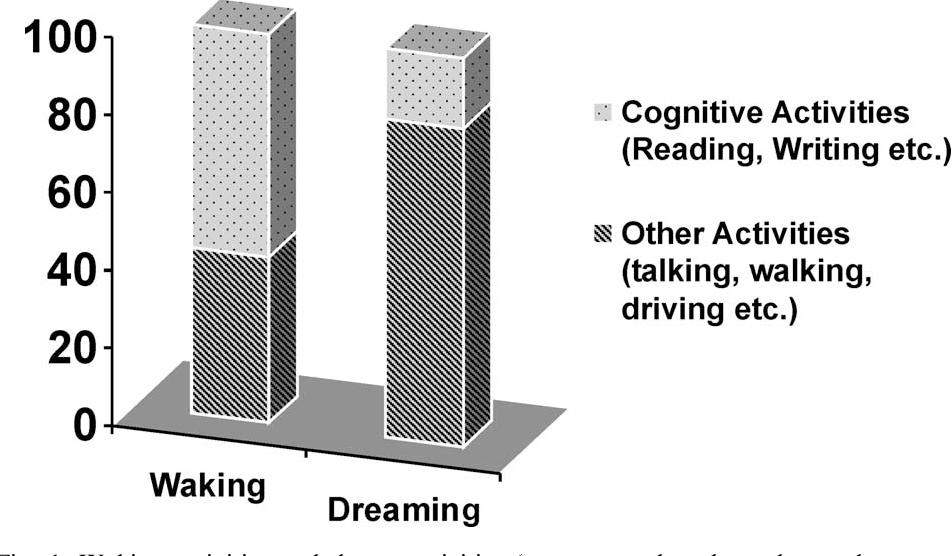
- Type of Activity: Not all waking activities are represented equally. As the chart below shows, focused, analytical tasks like reading, writing, or calculating are surprisingly rare in dreams. In contrast, more dynamic, social, and physical activities are very common.
Limitations of the Hypothesis
While powerful, the continuity hypothesis doesn't explain everything. Some dreams seem highly discontinuous with waking life, featuring fantastical creatures, alien worlds, or complex adventure narratives that bear little resemblance to our daily grind.
Let's read the final part of the Psychology Today article, which addresses this point.
The Continuity Hypothesis of Dreams: A More Balanced ...
To have a complete picture, it's important to understand the limits of the theory.
Please read the final section of the article, starting from 'But as every supporter of continuity theory acknowledges...'. Notice how the author calls for a theory that can accommodate both continuity and discontinuity.
Researchers acknowledge that a complete theory of dreaming must account for both the mundane, continuous aspects and the bizarre, discontinuous ones. For now, the continuity hypothesis provides the strongest foundation for understanding where the vast majority of our dream material originates.
Conclusion
Today, we've seen that the content of our dreams is not random but is drawn directly from the well of our waking lives. The people we meet, the challenges we face, and the emotions we feel are the raw materials the dreaming brain uses to construct its nightly narratives.
Key Takeaways:
- The Continuity Hypothesis states that dream content is continuous with a person's waking thoughts, concerns, and experiences.
- This continuity is a direct result of the brain's memory consolidation process, where it replays neural patterns from waking life.
- The bizarre nature of dreams is explained by the recombination of fragments from multiple different memories, not a simple replay of one event.
- The selection of dream content is influenced by factors like emotional intensity, with highly emotional events being prioritized.
- The hypothesis provides a strong framework but has limitations, as it doesn't fully account for highly fantastical or discontinuous dreams.
Preview of the Next Lesson:
Now that we know what our dreams are made of (our waking lives), our next lesson will delve into the neurobiology of the dream experience itself. We will explore the learning outcome: "Explain how brain activity during dreaming relates to the subjective dream experience." We'll investigate why dreams feel so immersive, why our bodies are paralyzed during REM sleep, and why we so often accept the bizarre logic of the dream world without question.