
Hello! Welcome to the final lesson of this module on autonomic and somatic nervous system indicators.
In our previous lessons, we explored individual physiological signals that act as windows into our internal state. We've covered:
- Electrodermal Activity (EDA): A direct measure of sympathetic arousal via sweat gland activity.
- Heart Rate Variability (HRV): An indicator of autonomic nervous system balance, revealing the interplay between stress and relaxation responses.
- Electromyography (EMG): A way to quantify muscle tension, including facial muscles linked to emotional expression.
- Electrooculography (EOG): A method for tracking eye movements and blinks, crucial for both user state analysis and EEG artifact correction.
Today, we will synthesize this knowledge to address a central challenge in neurotechnology and a core task for your work at Neuraease. This lesson will guide you through the learning outcome: Propose a multimodal sensor configuration (e.g., EEG, HRV, EDA) to assess stress or emotional state. We will explore why using a single signal is often insufficient and how to intelligently combine multiple data streams to build a more robust and accurate system.
1. Why Multimodality? The Limits of a Single Sensor
Imagine trying to understand a complex story by only listening to the audio, without any visuals. You'd get part of the picture, but you'd miss crucial context and nuance. The same is true for assessing emotional and psychological states.
While a single signal like EDA can tell you that a person is aroused, it can't distinguish between the excitement of a thrilling movie, the anxiety of public speaking, or the stress of a looming deadline. This ambiguity is why robust emotion and stress detection systems almost always rely on multimodality—the fusion of data from multiple sensors. Each signal provides a different piece of the puzzle, and together they create a richer, more reliable picture.
Physiological signals are attractive for this purpose because, as the systematic review paper "A Systematic Review on Emotion Recognition System..." notes, "no matter how hard a person tries to mask his/her emotions, their bodies usually experience a series of involuntary physiological changes."
2. A Framework for Emotion: The Valence-Arousal Model
Before we can design a system to measure emotion, we need a model for it. While we use discrete labels like "happy," "sad," or "angry" in daily life, an engineering approach benefits from a dimensional model. The most common is Russell's Circumplex Model of Affect.
This model maps emotional states onto a two-dimensional space:
- Valence: The pleasantness or unpleasantness of an emotion (positive vs. negative).
- Arousal: The intensity of the emotion (calm vs. excited).
This is Figure 4 from the review paper on Emotion Recognition Systems. It illustrates the 2D Valence-Arousal space, mapping emotions like 'happy' to high arousal/positive valence, and 'sad' to low arousal/negative valence. A state of high stress or agitation would typically fall in the high arousal/negative valence quadrant.
This framework is incredibly useful because we can now frame our design goal as: "Which combination of sensors best allows us to estimate a person's position in this Valence-Arousal space?"
A Systematic Review on Emotion Recognition System ...
To understand this model and the motivation for using physiological signals, please read from the following review paper.
Please read the 'Introduction' to understand the rationale behind physiological-based emotion recognition. Then, read Section 3, 'Emotion Models,' focusing on '3-2- Multidimensional Emotion Space Model' to solidify your understanding of the Valence-Arousal model.
3. Assembling the Toolkit: Choosing Your Sensors
With the Valence-Arousal model as our guide, let's evaluate the signals we've learned about (and a few others) to see what they contribute. Your goal is to select a combination of sensors that can effectively estimate both valence and arousal.
A Systematic Review on Emotion Recognition System ...
The following resources provide an excellent overview of the physiological signals most commonly used for emotion and stress detection. As you read, think about which axis (Valence or Arousal) each signal is best suited to measure.
Please skim Section 4, 'Modality of Physiological Based Emotions Recognition System'. Pay attention to the descriptions for EEG, ECG/HRV, EMG, EDA/GSR, and Skin Temperature (SKT). Note how each one relates to an aspect of emotion or stress.
Detection and monitoring of stress using wearables
This second paper offers a complementary perspective, focused specifically on stress detection with wearables.
Please read Section 3.1, 'Physiological signals that enable detecting and monitoring stress.' This will reinforce the key points and provide context specific to stress assessment.
Based on those readings, here is a summary of the most valuable signals for a multimodal configuration:
| Signal | What it Measures | Primary Contribution | Wearable Implementation |
|---|---|---|---|
| EDA / GSR | Sympathetic nervous system activation (sweat). | Arousal. Very sensitive to emotional intensity, but poor at distinguishing positive/negative states. | Wristband, finger sensors. |
| HRV (from PPG/ECG) | Autonomic balance (sympathetic vs. parasympathetic). | Arousal/Stress. Low HRV (reduced variability) indicates sympathetic dominance (stress). | Wristband (PPG), Chest strap (ECG). |
| EEG | Cortical brain activity. | Valence & Arousal. Asymmetry in alpha band power between frontal lobes is often linked to valence. Overall band power shifts can relate to arousal. | Headset, ear-EEG, forehead patch. |
| SKT (Skin Temp.) | Peripheral blood flow (vasoconstriction/dilation). | Arousal. Stress often causes peripheral vasoconstriction, leading to a drop in finger/toe temperature. | Wristband, ring. |
| EMG | Muscle contraction. | Valence. Facial EMG (frowning/smiling muscles) can be a good indicator of valence, though often subtle. General tension relates to stress. | Surface electrodes (face, neck, shoulders). |
| RSP (Respiration) | Breathing rate and depth. | Arousal. Breathing becomes faster and shallower during high arousal states. | Chest strap, can sometimes be estimated from PPG/ECG. |
A robust system for your startup would likely need, at a minimum, a strong indicator for arousal and another for valence.
- Arousal: EDA and HRV are excellent choices.
- Valence: This is trickier. EEG is the most direct measure of the brain's emotional response. Facial EMG is another option, but may be less practical for a consumer wearable.
4. System Architecture: Fusing the Data Streams
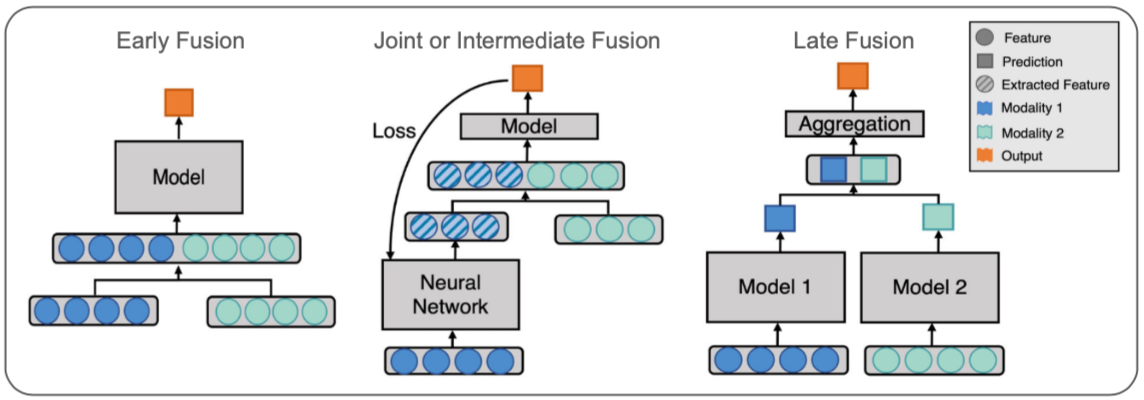
Once you've selected your sensors, the next critical step is to decide how to combine their data. This is known as multimodal fusion. There are three main strategies.
-
Early Fusion (Feature-Level): You extract features from all sensor streams (e.g., mean EDA, SDNN from HRV, alpha power from EEG) and concatenate them into a single, large feature vector. This vector is then fed into one machine learning model.
- Pro: The model can learn complex interactions between features from different modalities.
- Con: It's sensitive to missing data from any one sensor and requires careful synchronization of the data streams.
-
Late Fusion (Decision-Level): You build a separate classifier for each modality (e.g., an "EDA-only stress model," an "HRV-only stress model"). The final decision is made by combining the outputs of these individual models, for example, through voting or weighted averaging.
- Pro: More robust. If one sensor fails or provides noisy data, the system can still function using the others.
- Con: It doesn't allow the models to learn direct interactions between features from different modalities.
-
Intermediate (or Hybrid) Fusion: This is a common approach in deep learning, where data from different modalities might be processed through a few initial layers separately before being merged in a deeper layer of the network.
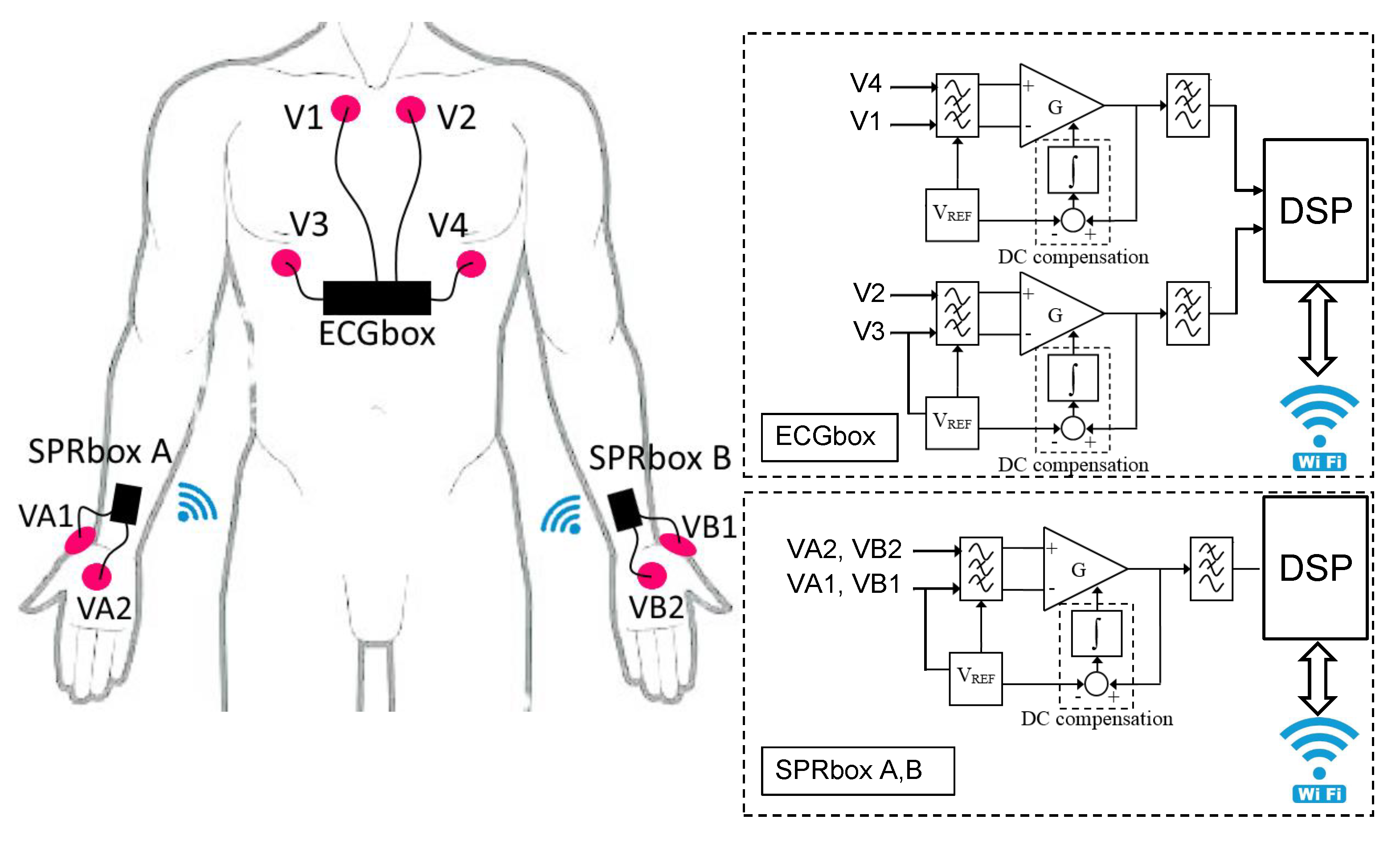
A practical implementation of a multimodal system involves significant signal processing before any fusion can happen.
5. Putting It All Together: Proposing Your System
Now it's time to apply these concepts. Think like the head of product and engineering at Neuraease. You need to design a system to provide meltdown warnings, which likely corresponds to a state of high arousal and negative valence.
Design Challenge: Propose your multimodal configuration
Based on everything we've covered, propose a multimodal sensor configuration for the Neuraease wearable device.
Your proposal should address the following points in a few paragraphs:
- Sensor Selection: Which 2-3 physiological signals would you choose?
- Justification: For each signal, explain why you chose it. Connect your choice back to the Valence-Arousal model and the specific goal of detecting pre-meltdown states. Critically, consider the trade-offs between measurement accuracy and user comfort/wearability for a consumer device.
- Fusion Strategy: Would you use Early Fusion or Late Fusion? Explain your reasoning.
Show an example answer
Here is one possible approach:
1. Sensor Selection:
For the Neuraease wearable, I would propose a core configuration of EDA, PPG (for HRV analysis), and a single-channel EEG sensor placed on the forehead.
2. Justification:
- EDA: This is my primary sensor for the arousal axis. It is highly sensitive to the activation of the sympathetic nervous system, which is a key physiological component of the escalating stress that precedes a meltdown. It is relatively easy to integrate into a wrist-worn device, making it practical and non-intrusive.
- PPG (for HRV): This is my secondary sensor for arousal and overall stress. A sharp drop in HRV parameters like RMSSD or SDNN provides a robust, quantitative measure of increasing physiological stress. While PPG from the wrist is more susceptible to motion artifact than a chest-strap ECG, modern algorithms have made it reliable enough for this application, and the wearability is a massive advantage for a device intended for continuous use.
- EEG (Forehead): This is my primary sensor for the valence axis. While a full EEG cap is impractical, a single dry-electrode EEG sensor on the forehead can measure frontal alpha asymmetry. A relative increase in right frontal alpha power compared to the left is correlated with negative valence and withdrawal motivation, which is characteristic of the target state. Placing it on the forehead (perhaps integrated into a discreet patch or headband) is a reasonable compromise between signal quality and user acceptance.
3. Fusion Strategy:
I would opt for a Late Fusion (Decision-Level) strategy. My reasoning is robustness and practicality for a real-world device. A meltdown state is critical to detect, but sensor data can be noisy or temporarily unavailable (e.g., poor PPG signal during intense movement).
With Late Fusion, I can train three separate, simpler models:
- An EDA-based "high arousal" detector.
- An HRV-based "high stress" detector.
- An EEG-based "negative valence" detector.
The final system can then trigger a warning based on a weighted combination of their outputs (e.g., "high confidence of high arousal from EDA" + "high confidence of high stress from HRV" + "moderate confidence of negative valence from EEG"). This makes the system resilient; even if the EEG signal is lost, a warning can still be triggered if the EDA and HRV signals are strong enough, which is a critical safety feature.
Conclusion
Congratulations on completing this module! You are now equipped to think critically about designing systems that interpret the complex language of the human body.
Key Takeaways:
- Assessing complex states like stress and emotion requires a multimodal approach for robustness and accuracy.
- The Valence-Arousal model provides a practical engineering framework for classifying emotional states.
- A thoughtful sensor configuration balances signal fidelity with user-centric factors like comfort and wearability. Core signals include EDA, HRV, and EEG, which map well to arousal and valence.
- Data fusion strategies (Early vs. Late) determine how information from different sensors is combined, with trade-offs between learning complex interactions and system robustness.
Preview of the Next Module:
In the next module, "Instrumentation for Motion and Behavior Analysis," we will add another critical layer to our system: movement. We will explore how accelerometers and gyroscopes work and how their data can be used to recognize activities, track motor responses, and provide crucial context to our physiological measurements. After all, knowing a user's heart rate is high is useful, but knowing it's high while they are sitting still versus running makes all the difference.
Can't find a good explanation? Sign up and we'll make it for you
Sign up