
Welcome to the final lesson of your course! Over the past several weeks, we have journeyed from advanced algorithmic patterns all the way to designing complex, large-scale distributed systems like the chat application and news feed. You've accumulated the technical building blocks. Today, we focus on the capstone skill: how to assemble and present this knowledge in a high-stakes interview.
Our goal is to learn how to synthesize and articulate system designs using a structured interview framework. This isn't just about showing what you know; it's about demonstrating how you think. For a senior role, this ability to communicate a clear, reasoned architectural vision is often more important than the specific technologies chosen. We will use a popular framework called PEDALS as our primary example, tying it back to the systems you've already designed.
The Mindset: Engineering vs. Design
Before we dive into a framework, it's crucial to adopt the right mindset. A system design interview presents a design problem, not an engineering problem. This distinction is subtle but fundamental to your success.
System Design Interview Guide for Senior Engineers
This guide from interviewing.io provides an exceptional explanation of the mindset required for system design interviews. It differentiates between engineering problems, which have optimal solutions, and design problems, which are open-ended and collaborative.
Please read the section under the heading "The difference between engineering problems and design problems". This will help you understand that the goal is not to find a single "correct" answer, but to build a solution collaboratively.
As the article highlights, there is no single best solution. Your interviewer is looking to see how you navigate ambiguity, make reasoned trade-offs, and collaborate. You are playing the role of a tech lead, not a junior developer executing a well-defined task.
With your five years of experience, you'll be evaluated against mid-level or even senior expectations. Take a look at this summary of what that means in practice.
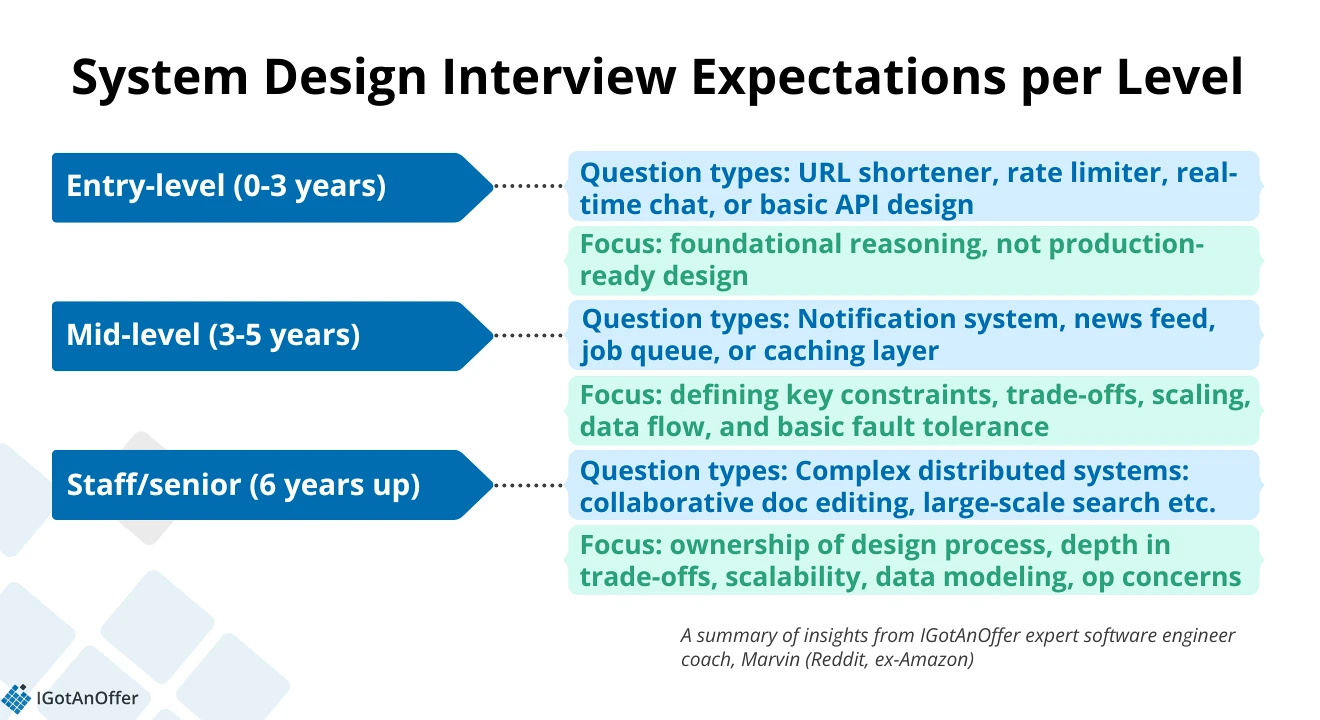
Notice the emphasis on "trade-offs, scaling, data flow," and "depth in trade-offs, scalability, data modeling." A structured framework is the tool that enables you to address these points systematically and confidently.
A Structured Framework: The PEDALS Method
To avoid rambling or getting lost in details, it's essential to follow a structured approach. There are many frameworks, like UMPIRE (which we saw for algorithms) or the 5-step process from Exponent. Today, we'll focus on one called PEDALS.

PEDALS is an acronym that stands for:
- P - Process Requirements
- E - Estimate
- D - Design the Service
- A - Articulate the Data Model
- L - List the Architectural Components
- S - Scale
Let's explore each step.
Intro the PEDALS Method™ Framework for System Design | Lewis C. Lin
This article by Lewis Lin, the creator of the framework, provides a concise overview of each step in the PEDALS method.
Please read the entire article, paying close attention to the descriptions for each letter in the PEDALS acronym, starting from the section on processing requirements through the final section on scaling.
As you can see, the framework provides a logical progression from understanding the problem to building a scalable solution. It ensures you don't jump straight into drawing boxes and arrows without first agreeing on what you're building.
Putting It All Together: Applying PEDALS to the News Feed
Theory is good, but application is better. Let's retrospectively apply the PEDALS framework to the news feed system we designed in the last lesson. This will solidify how you can use it as a narrative guide during an interview.
P - Process Requirements
This is the most critical step. We did this when we defined:
- Functional Requirements: Post content, follow users, view a reverse-chronological feed.
- Non-Functional Requirements: Low read latency, high availability, eventual consistency.
- Scope: We explicitly excluded features like algorithmic ranking, ads, or rich media to focus on the core problem. In an interview, you would state, "For this initial design, I'll focus on text-based posts and a simple timeline. We can discuss adding features like image hosting or a ranked feed later if time permits."
E - Estimate
Here, we would perform back-of-the-envelope calculations to understand the scale. For example:
- "Let's assume 100 million daily active users (DAU). If an average user views their feed 5 times a day, that's 500 million feed loads per day."
- "This translates to roughly queries per second (QPS) on the read path."
- "If an average user posts once per week and has 200 followers, the write path needs to handle millions of fan-out operations."
These numbers immediately tell you that read performance is critical and the write path involves significant amplification, justifying our focus on a push-based model.
D - Design the Service
This is the high-level service breakdown. We identified:
- Post Service: Handles post creation and storage.
- User Service / Social Graph Service: Manages user data and follow relationships.
- Feed Generation Service (or Fan-out Service): Asynchronously generates feeds.
- News Feed Service: Handles feed retrieval requests.
A - Articulate the Data Model
We would define the schemas for our databases.
- User Table (SQL):
user_id (PK),username,profile_info - Follows Table (SQL):
follower_id (FK),followee_id (FK) - Posts Table (NoSQL/SQL):
post_id (PK),author_id,content,created_at - Feed Cache (Redis): A Redis List for each user, e.g.,
feed:<user_id>, storing a list ofpost_ids.
L - List the Architectural Components
This is where you draw the diagram on the whiteboard, connecting the services defined in step 'D'. Your diagram would show:
- Clients connecting to a Load Balancer.
- The load balancer routing to the API Gateway / Web Servers.
- Requests being handled by the various microservices.
- A Message Queue (like Kafka or RabbitMQ) decoupling the Post Service from the Fan-out Service.
- Multiple databases and caches (
User DB,Post DB,Feed Cache).
S - Scale
This is where you address the non-functional requirements and bottlenecks identified in your estimations. This is the "deep dive" part of the interview. Here, you would discuss:
- The fan-out on write vs. read trade-off.
- The "Celebrity Problem" and how our hybrid approach (push for normal users, pull for celebrities) solves it.
- Caching strategies for posts, user metadata, and the pre-computed feeds to ensure low read latency.
- Database Scaling: Using read replicas for the user database and sharding the posts database by
post_idorauthor_id. - Asynchronous Processing: Explaining how the message queue provides resilience and allows the fan-out process to happen in the background without blocking the user.
- Content Delivery Network (CDN): Mentioning that for a real-world system, images and videos would be stored in Blob Storage (like S3) and served via a CDN.
By following this structure, you create a coherent story that is easy for the interviewer to follow, and you naturally hit all the evaluation points for a senior engineer.
The Art of Communication
Having a framework is necessary but not sufficient. How you communicate your design is just as important.
How to Prepare for System Design Interviews w/ Meta Staff Engineer
This video from Hello Interview clearly outlines what interviewers are evaluating.
Please watch the segment from "understanding how your interviewer is going to be evaluating you". It breaks down the evaluation criteria into Problem Solving, Solution Design, Technical Excellence, and Communication.
Your primary goal is to demonstrate your thought process. Here are some key principles for effective communication, drawn from our resources:
- Collaborate, Don't Lecture: Treat the interview as a collaborative design session with a colleague. Ask questions like, "My initial thought is to use a push model to optimize for read latency. Does that align with the product goals you have in mind?"
- Justify Everything: Never state a choice without a reason. Instead of "I'll use Redis for the cache," say "For the feed cache, I'll use an in-memory store like Redis because its sorted set or list data structures are perfect for storing and retrieving a chronologically ordered list of post IDs with very low latency."
- Talk Trade-offs: Every decision has a downside. Acknowledge it. "By choosing a fan-out-on-write approach, we're optimizing for fast reads, but we're taking on significant complexity and cost on the write path, especially for users with many followers." This demonstrates senior-level thinking.
- Control the Narrative: For a senior role, you are expected to drive the conversation. Use your framework to guide the discussion. After outlining the high-level design, you can proactively say, "There are a few interesting areas to dive deeper into: how we handle the 'celebrity' problem, the data partitioning strategy, or the specifics of the feed hydration. Which of these seems most critical to you?"
Conclusion: Your Path Forward
This lesson, and indeed this entire course, has been about equipping you with the knowledge and strategies to achieve your goal of joining a top-tier remote engineering team. You've tackled advanced algorithms, delved into the fundamentals of scalability, and designed complex systems from the ground up.
Key Takeaways:
- Mindset is Key: Approach system design interviews as open-ended, collaborative design problems, not engineering problems with a single right answer.
- Use a Framework: A structured framework like PEDALS ensures you cover all critical aspects of the design, from requirements to scale, creating a clear and compelling narrative.
- Articulate and Justify: Your ability to communicate your thought process, explain trade-offs, and justify your decisions is what interviewers are primarily evaluating.
- Practice is Everything: Knowledge is useless without application. The only way to get good at system design interviews is to practice them.
Your journey doesn't end here. The next step is to put this into practice.
How to Prepare for System Design Interviews w/ Meta Staff Engineer
This final clip gives you a concrete, prioritized list of problems to practice. This is your roadmap for self-study.
Watch the section on practice strategy, starting from "Okay, finally the most important part". The presenter gives a list of 10 core problems to work through.
Take that list of problems, grab a whiteboard (or an online equivalent), and talk through them out loud, using the PEDALS framework. For each one, go through the steps: clarify requirements, estimate scale, design the services, model the data, draw the architecture, and then identify and solve for the scaling bottlenecks.
You have the tools and the knowledge. With consistent practice, you will be well-prepared to demonstrate your expertise and land the role you're aiming for. Congratulations on completing the course, and best of luck in your interviews